

THE SHORT ANSWER
Govern translated search content through a registry of published URL pairs, their source versions and the technical relationships between them. Propagate material source changes to affected equivalents, then test routes, canonicals, hreflang and language switching before release. Editorial translation quality is a prerequisite; this process keeps the published search architecture honest as content changes.
For the broader picture of technical foundations, useful content and visibility measurement, read the pillar guide SEO, GEO and AEO for SaaS: visibility that supports buying decisions.
Create a registry of published equivalents
Give each content item a stable internal identifier independent of its translated slug. Store the live URL, language or region, publication status, current source version and responsible owner for every equivalent. Distinguish missing translations from drafts and from intentionally different regional pages. Do not assume matching filenames prove that two pages still answer the same question. Include related files and structured content when they carry translated claims. The registry should describe the public state, while the editorial workflow can maintain its own richer drafting and terminology records. Explore this further in the guide A bilingual editorial workflow for German and English B2B content.
Classify changes by their dependencies
When a source article changes, record whether the update affects facts, implementation steps, availability, scope or merely wording. Material corrections can require rapid review of all published equivalents; a punctuation change may not. Identify technical dependencies such as renamed routes, retired downloads or changed section anchors. Create tasks for affected versions instead of automatically marking them current. Store the source revision each translation has actually reviewed. That distinction prevents a freshly rebuilt page from appearing synchronised when its central instructions still describe an earlier product or a withdrawn recommendation.
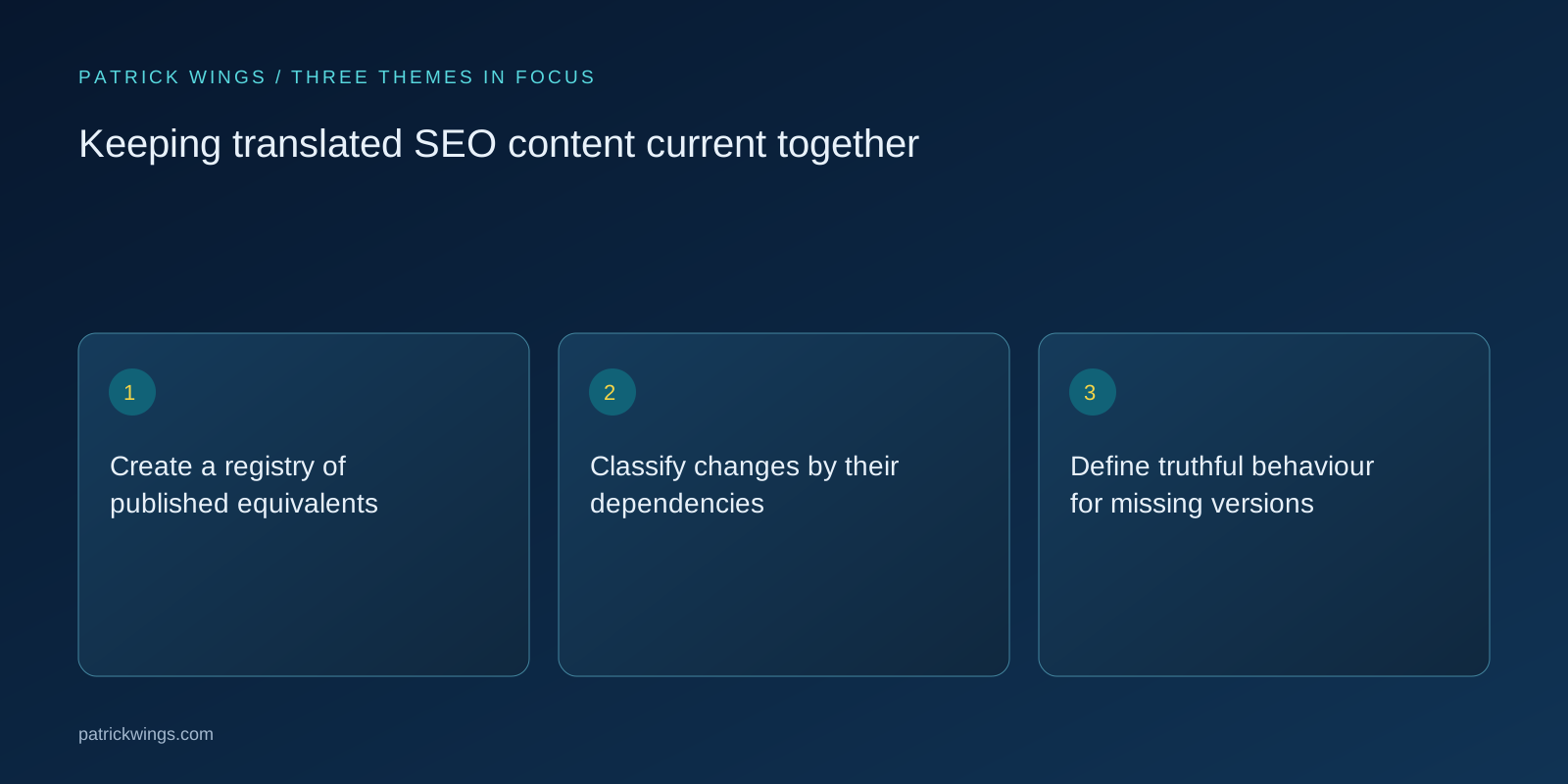
Define truthful behaviour for missing versions
Decide what a language switch does when the equivalent is absent, delayed or retired. Offer a clearly labelled alternative where useful rather than sending readers silently to an unrelated page. Publish hreflang references only to genuine supported equivalents, and remove or repair relationships when a page leaves publication. Do not create a thin placeholder solely to complete a language pair. A partial rollout can be legitimate if the visible navigation and annotations accurately describe it. Keep the missing-version queue visible so a temporary editorial delay does not become an unexplained permanent gap. Explore this further in the guide Debugging hreflang through complete page groups.
Run a technical release checklist on the group
Before release, fetch every affected URL directly and verify the intended language, main answer, successful response and appropriate canonical. Check that alternate references are complete and reciprocal according to the chosen implementation. Confirm that final URLs are used after moves and that no annotation points to a draft, redirect or unrelated translation. Test language-switch links and meaningful section anchors. Examine the production output after caching and deployment, not only the CMS preview. A correct pair in a database can still be delivered incorrectly by a shared template or routing layer.

Illustrative example: changing an integration requirement
Imagine an illustrative English guide whose integration prerequisite changes. Its German translation has not yet been reviewed, and an old download URL is also being retired. The team flags the German equivalent, assigns review and coordinates the replacement file, links and published relationship. It does not automatically update the German review date merely because the site rebuilds. This example demonstrates version-aware release control, not a guarantee of equal search performance across languages. The two audiences may still differ in demand, terminology and familiarity with the implementation task.
Audit drift and assign explicit ownership
Regularly compare the registry with delivered routes and current source revisions. Investigate references to retired URLs, mismatched content promises and translations awaiting material corrections. Give content owners responsibility for meaning and engineering owners responsibility for reliable implementation, with one person coordinating the release. Prioritise consequential stale guidance over cosmetic parity. Success means published relationships remain accurate and important corrections reach affected readers. Hreflang does not translate content or guarantee the chosen search result; governance reduces avoidable contradiction but cannot remove all processing delays or variation in regional search behaviour.
INTERACTIVE / FROM READING TO ACTION
Three checkpoints for your implementation
Choose a checkpoint and track your reading progress. Checks are neither saved nor sent and do not score your business.
CHECKPOINT 01
Define truthful behaviour for missing versions
Decide what a language switch does when the equivalent is absent, delayed or retired.
Explore in the article ↗CHECKPOINT 02
Run a technical release checklist on the group
Before release, fetch every affected URL directly and verify the intended language, main answer, successful response and appropriate canonical.
Explore in the article ↗CHECKPOINT 03
Illustrative example: changing an integration requirement
Imagine an illustrative English guide whose integration prerequisite changes.
Explore in the article ↗Frequently asked questions
Does a rebuild mean translations are current?
No. Track the source revision that a translation actually reviewed.
Should missing translations get placeholders?
Not solely to complete annotations. Publish useful content and represent missing versions honestly.
Who owns release checks?
Coordinate content and engineering owners, with one explicit person accountable for the group’s published state.
How can I put “Create a registry of published equivalents” into practice?
Give each content item a stable internal identifier independent of its translated slug. Store the live URL, language or region, publication status, current source version and responsible owner for every equivalent. Distinguish missing translations from drafts and from intentionally different regional pages.
What matters when working on “Classify changes by their dependencies”?
When a source article changes, record whether the update affects facts, implementation steps, availability, scope or merely wording. Material corrections can require rapid review of all published equivalents; a punctuation change may not. Identify technical dependencies such as renamed routes, retired downloads or changed section anchors.