

THE SHORT ANSWER
An AI judge can scale assessment, but should first be calibrated against professional human judgments. Supply explicit criteria, require references to the assessed output and investigate systematic disagreement. Do not treat its verdict as independent proof of truth. Consequential decisions need checks that account for sources, rules and the possibility that the evaluator itself is wrong despite a convincing explanation.
To connect individual AI applications with reliable marketing operations, read the pillar guide AI transformation in B2B marketing: from individual prompts to reliable operations.
Bound the evaluator’s task
Ask the automated judge to assess a specific property, such as whether an answer respects the requested region or a claim follows from supplied evidence. A broad judgment of overall quality is harder to validate. Give the judge necessary context without supplying a desired overall score. Allow insufficient evidence as an outcome. If it cannot establish an external fact, it should identify that limitation rather than silently substituting its general knowledge for a source. Define the scope clearly enough that a person can later inspect whether the verdict follows the rule.
Create a professionally reviewed comparison set
Have specialists assess cases independently and resolve disagreement using a shared rubric. Include good, defective and difficult-to-distinguish outputs. Add polished but incorrect answers and short, less elegant answers that remain correct. Preserve reasoned reference judgments. Unresolved disagreement among people is not a clean standard for an automated evaluator. Label those cases separately and improve the criterion or context first. The comparison should measure actual judgment quality rather than the model’s ability to guess ambiguous human expectations. Keep some reviewed cases out of prompt development so later assessment remains informative. Explore this further in the guide Evaluating AI outputs: rubrics reviewers can use consistently.
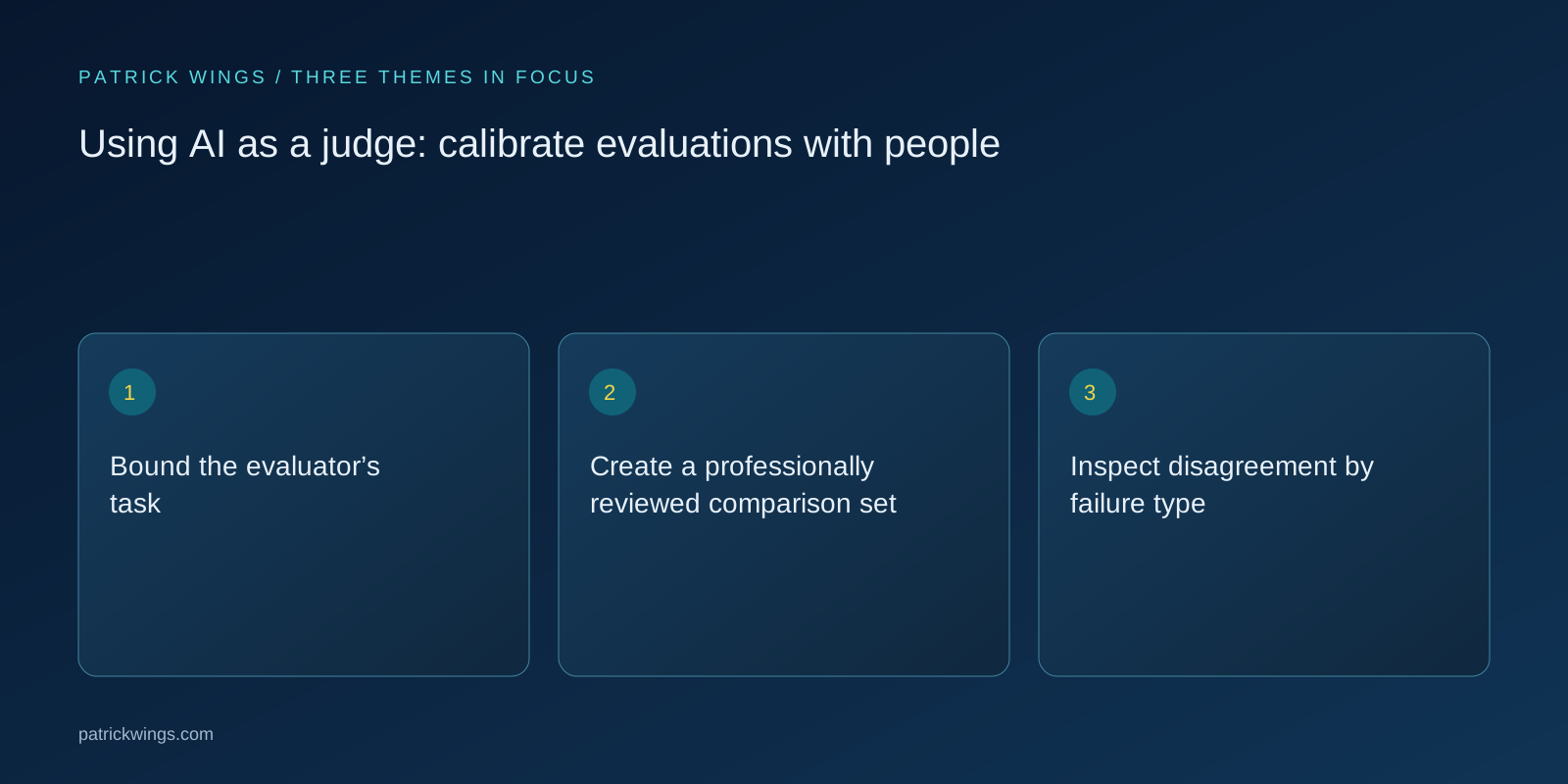
Inspect disagreement by failure type
Look beyond average agreement. Identify defects the judge misses and valid outputs it unnecessarily rejects. Determine whether consequential mistakes pass because the wording sounds good. Group disagreement by language, length, task and consequences. A strong overall number can hide a weak subgroup. Inspect explanations too: they may sound plausible without matching the score or available evidence. A useful judge identifies the relevant passage and violated criterion concretely. Track these patterns over time rather than treating each disagreement as an isolated anecdote or assuming the human reviewer must always be correct.
Test order, presentation and input boundaries
In pairwise comparisons, order and presentation can affect judgments. Swap positions under controlled conditions and change irrelevant formatting while preserving factual content. Check whether longer answers receive an unjustified advantage. Treat evaluated text as data: instructions embedded inside it are not valid evaluation rules. Separate the rubric from the material being assessed. If the judge follows manipulation attempts, add technical and professional boundaries. An explicit instruction alone does not guarantee protection against every adversarial input, so test actual behaviour instead of equating the presence of a warning with successful enforcement. Explore this further in the guide Prompt injection in marketing workflows: contain untrusted content.

Inspect an explicitly fictional comparison
A fictional team compares two answers about product availability. Answer A is detailed and friendly but asserts an unsupported launch. Answer B briefly states that availability is unknown and cites the source. Initially the automated judge prefers A because it appears helpful. Professional review establishes that the rubric must reject the unsupported promise. This hypothetical example illustrates calibration work rather than a measured weakness of a particular product. After revision, the team tests held-out cases instead of demonstrating only that the judge now handles this single familiar example differently.
Operate the judge as a versioned system
Record the rubric version, evaluator configuration and inputs relevant to each assessment. Test model, prompt and source changes on a common case set. Continue human sampling and an escalation path for disputed cases after launch. Where a verdict authorises a consequential action, one automated score must not silently replace every other control. Specify which results are advisory and which may trigger a technical block. Add confirmed misjudgments to the collection so known weaknesses remain visible and subsequent changes can be checked for recurrence rather than assuming a newer evaluator necessarily performs better.
INTERACTIVE / FROM READING TO ACTION
Three checkpoints for your implementation
Choose a checkpoint and track your reading progress. Checks are neither saved nor sent and do not score your business.
CHECKPOINT 01
Inspect disagreement by failure type
Look beyond average agreement.
Explore in the article ↗CHECKPOINT 02
Test order, presentation and input boundaries
In pairwise comparisons, order and presentation can affect judgments.
Explore in the article ↗CHECKPOINT 03
Inspect an explicitly fictional comparison
A fictional team compares two answers about product availability.
Explore in the article ↗Frequently asked questions
Can an AI judge fully replace a human reviewer?
That depends on the task and consequences. Test suitability specifically and retain a professional path for critical or disputed cases.
Does a convincing explanation prove correctness?
No. Check its relationship to passages, criteria and available evidence.
When should we recalibrate?
After material changes to the rubric, judge, inputs or task scope, and when new systematic disagreements appear.
How can I put “Bound the evaluator’s task” into practice?
Ask the automated judge to assess a specific property, such as whether an answer respects the requested region or a claim follows from supplied evidence. A broad judgment of overall quality is harder to validate. Give the judge necessary context without supplying a desired overall score.
What matters when working on “Create a professionally reviewed comparison set”?
Have specialists assess cases independently and resolve disagreement using a shared rubric. Include good, defective and difficult-to-distinguish outputs. Add polished but incorrect answers and short, less elegant answers that remain correct.