
THE SHORT ANSWER
Regression tests examine whether a change weakens existing capabilities or boundaries. Compare model, prompt, tool and source changes against a versioned common case set and inspect consequential defects separately. A higher overall score is insufficient when an important work path newly fails. Assess the suitability of the whole changed workflow version for its intended use, rather than judging a component through a few favourable examples.
To connect individual AI applications with reliable marketing operations, read the pillar guide AI transformation in B2B marketing: from individual prompts to reliable operations.
Describe the change and expected benefit
Record which component changes and the concrete problem it should solve. A new model, revised tool description and updated source collection affect different parts of the system. Changing everything at once makes new failures harder to attribute. Small traceable revisions improve diagnosis. Sometimes a bundled update is necessary; document its components and remaining uncertainty. Before testing, identify functions that must continue working, such as correct record selection, handling missing sources and respecting sending boundaries. These requirements should remain visible even when the headline objective concerns a different quality dimension or operational improvement.
Keep comparison conditions traceable
Use the same tasks, criteria and relevant inputs for the old and new variants. Preserve prompt, tool and source versions. Changes in a live external system can affect the comparison, so use appropriate controlled data or explicitly disclose differences. Language models may vary on identical inputs; one successful response does not demonstrate stable improvement. Repeat runs where the decision depends on that variability. Describe findings cautiously when available time or case coverage cannot establish much about rare failures. Avoid presenting a small demonstration as proof that the updated workflow is reliable across untested business conditions.
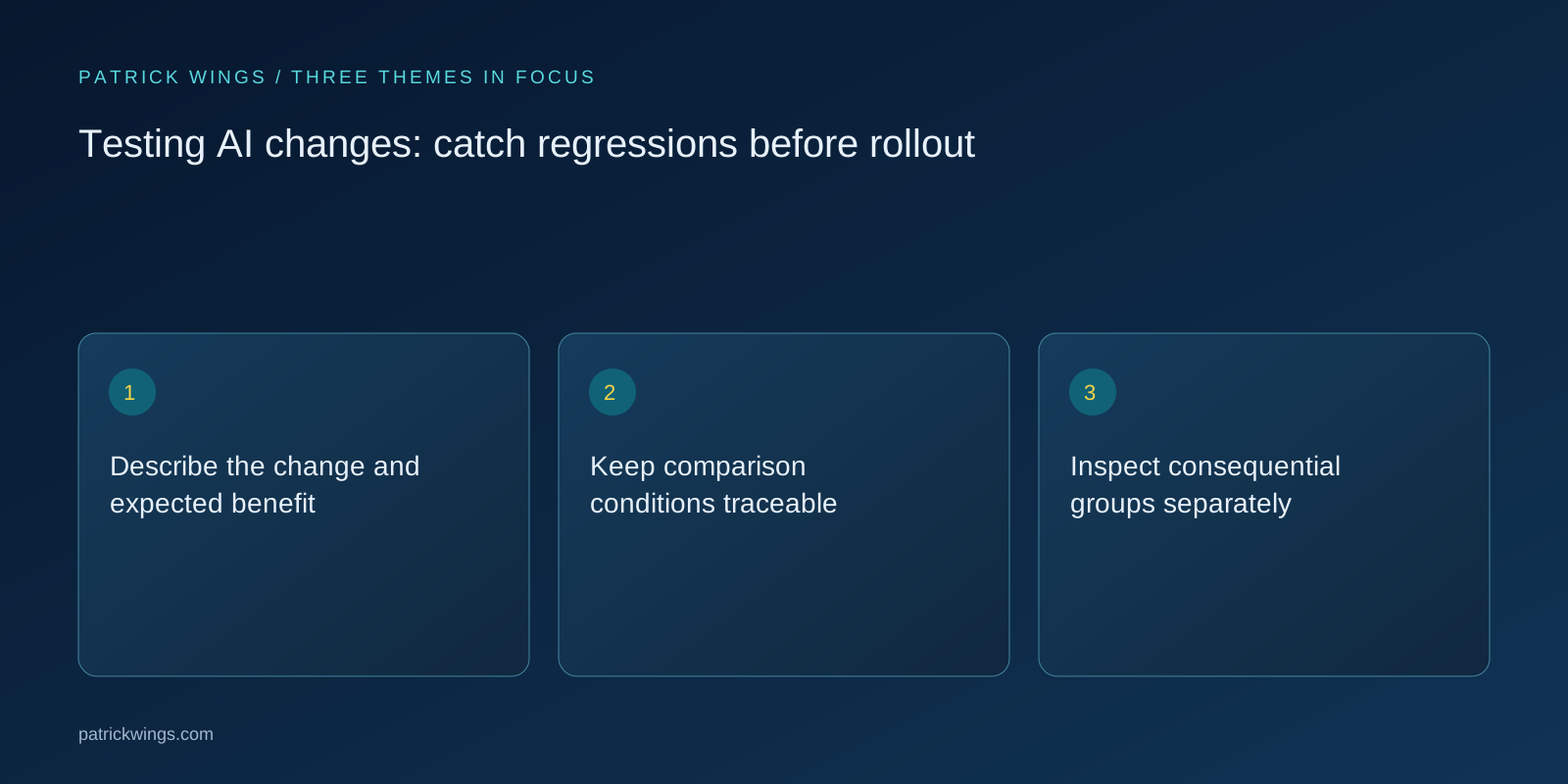
Inspect consequential groups separately
Report outcomes by task, language, source conditions and consequences of error. Gains on common easy questions can conceal losses on a few important exceptions. Use mandatory acceptance conditions for boundaries that cannot be compensated for by other strengths. Add examples reviewers can inspect to understand the change. Check effort, runtime and extra clarification too. A quality gain can be operationally unsuitable if the new variant regularly misses the agreed deadline. Conversely, faster responses do not justify accepting a newly introduced factual weakness without an explicit decision about its effect and permitted use. Explore this further in the guide Evaluating AI outputs: rubrics reviewers can use consistently.
Test behaviour across the whole chain
Do not assess only the final text. A correct draft may result from an unauthorised retrieval, while an apparently failed run may already have changed a record. Inspect tool choice, permission checks, state transitions and actual destination states. Add cases likely to expose handoff failures between components. If a tool introduces new status values, the agent must interpret them correctly. An unchanged response format does not prove unchanged meaning. Such interface changes belong in a shared regression assessment because each component can appear healthy while the combined workflow makes an incorrect decision.

Inspect a fictional prompt revision
A fictional team shortens its knowledge agent’s instructions to make answers clearer. Normal questions improve, but when two product sources conflict, the new variant no longer explains the limitation. The overall score still rises in the hypothetical test because easy cases dominate. The team pauses rollout and restores the conflict rule deliberately. This invented example shows why attractive demonstrations and improved averages cannot replace every acceptance condition. The subsequent common-case comparison must establish whether the fix addresses the issue without reversing the clarity gains or introducing another failure in a different task group.
Connect testing, rollout and recovery
Document the release decision with findings, unresolved risks and ownership. Use a bounded rollout when results justify deployment and monitor relevant operating signals. Preserve the previous usable version plus necessary configuration, data and interface information. Switching back helps only if that version still works with the current environment. Turn newly observed production failures into test cases. After a fix, check both the original problem and established work paths. This reduces the chance that a local repair quietly becomes the next regression while maintaining a traceable basis for subsequent changes and operational decisions. Explore this further in the guide Monitoring operational AI: signals rather than activity noise.
INTERACTIVE / FROM READING TO ACTION
Three checkpoints for your implementation
Choose a checkpoint and track your reading progress. Checks are neither saved nor sent and do not score your business.
CHECKPOINT 01
Inspect consequential groups separately
Report outcomes by task, language, source conditions and consequences of error.
Explore in the article ↗CHECKPOINT 02
Test behaviour across the whole chain
Do not assess only the final text.
Explore in the article ↗CHECKPOINT 03
Inspect a fictional prompt revision
A fictional team shortens its knowledge agent’s instructions to make answers clearer.
Explore in the article ↗Frequently asked questions
Is a higher overall score sufficient?
No. Assess consequential boundaries and important subgroups independently of the average.
Should source changes be tested?
Yes. Changed documents, scope or retrieval results can alter behaviour even with the same model.
What belongs in the recovery path?
A usable previous version with matching configuration and a checked approach to data or interfaces that changed meanwhile.
How can I put “Describe the change and expected benefit” into practice?
Record which component changes and the concrete problem it should solve. A new model, revised tool description and updated source collection affect different parts of the system. Changing everything at once makes new failures harder to attribute.
What matters when working on “Keep comparison conditions traceable”?
Use the same tasks, criteria and relevant inputs for the old and new variants. Preserve prompt, tool and source versions. Changes in a live external system can affect the comparison, so use appropriate controlled data or explicitly disclose differences.