
THE SHORT ANSWER
Resolve conflicting AI sources through authority, scope and timing rather than the number of similar statements. Document which source governs which question and when a person must decide. An agent should expose real contradictions instead of blending them into a superficially coherent answer or selecting whichever document supports the most convenient wording for the requested result.
To connect individual AI applications with reliable marketing operations, read the pillar guide AI transformation in B2B marketing: from individual prompts to reliable operations.
Check whether the contradiction is genuine
Two statements may concern different markets, product versions, customer groups or periods. Compare those attributes before declaring one wrong. A general product overview and a regional restriction can both be correct. Ask the agent to identify the apparently conflicting claims and their supporting passages. A vague warning about inconsistent information is insufficient. Comparing claims and scope reveals whether a more carefully bounded answer is possible or a professional source decision is required. Preserve the original statements during this investigation so an attractive summary does not erase the distinction that explains the apparent conflict.
Define authority for specific questions
Specify who maintains binding information for each claim type. An approved product list may govern current regional availability, while an appropriately permissioned contract system governs a customer-specific agreement. One universal document ranking is often too crude. Even an official source can be inadequate outside its area of responsibility. Record the rule and its business owner. The agent should apply the rule rather than invent convenient authority. If the organisation has no clear policy itself, the issue belongs with knowledge ownership; better phrasing cannot resolve a substantive disagreement about which information should govern the decision. Explore this further in the guide A RAG source register: knowledge with owners and expiry dates.
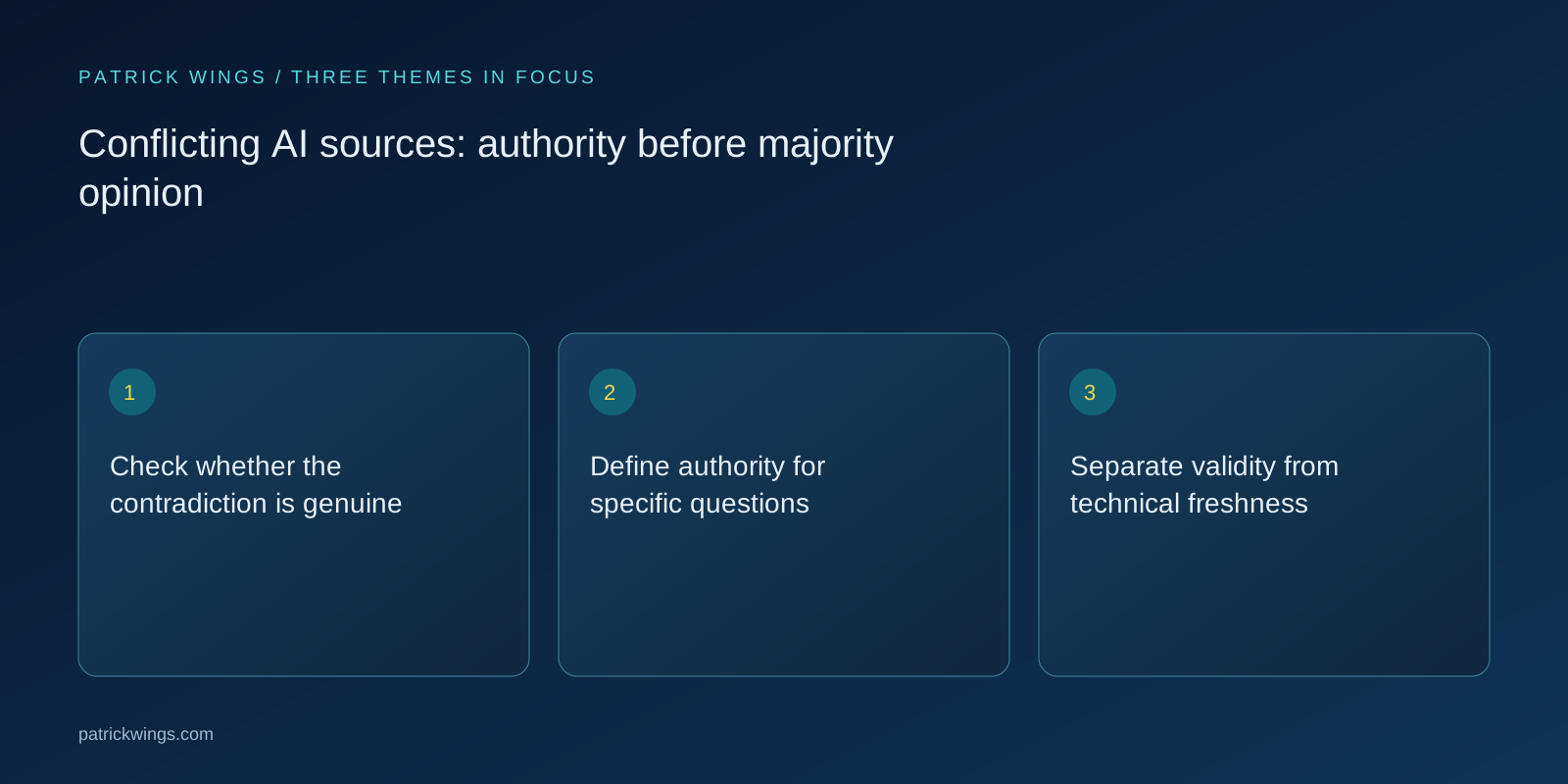
Separate validity from technical freshness
A recently fetched document is not necessarily professionally current. Check publication dates, effective dates and indications of superseded versions. An older source may be exactly right for a historical question. A new announcement may describe a future change that does not apply today. The agent must preserve those distinctions. When dates or status are missing, it should state uncertainty and request review. Avoid a blanket preference for the newest timestamp. That can wrongly promote a draft or future announcement above an approved rule that remains in force for the specific question and period under discussion.
Preserve the conflict and decision rationale
When an agreed rule gives one source priority, explain the reason and remaining limitation where material to the answer. For an unresolved conflict, provide the competing statements, their locations and a concrete question for the accountable person. Do not prepare a final commitment treating an unconfirmed version as established fact. When the issue is resolved, record the decision against the relevant sources. This improves the knowledge foundation and prevents the same contradiction from recurring as an isolated language problem each time a different colleague asks a related question through the agent.

Inspect an explicitly fictional market case
A fictional vendor lists a feature in a global brochure. A current regional approval list excludes the requested market. The agent explains the regional restriction using the accountable list instead of adopting the more frequently repeated statement across several brochures. This hypothetical example assumes the organisation has designated that list as authoritative. If two equally authoritative current lists disagree about the same market, the agent must escalate the conflict. Counting copied statements in other documents cannot substitute for professional clarification, and an apparently helpful definitive answer would conceal the unresolved decision rather than solve it.
Test conflict rules through counterexamples
Include regional differences, historical questions, future changes and genuine conflicts between equally authoritative sources. Check that the system identifies the proper scope and does not hide unresolved disagreement. Add multiple copies of a weaker source to test whether repetition is wrongly treated as greater authority. When a source issue is resolved, update the register, retrieval collection and evaluation case together. Verify that later answers reflect the decision. A one-time correction inside a conversation will not help the next run if the underlying source rule remains unclear or the search index still supplies an obsolete version as controlling evidence. Explore this further in the guide Sources in AI answers: verify evidence claim by claim.
INTERACTIVE / FROM READING TO ACTION
Three checkpoints for your implementation
Choose a checkpoint and track your reading progress. Checks are neither saved nor sent and do not score your business.
CHECKPOINT 01
Separate validity from technical freshness
A recently fetched document is not necessarily professionally current.
Explore in the article ↗CHECKPOINT 02
Preserve the conflict and decision rationale
When an agreed rule gives one source priority, explain the reason and remaining limitation where material to the answer.
Explore in the article ↗CHECKPOINT 03
Inspect an explicitly fictional market case
A fictional vendor lists a feature in a global brochure.
Explore in the article ↗Frequently asked questions
Does the newest source always win?
No. Validity, authority and the time perspective of the question matter.
Are many matching statements stronger evidence?
Not automatically. Copies may all originate from the same weak or outdated source.
What should happen with equally authoritative conflicts?
The agent should document the disagreement with evidence and refer it to a named professional owner.
How can I put “Check whether the contradiction is genuine” into practice?
Two statements may concern different markets, product versions, customer groups or periods. Compare those attributes before declaring one wrong. A general product overview and a regional restriction can both be correct.
What matters when working on “Define authority for specific questions”?
Specify who maintains binding information for each claim type. An approved product list may govern current regional availability, while an appropriately permissioned contract system governs a customer-specific agreement. One universal document ranking is often too crude.