
THE SHORT ANSWER
A RAG source register establishes which knowledge a system may use, where it applies and who maintains it. Connect documents to owners, scope, versions and review requirements. A search index alone does not create that professional accountability. Without maintained sources, a technically functioning knowledge agent can confidently repeat outdated information or material that does not apply to the question being asked.
To connect individual AI applications with reliable marketing operations, read the pillar guide AI transformation in B2B marketing: from individual prompts to reliable operations.
Treat sources as accountable knowledge objects
A source is more than a URL. Record its title, provenance, responsible specialist and permitted purpose. Link the register entry to a stable identifier and the version actually ingested. Renaming a file should not erase its history. Distinguish approved product information from drafts, meeting notes and external observations. All may be useful, but they carry different authority. The register should expose those differences before a model merges several retrieved passages into an apparently unified truth. Also document the relationship between an authoritative document and derivative summaries that may become outdated when the original changes. Explore this further in the guide Conflicting AI sources: authority before majority opinion.
Describe scope and time boundaries
Record region, product, customer group and relevant validity period. A global overview does not automatically answer a regional contract question. Distinguish publication date, effective date, last professional review and ingestion time. These are not interchangeable: a document imported yesterday may have been outdated for months. Define treatment of sources without reliable dates as well. They may remain useful within limits but should not become evidence of current conditions solely because they were recently fetched. Make the scope available to retrieval and assessment rather than leaving it buried in an administrative note nobody uses.
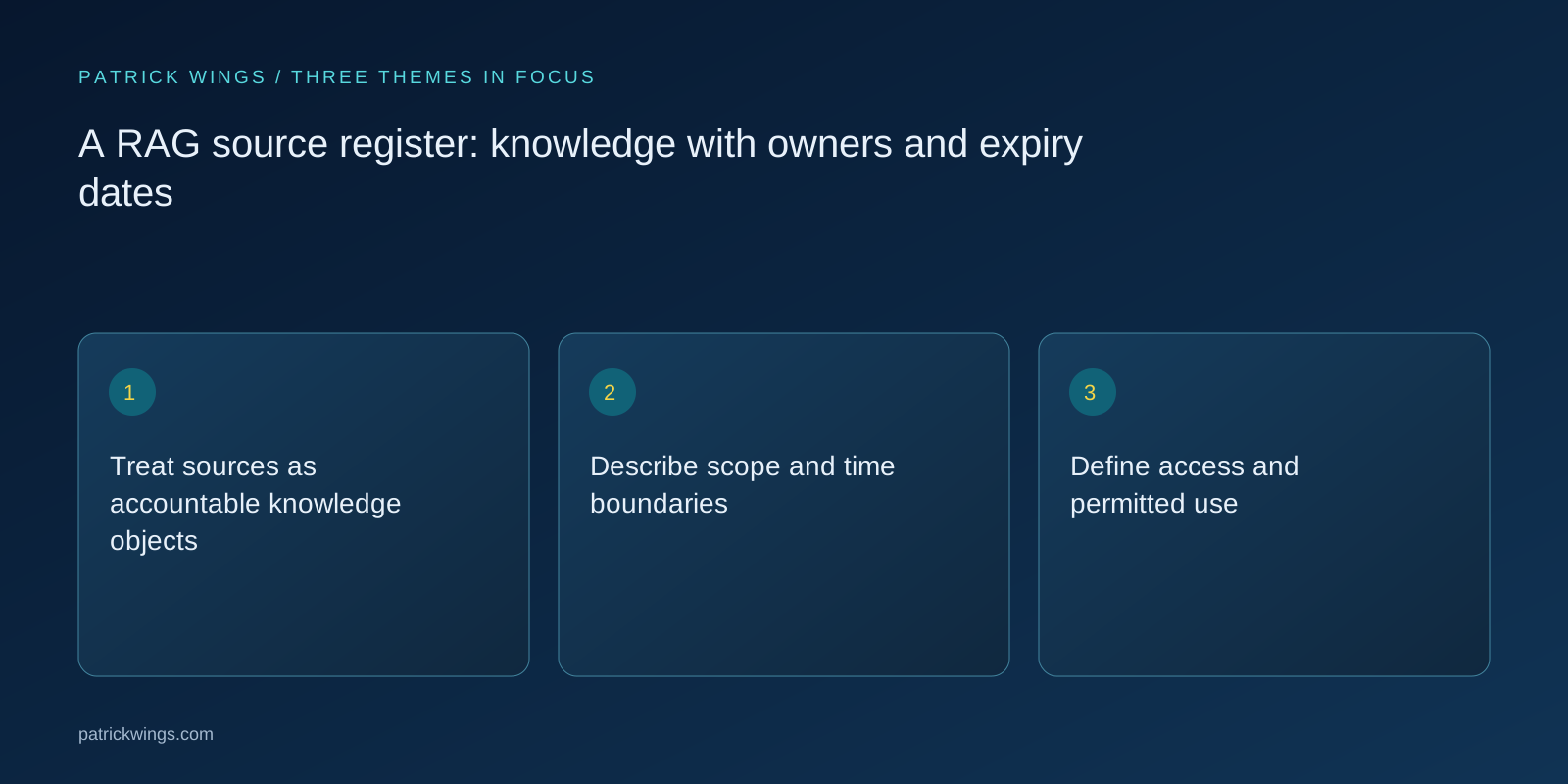
Define access and permitted use
Carry authorised data boundaries through retrieval and output. A system must not cite a confidential source simply because search can find it. Check who may see the source and which information may be reused. Do not represent rules only as prose when they require enforcement at the search boundary. Distinguish internal research from external communication. An internal note can justify a clarification request without supporting a public claim. Where authorisation is unclear, assign an explicit review status and responsible person rather than silently treating the document as either unrestricted or permanently unusable.
Organise updates and removal
Agree review triggers such as product changes, expiring offers or reported contradictions. Different source types need different review patterns. Specify who detects changes, approves them professionally and makes them effective in the index. A file removed from the register may remain in a search index or cache, so inspect the full removal chain and actual retrieval. Record replacement sources and unresolved gaps. When a necessary document is missing, the agent should state the limitation rather than continuing to rely on a withdrawn version or substituting general model knowledge without making that change of basis explicit. Explore this further in the guide Maintaining technical claims through editorial review.

Inspect an explicitly fictional product collection
A fictional SaaS team has a public product overview, a regional approval list and an internal draft about future features. The register marks the overview as general, the list as authoritative for availability and the draft as unsuitable for commitments. A question about a particular market should therefore use the list. This hypothetical example distinguishes discoverability from professional suitability. When the regional list expires, it needs review or the answer must be limited. The continued availability of the public overview does not automatically close that gap or establish which regional claims remain valid.
Test the register and retrieval together
Choose questions whose answers depend on source scope or status. Check whether outdated, withdrawn or inaccessible documents are genuinely excluded or handled appropriately. Compare registered versions with retrieved versions. A well-maintained register is ineffective if retrieval ignores its attributes. Test accountability too: can someone trace a disputed claim to the responsible source owner? Turn contradictions and missing documents into maintenance tasks. Operations should distinguish absent knowledge from existing knowledge that search failed to find, because those problems require different remedies. Preserve this distinction in reports instead of grouping every poor answer under one general model-error label.
INTERACTIVE / FROM READING TO ACTION
Three checkpoints for your implementation
Choose a checkpoint and track your reading progress. Checks are neither saved nor sent and do not score your business.
CHECKPOINT 01
Define access and permitted use
Carry authorised data boundaries through retrieval and output.
Explore in the article ↗CHECKPOINT 02
Organise updates and removal
Agree review triggers such as product changes, expiring offers or reported contradictions.
Explore in the article ↗CHECKPOINT 03
Inspect an explicitly fictional product collection
A fictional SaaS team has a public product overview, a regional approval list and an internal draft about future features.
Explore in the article ↗Frequently asked questions
Is a list of document links sufficient?
No. Include ownership, version, scope, permitted use and maintenance requirements.
Does every source need a fixed expiry date?
Not necessarily. It needs an appropriate review rule and handling for uncertain freshness.
Does deleting a file immediately remove it from RAG?
Not necessarily. Check the index, caches and retrieval for effective removal.
How can I put “Treat sources as accountable knowledge objects” into practice?
A source is more than a URL. Record its title, provenance, responsible specialist and permitted purpose. Link the register entry to a stable identifier and the version actually ingested.
What matters when working on “Describe scope and time boundaries”?
Record region, product, customer group and relevant validity period. A global overview does not automatically answer a regional contract question. Distinguish publication date, effective date, last professional review and ingestion time.