

THE SHORT ANSWER
A technical article can become inaccurate after publication even while every link still works. A review process connects claims to product versions, sources and responsible owners. It helps a team identify relevant changes and inspect the affected explanations. A calendar reminder alone is insufficient when important prerequisites change before the next scheduled review.
For the broader picture of technical foundations, useful content and visibility measurement, read the pillar guide SEO, GEO and AEO for SaaS: visibility that supports buying decisions.
Classify claims by change risk
Mark information whose validity depends on product version, edition, region or an external platform. Distinguish foundational explanations from setup procedures and commercial promises. A general definition ages differently from a screenshot of an administrative interface. Record the governing source and the last actual verification date. Avoid assigning the same artificial expiry to every page. Review effort should reflect the consequence of an incorrect statement: an unclear format detail requires a different response from instructions that change important records. Document the distinction so that the team does not have to reinvent its priorities whenever something changes.
Connect publication to change triggers
Link relevant articles to release notes, documentation areas or internal product owners. Identify who checks a new change against public explanations. An edition change, for example, may affect product pages, FAQs and older blog examples. Search for the underlying promise as well as the exact new term. Add scheduled checks where there is no dependable change feed. Keep the connection practical: a modest register of claim group, destinations and accountable person may be more useful than an elaborate system nobody maintains. Treat missing ownership as an explicit unresolved action rather than assuming the original writer will notice every change. Explore this further in the guide A RAG source register: knowledge with owners and expiry dates.
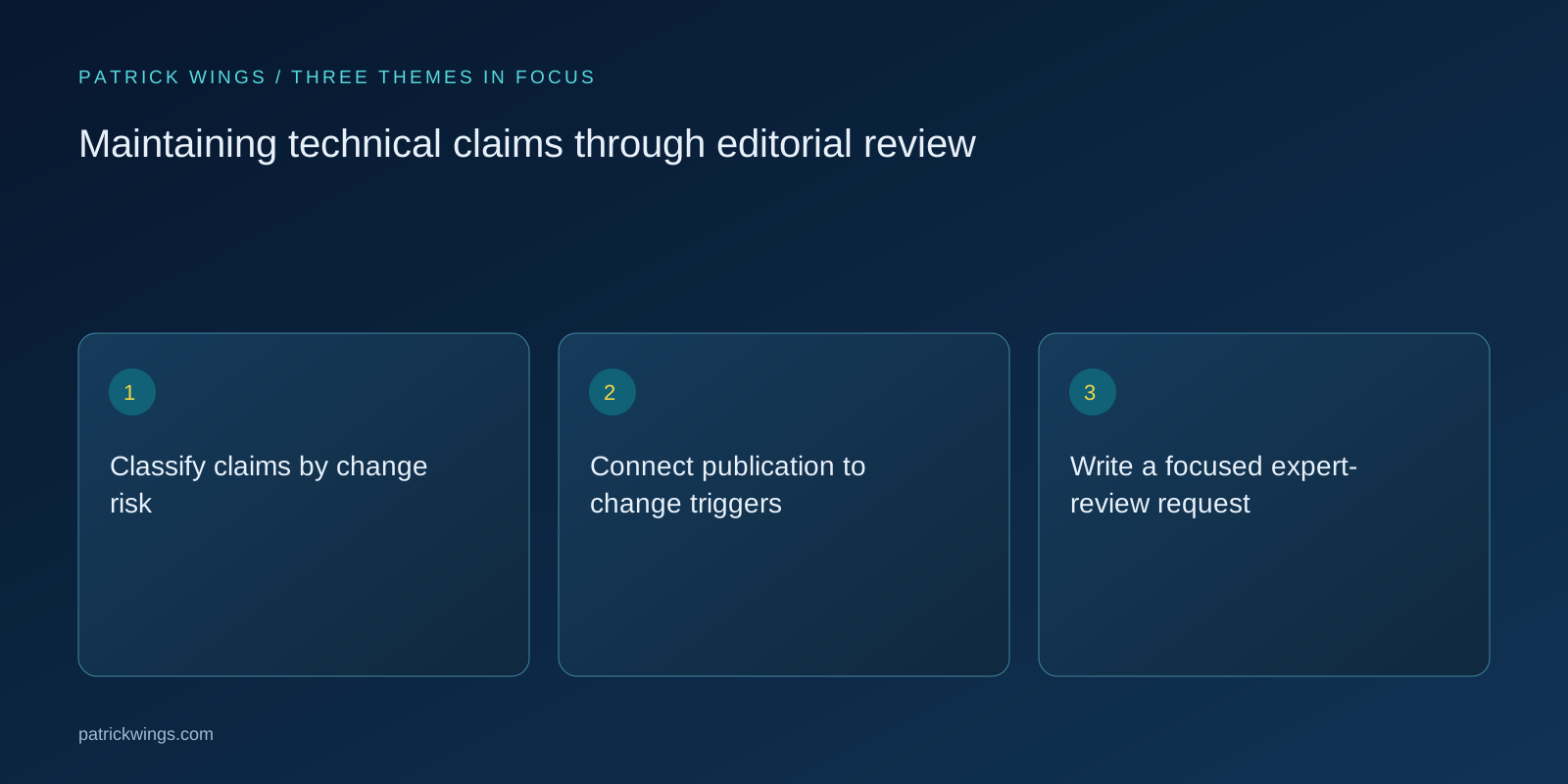
Write a focused expert-review request
Give the reviewer the disputed sentence, its context and the decision a reader might derive from it. Do not merely ask whether the whole draft sounds good. Request confirmation, qualification or correction with a dependable source. Procedures may require a reproducible check using test data. Record which areas were not checked, such as particular regions or older versions. Editors and experts remain accountable for different tasks: better phrasing does not verify product functionality. Where important details remain unresolved, qualify or withhold the statement rather than treating a broad expression of approval as complete technical validation.
Example: changed integration prerequisites
A hypothetical supplier changes the prerequisites for a CRM integration. The editor finds the affected claim on the integration page, in a comparison table and in an older guide. The product owner confirms the new conditions. The team updates all three destinations, explains relevant version context and checks the English equivalents. A cosmetic date update would have been inadequate. Historical observations, however, are not rewritten as though they describe the current product. This example demonstrates the search for dependent claims; it does not report an actual product change or establish a particular efficiency gain from adopting the process.

Publish corrections clearly
Update the actual claim and all affected illustrations, tables and summaries. A material factual correction may need a visible explanation of what changed. Distinguish original publication from a substantive revision where both dates are shown. Check downloads and social templates that still repeat the previous claim. An internal comment does not protect readers from publicly visible incorrect instructions. If a destination temporarily cannot provide a dependable answer, explain that condition and offer a safe next step. Avoid vague blanket warnings that conceal the specific uncertainty or leave users unable to understand whether the guidance applies to them.
Improve the process through unresolved cases
Review recurring reasons for late or incomplete checks. Product contacts, translation dependencies or clear sources may be missing. Improve those handoffs rather than merely counting completed reviews. A short review record should identify what was examined, by whom and with which outcome. Sample published destinations to confirm that they reflect the approved version. If a subject area cannot be maintained, decide whether to narrow it, replace it or retire it responsibly. The process succeeds through dependable decisions about specific claims, not through maximising the number of pages carrying apparently recent dates or generic reviewed labels. Explore this further in the guide Editorial approvals with clear responsibilities and bounded review.
INTERACTIVE / FROM READING TO ACTION
Three checkpoints for your implementation
Choose a checkpoint and track your reading progress. Checks are neither saved nor sent and do not score your business.
CHECKPOINT 01
Write a focused expert-review request
Give the reviewer the disputed sentence, its context and the decision a reader might derive from it.
Explore in the article ↗CHECKPOINT 02
Example: changed integration prerequisites
A hypothetical supplier changes the prerequisites for a CRM integration.
Explore in the article ↗CHECKPOINT 03
Publish corrections clearly
Update the actual claim and all affected illustrations, tables and summaries.
Explore in the article ↗Frequently asked questions
How often should technical articles be reviewed?
Use claim risk and meaningful change triggers rather than one universal interval.
Is a new date enough?
No. Freshness requires an actual check and substantive changes where needed.
What if product details remain uncertain?
Qualify the claim and route the specific unresolved question to the responsible expert.
How can I put “Classify claims by change risk” into practice?
Mark information whose validity depends on product version, edition, region or an external platform. Distinguish foundational explanations from setup procedures and commercial promises. A general definition ages differently from a screenshot of an administrative interface.
What matters when working on “Connect publication to change triggers”?
Link relevant articles to release notes, documentation areas or internal product owners. Identify who checks a new change against public explanations. An edition change, for example, may affect product pages, FAQs and older blog examples.