
THE SHORT ANSWER
Find orphan pages by comparing a crawlable internal-link graph with independent URL inventories such as the CMS, sitemaps and analytics. Then decide whether each unmatched page deserves contextual connections, consolidation or retirement. A page missing from one crawl is a lead to investigate, not automatic proof that it has no internal links.
For the broader picture of technical foundations, useful content and visibility measurement, read the pillar guide SEO, GEO and AEO for SaaS: visibility that supports buying decisions.
Assemble independent inventories
Export published content from the CMS and collect URLs from sitemaps, analytics, search reports and known campaign destinations. Keep the provenance of each address so you understand why it appears. A sitemap-generated inventory alone may repeat the same omissions as the navigation. Retain recently published and low-traffic pages because lack of visits does not prove lack of value. Standardise hostnames and tracking variants carefully, preserving genuine language or content differences. Record the observation date so a later deletion or redirect does not turn a valid comparison into an unexplained discrepancy. Explore this further in the guide Maintaining XML sitemaps as a deliberate URL inventory.
Build a graph with known crawl boundaries
Crawl from the relevant public entry points and collect links that the implementation actually exposes. Document authentication limits, robots rules, rendering settings and excluded subdomains. A crawler that does not render a client-side menu may falsely suggest widespread orphaning. Conversely, links visible only after a private login do not provide public navigation. Compare raw and rendered output for suspicious templates. Establish which links belong to global navigation, archives and meaningful body context; a page with one obscure footer link may technically be connected while remaining difficult for readers to discover.
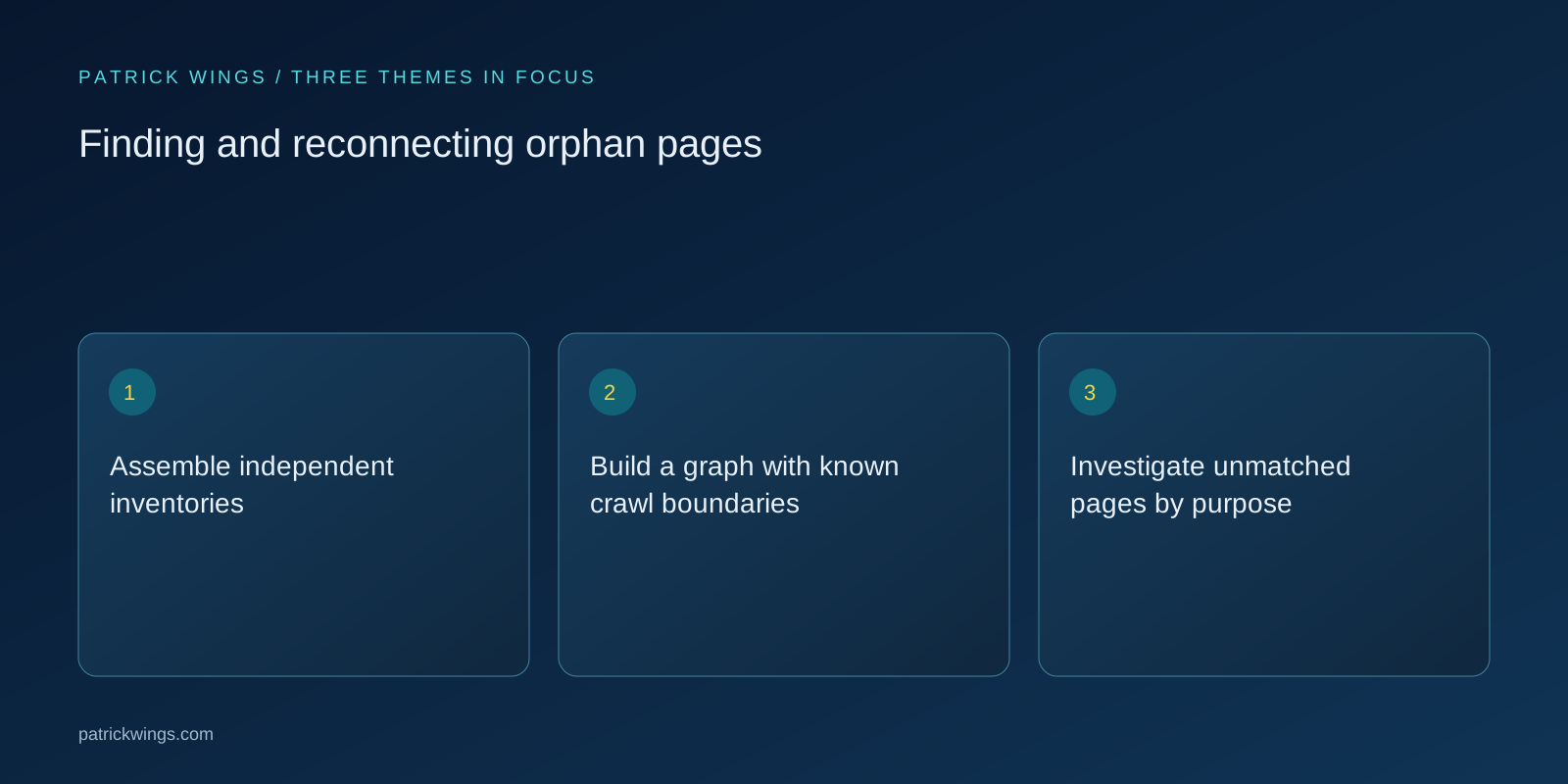
Investigate unmatched pages by purpose
Join the inventories with the graph and inspect unmatched canonical URLs. Check whether the page redirects, has moved, is blocked or belongs to a deliberate standalone campaign. Open important examples manually. Ask which reader question the page answers and where that question naturally arises elsewhere. Assign a content owner before deciding on restoration. Not every unmatched address deserves a link: expired previews, accidental duplicates and unsupported claims may need a different decision. Preserve the reason for intentional isolation, including any campaign constraints that should be revisited when the campaign ends.
Reconnect through relevant reader journeys
Add links from pages where the destination helps answer a concrete next question. Use descriptive anchors and enough surrounding context to explain the transition. A topic hub can support several useful resources, but an indiscriminate directory of every URL provides weak editorial guidance. Update neighbouring articles and category structures where appropriate. Check both language versions when the destination has a translated equivalent. Avoid adding links solely to satisfy an incoming-link count; the destination must fulfil the promise made by the source sentence and remain appropriate for its audience.

Illustrative example: a hidden security guide
Imagine an illustrative SaaS site with a useful security implementation guide present in its CMS and sitemap but absent from crawled navigation. Investigation finds that a category redesign dropped its only contextual links. The team restores relevant links from onboarding and security-overview pages, while separately retiring an obsolete draft found in the same comparison. This demonstrates why inventory differences need editorial judgement. It does not claim that every orphan page deserves recovery or that reconnecting one guide produces a particular ranking or conversion improvement.
Prevent recurrence in publishing reviews
Make discovery routes part of the publication checklist: identify a suitable source page, confirm the destination link and verify the live result. Recheck inventories after category redesigns, migrations and bulk retirements. Track useful pages restored to sensible journeys, not just the disappearance of unmatched rows. Review pages with only marginal connections as a separate usability concern. Success means valuable resources remain accessible through purposeful navigation. Search engines can still discover addresses through external links or sitemaps, but that possibility does not replace an internal architecture that helps real visitors understand and find your material. Explore this further in the guide Aligning internal link distribution with business priorities.
INTERACTIVE / FROM READING TO ACTION
Three checkpoints for your implementation
Choose a checkpoint and track your reading progress. Checks are neither saved nor sent and do not score your business.
CHECKPOINT 01
Investigate unmatched pages by purpose
Join the inventories with the graph and inspect unmatched canonical URLs.
Explore in the article ↗CHECKPOINT 02
Reconnect through relevant reader journeys
Add links from pages where the destination helps answer a concrete next question.
Explore in the article ↗CHECKPOINT 03
Illustrative example: a hidden security guide
Imagine an illustrative SaaS site with a useful security implementation guide present in its CMS and sitemap but absent from crawled navigation.
Explore in the article ↗Frequently asked questions
Is a sitemap link enough?
It can support discovery, but it does not provide a contextual navigation path for a reader.
Should every orphan receive links?
No. Check current usefulness, duplication and publication intent before choosing restoration or retirement.
Why compare rendering settings?
A crawl can miss JavaScript-generated links and report false orphan candidates when its settings do not match the implementation.
How can I put “Assemble independent inventories” into practice?
Export published content from the CMS and collect URLs from sitemaps, analytics, search reports and known campaign destinations. Keep the provenance of each address so you understand why it appears. A sitemap-generated inventory alone may repeat the same omissions as the navigation.
What matters when working on “Build a graph with known crawl boundaries”?
Crawl from the relevant public entry points and collect links that the implementation actually exposes. Document authentication limits, robots rules, rendering settings and excluded subdomains. A crawler that does not render a client-side menu may falsely suggest widespread orphaning.