
THE SHORT ANSWER
Triage outdated pages by current usefulness, search demand, inbound references and the availability of a genuine replacement. Choose keep, update, consolidate or remove before deciding index directives and HTTP behaviour. Age alone is not a reason to delete a URL, and low traffic alone does not show that a page has no business or reader value.
For the broader picture of technical foundations, useful content and visibility measurement, read the pillar guide SEO, GEO and AEO for SaaS: visibility that supports buying decisions.
Build a URL-level decision record
Collect the canonical address, content owner, current topic, publication state and known language equivalents. Add available search impressions, landing visits, meaningful conversions and external references with dates and coverage limits. Record whether a page supports sales, onboarding or documentation even when search volume is modest. Identify unsupported or obsolete claims separately from formatting age. This record supports a defensible decision for each URL. It also prevents a bulk cleanup from deleting a small but essential resource simply because a dashboard ranks it below a broad high-traffic introduction.
Separate content defects from demand changes
Read the page and verify whether its answer remains correct. Investigate whether declining visits reflect seasonality, a changed product, a new URL, lost navigation or changing reader needs. A technically inaccessible page needs a different response from an accessible but outdated explanation. Check relevant incoming links and the current search result context without assuming every decline has one cause. Ask the owner what users still need from the page. When evidence is incomplete, choose further investigation or a bounded update rather than presenting an uncertain deletion as a proven optimisation. Explore this further in the guide Consolidating similar content without losing useful answers.
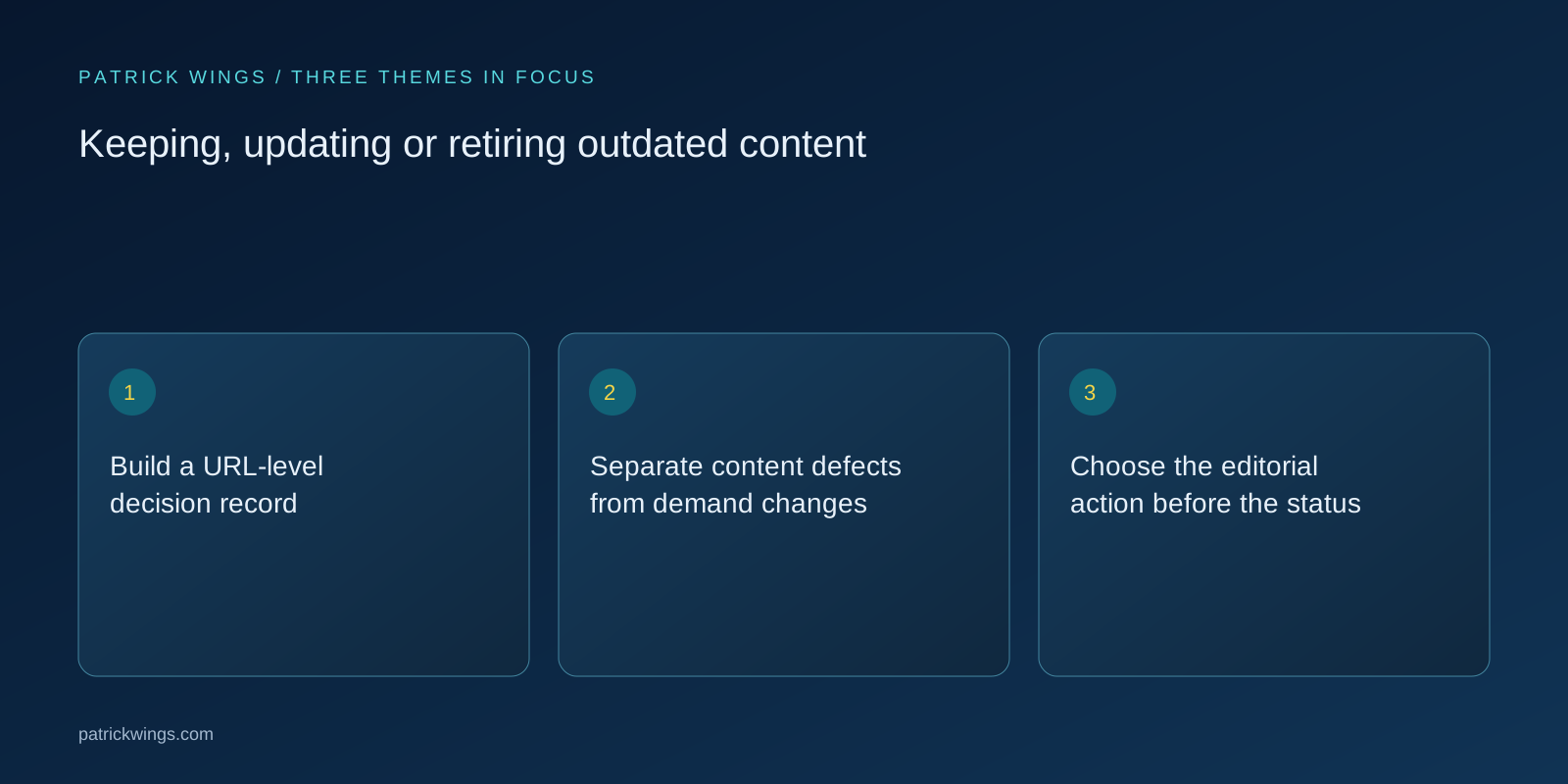
Choose the editorial action before the status
Keep a useful accurate page even if it is old. Update when the task remains important and specific sections need new evidence or instructions. Consolidate when another maintained page can fulfil the same promise more clearly, preserving unique useful material. Remove when the content should no longer be offered and no adequate repair is justified. Record the reason and review owner. Do not use noindex as a substitute for deciding whether a public page remains useful; a search exclusion directive does not fix misleading claims for direct visitors.
Implement truthful URL and index behaviour
When an equivalent successor exists, map the retired URL to that destination and update controlled links. When no suitable replacement exists, an appropriate not-found or gone response may be correct. A public page retained for a special non-search purpose can have a deliberate indexing policy, but crawlers must access noindex to read it. Remove retired URLs from the ongoing sitemap inventory and review canonical and hreflang dependencies. Protect sensitive information with access controls rather than relying on search directives. Test the final production responses at the original addresses.

Illustrative example: an obsolete webinar page
Imagine an illustrative webinar page about an integration that has changed substantially. Its recording still has historical value, but its setup instructions are unsafe to follow today. The team assesses whether to retain a clearly labelled archive with links to current guidance or retire the page in favour of an equivalent maintained tutorial. A separate expired registration form has no useful successor. The decisions differ because the URLs serve different tasks. This scenario does not establish that pruning old pages improves rankings or predict the traffic effect of removing either address.
Monitor consequences and preserve the rationale
After the change, check important incoming paths, response codes, updated links and the intended index policy. Observe search and business signals with a dated change record and allow for recrawling and unrelated demand movements. Investigate unexpected losses of useful reader journeys rather than automatically reversing every traffic decline. Keep retired material internally where appropriate for review. Success means accurate public coverage, coherent replacements and explicit ownership. Report decisions and unresolved risks, not just the number of deleted URLs. A smaller site is not inherently a better site, and no retirement action guarantees improved search performance. Explore this further in the guide Using HTTP status codes for editorial URLs.
INTERACTIVE / FROM READING TO ACTION
Three checkpoints for your implementation
Choose a checkpoint and track your reading progress. Checks are neither saved nor sent and do not score your business.
CHECKPOINT 01
Choose the editorial action before the status
Keep a useful accurate page even if it is old.
Explore in the article ↗CHECKPOINT 02
Implement truthful URL and index behaviour
When an equivalent successor exists, map the retired URL to that destination and update controlled links.
Explore in the article ↗CHECKPOINT 03
Illustrative example: an obsolete webinar page
Imagine an illustrative webinar page about an integration that has changed substantially.
Explore in the article ↗Frequently asked questions
Is low traffic enough to delete?
No. Review usefulness, search coverage, important references and non-search tasks first.
Should outdated pages simply receive noindex?
Noindex changes supported search eligibility; it does not correct misleading information still available to visitors.
When is a redirect suitable?
When a specific replacement meaningfully fulfils the old URL’s reader task.
How can I put “Build a URL-level decision record” into practice?
Collect the canonical address, content owner, current topic, publication state and known language equivalents. Add available search impressions, landing visits, meaningful conversions and external references with dates and coverage limits. Record whether a page supports sales, onboarding or documentation even when search volume is modest.
What matters when working on “Separate content defects from demand changes”?
Read the page and verify whether its answer remains correct. Investigate whether declining visits reflect seasonality, a changed product, a new URL, lost navigation or changing reader needs. A technically inaccessible page needs a different response from an accessible but outdated explanation.