
THE SHORT ANSWER
Write internal anchors that tell readers what the destination will help them understand or do. Choose the next relevant question, link the words that describe it and make sure the destination fulfils that promise. Natural descriptive links support navigation and search understanding without a fixed keyword ratio or a requirement to repeat the same phrase everywhere.
For the broader picture of technical foundations, useful content and visibility measurement, read the pillar guide SEO, GEO and AEO for SaaS: visibility that supports buying decisions.
Start from the reader’s unresolved question
Read the source paragraph and ask what a reader might need next: an implementation guide, a comparison, a definition or evidence for a claim. Choose one useful transition rather than linking any related word. A product article discussing migration risk might lead to a redirect-mapping guide, while a glossary explanation may require a simpler introduction. Match the destination’s depth to the current context. This preserves a coherent journey instead of treating every available internal page as equally relevant whenever its topic happens to appear.
Make the destination understandable before clicking
Prefer concise descriptive words that identify the topic and purpose of the linked material. Generic instructions such as click here often withhold information that could help a reader decide. At the same time, avoid a long anchor crammed with every variation of a target phrase. Read the sentence aloud and check whether it remains natural. The surrounding text also matters: a precise anchor inside a misleading sentence still creates the wrong expectation. Where destinations have similar titles, clarify the particular decision each page supports. Explore this further in the guide Separating search intent across similar articles.
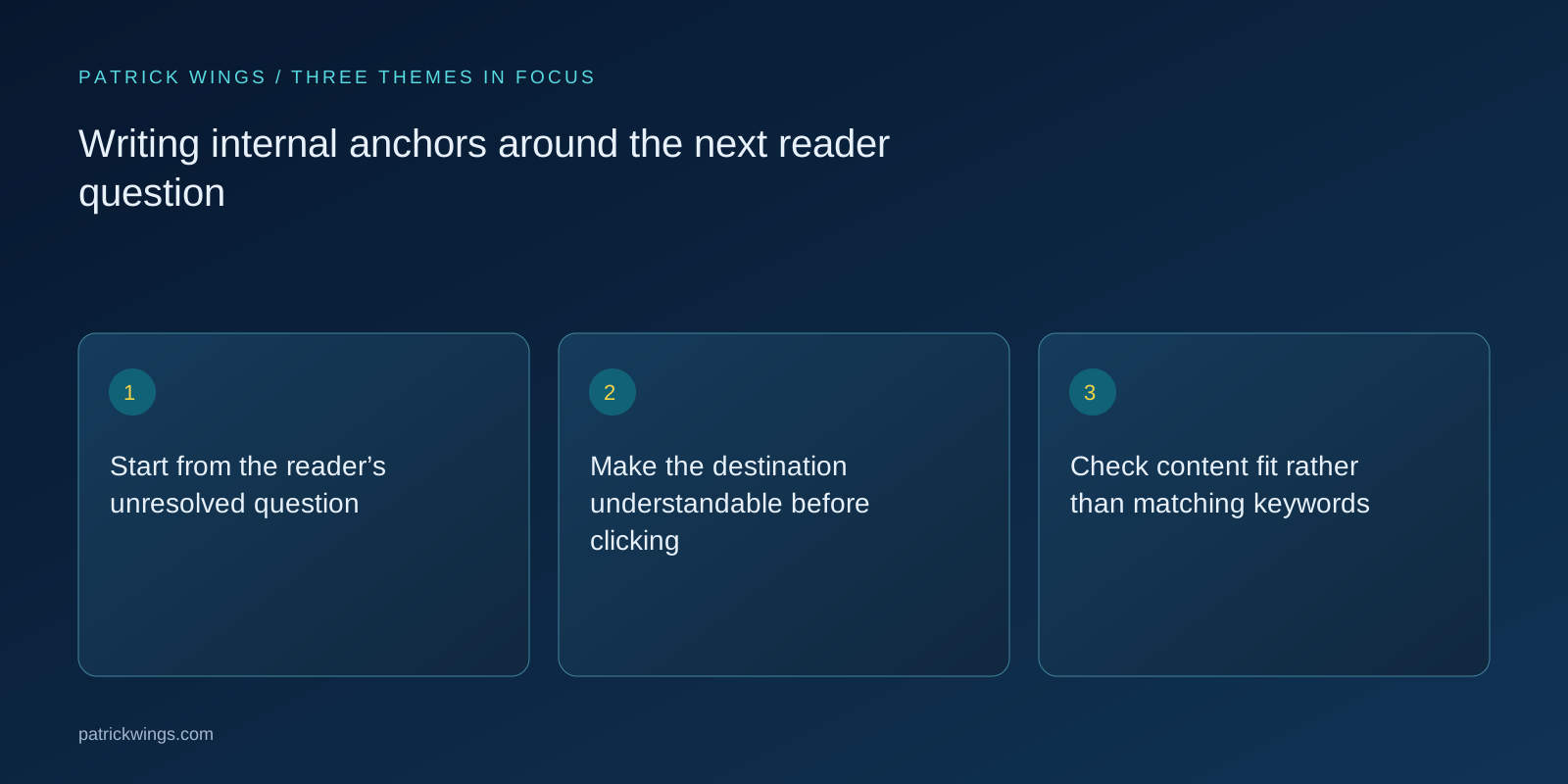
Check content fit rather than matching keywords
Open the destination and verify that it answers the promised question at the appropriate level. A commercial landing page may not satisfy a promise of detailed technical troubleshooting. Likewise, a narrow implementation note should not be described as a comprehensive strategy guide. Check currency, language and accessibility before adding the link. When the best answer does not yet exist, create an editorial task instead of linking to the nearest weak substitute. Relevance comes from the relationship between source, anchor and destination, not merely shared terminology.
Implement accessible crawlable links
Use ordinary anchor elements with valid href destinations for important internal navigation. Check the rendered page because CMS widgets can turn apparent links into scripted controls. Make the link distinguishable and usable with a keyboard. Avoid relying on visual position alone to describe its meaning. Inspect translated content separately so a German anchor does not unexpectedly open an unrelated English sales page. Prefer the final intended URL over an obsolete redirect source, and verify fragment targets when promising a particular section within a longer guide.

Illustrative example: linking a migration article
Imagine an illustrative migration overview that mentions both URL inventory and post-launch monitoring. The editor adds one link where readers need to assemble the inventory and another where they need to investigate launch anomalies. Each anchor describes that distinct task; neither repeats a broad SEO services phrase. A third possible link is omitted because it would interrupt the argument without answering another question. This example illustrates editorial restraint and useful specificity, not a measured ranking effect or a formula for how many links an article should contain.
Review links as part of maintenance
During updates, sample incoming anchors as well as links leaving the article. A renamed or consolidated destination may no longer fulfil older promises. Fix misleading wording, outdated targets and broken fragments together. Review important journeys manually after broad navigation changes. Do not impose universal exact-match percentages or a fixed link quota; assess clarity, context and reader value. Success means readers can anticipate the next page and reach a useful answer. Search engines may use link information, but better anchors do not independently guarantee rankings, indexing or inclusion in AI-generated responses. Explore this further in the guide Aligning internal link distribution with business priorities.
INTERACTIVE / FROM READING TO ACTION
Three checkpoints for your implementation
Choose a checkpoint and track your reading progress. Checks are neither saved nor sent and do not score your business.
CHECKPOINT 01
Check content fit rather than matching keywords
Open the destination and verify that it answers the promised question at the appropriate level.
Explore in the article ↗CHECKPOINT 02
Implement accessible crawlable links
Use ordinary anchor elements with valid href destinations for important internal navigation.
Explore in the article ↗CHECKPOINT 03
Illustrative example: linking a migration article
Imagine an illustrative migration overview that mentions both URL inventory and post-launch monitoring.
Explore in the article ↗Frequently asked questions
Should all anchors use the target keyword?
No. Describe the destination naturally in the specific source context.
How many links should an article have?
Use as many as the reader journey justifies; a universal quota cannot establish usefulness.
Should a link point through a redirect?
Prefer the final relevant destination when you control the source link and can update it.
How can I put “Start from the reader’s unresolved question” into practice?
Read the source paragraph and ask what a reader might need next: an implementation guide, a comparison, a definition or evidence for a claim. Choose one useful transition rather than linking any related word. A product article discussing migration risk might lead to a redirect-mapping guide, while a glossary explanation may require a simpler introduction.
What matters when working on “Make the destination understandable before clicking”?
Prefer concise descriptive words that identify the topic and purpose of the linked material. Generic instructions such as click here often withhold information that could help a reader decide. At the same time, avoid a long anchor crammed with every variation of a target phrase.