
THE SHORT ANSWER
Choose an international URL architecture from the markets you actually serve, the languages you can maintain and the operating model behind them. Language directories, subdomains and country domains carry different maintenance and localisation implications. None creates a universal ranking advantage. Document the decision and preserve distinct accessible URLs for genuine language versions.
For the broader picture of technical foundations, useful content and visibility measurement, read the pillar guide SEO, GEO and AEO for SaaS: visibility that supports buying decisions.
Distinguish language from market
List the languages readers need and the countries or regions where your offer genuinely differs. German content does not automatically mean a Germany-only offer, just as English does not identify one country. Record differences in product availability, commercial terms, support and regulatory context that actually affect the page. Identify which differences need expert review. Avoid multiplying regional pages before the organisation can explain their purpose. Architecture should make a real operating distinction understandable, rather than implying a local presence or service commitment that the business cannot support. Explore this further in the guide Publishing regional pages when the differences are real.
Compare operational trade-offs explicitly
Directories on one generic domain can simplify shared hosting and maintenance. Separate subdomains or domains may support organisational separation but create additional configuration and governance work. Country-code domains can communicate country targeting, while eligibility and availability need investigation for the particular domain. Compare ownership, deployment, analytics, certificates, content workflows and future migration cost. Do not reduce the choice to an unsupported claim that one folder structure is always best for SEO. Write the assumptions behind the preferred option so a later expansion can revisit them intelligently.
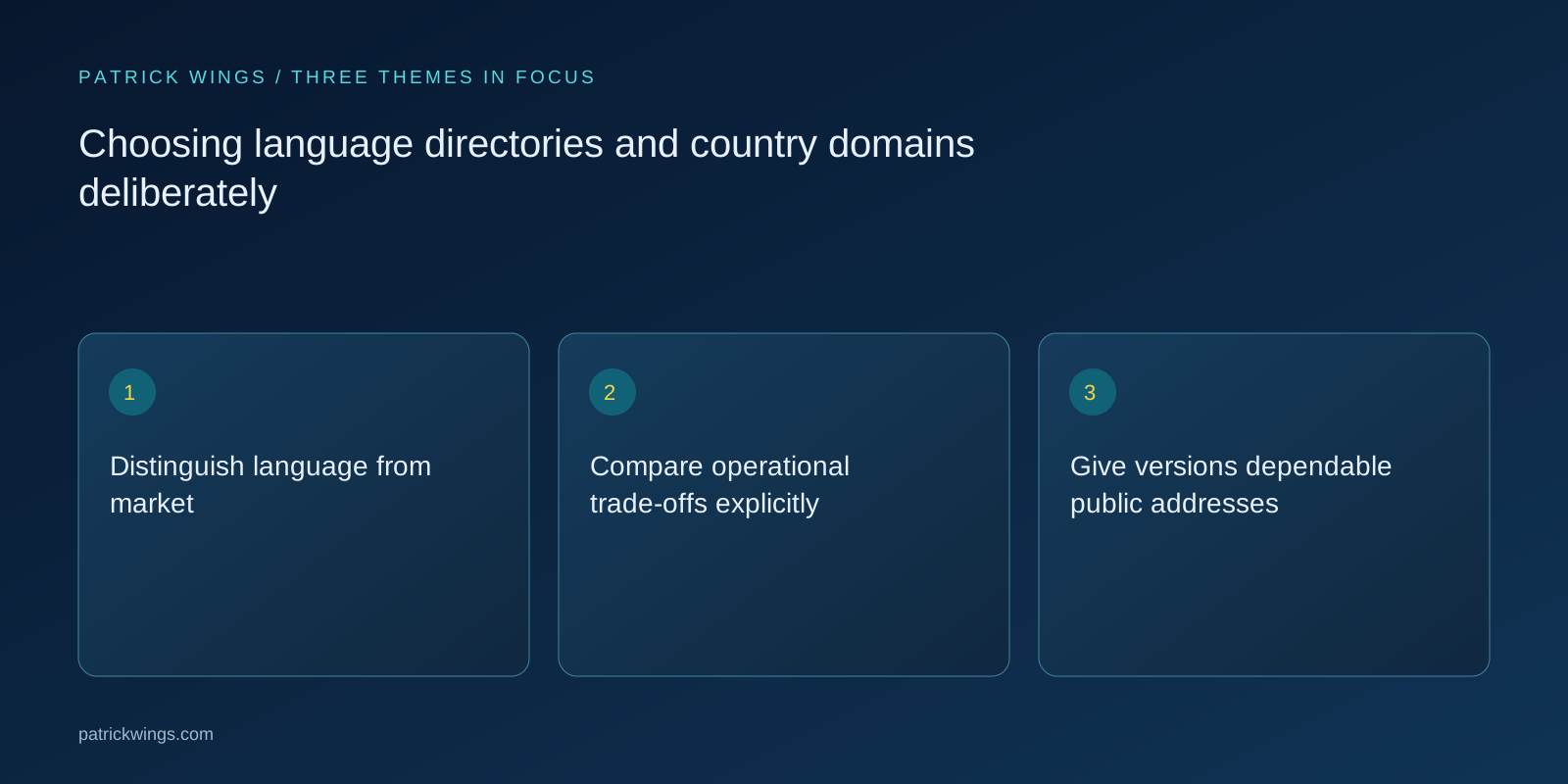
Give versions dependable public addresses
Google recommends separate URLs for different language versions rather than relying solely on cookies or browser settings. Make each intended version directly reachable and let readers switch deliberately. Avoid forcing visitors into a different language based only on an inferred location. Such routing can prevent both people and crawlers from seeing the version they need. Keep content and navigation coherent in the selected language. A translated header around a largely untranslated article does not establish a useful localised answer, regardless of the directory name chosen for the route.
Plan annotations and equivalents together
Map which pages are genuine language or regional equivalents and define how the relationship is published and tested. Use appropriate hreflang annotations for supported equivalents, with complete reciprocal references and valid language or region values. Keep canonical decisions coherent with the actual content relationship. Do not invent a translated counterpart when one does not exist. Define missing-translation behaviour for language switches and navigation. Review documentation, product and marketing routes together because independent systems can accidentally use conflicting conventions for the same language or market across the public website. Explore this further in the guide Keeping translated SEO content current together.

Illustrative example: a bilingual SaaS expansion
Imagine an illustrative SaaS company serving international customers in English and German from one shared product and support operation. It selects language directories because common infrastructure and ownership fit its needs. Later, a country-specific offering introduces genuinely different contracting and support details; the team reassesses regional pages without assuming it must immediately move to separate domains. This example demonstrates a decision process, not a universal recommendation. The directory choice alone does not guarantee local relevance, and each published page still requires accurate content and a maintained relationship to its equivalents.
Validate maintainability before committing
Test representative routes, language switching, annotations, canonical targets and deployment permissions before expanding the pattern. Confirm that analytics can distinguish useful language and market groups without fragmenting reporting beyond operational need. Document who approves new regions and who maintains shared components. Review the architecture when the business model changes, not whenever a competitor adopts another URL pattern. Success means accessible versions, truthful market differences and sustainable ownership. Search systems still decide which page best fits an individual query, and an architectural choice cannot guarantee rankings or the exclusive display of one regional result.
INTERACTIVE / FROM READING TO ACTION
Three checkpoints for your implementation
Choose a checkpoint and track your reading progress. Checks are neither saved nor sent and do not score your business.
CHECKPOINT 01
Give versions dependable public addresses
Google recommends separate URLs for different language versions rather than relying solely on cookies or browser settings.
Explore in the article ↗CHECKPOINT 02
Plan annotations and equivalents together
Map which pages are genuine language or regional equivalents and define how the relationship is published and tested.
Explore in the article ↗CHECKPOINT 03
Illustrative example: a bilingual SaaS expansion
Imagine an illustrative SaaS company serving international customers in English and German from one shared product and support operation.
Explore in the article ↗Frequently asked questions
Does German require a .de domain?
No. Choose the structure from market scope and operating requirements, not language alone.
Are language directories always best?
No universal choice applies. Compare maintenance, ownership, market differences and migration implications.
Should location force a language redirect?
Prefer accessible versions and deliberate switching; inferred-location redirects can block the version a reader needs.
How can I put “Distinguish language from market” into practice?
List the languages readers need and the countries or regions where your offer genuinely differs. German content does not automatically mean a Germany-only offer, just as English does not identify one country. Record differences in product availability, commercial terms, support and regulatory context that actually affect the page.
What matters when working on “Compare operational trade-offs explicitly”?
Directories on one generic domain can simplify shared hosting and maintenance. Separate subdomains or domains may support organisational separation but create additional configuration and governance work. Country-code domains can communicate country targeting, while eligibility and availability need investigation for the particular domain.