
THE SHORT ANSWER
Lead nurturing is the planned support of contacts for whom an immediate sales conversation is not yet the right step. Useful programmes answer unresolved questions and respect context. They are not simply a fixed number of automated promotional emails.
For the broader picture of how target customers, channels and sales handoffs work together, read the pillar guide B2B demand generation: from attention to qualified pipeline.
Understand why the relationship exists
Start by asking why the contact entered your system. A whitepaper request, a technical question and a previous sales discussion are different starting points. Record the subject, expressed interest and permitted communication clearly. Requesting a download does not automatically authorise every subsequent message. Clarify the legal and operational basis with the responsible people. Also establish what information the contact has already received. Nurturing should continue an existing context rather than restart with the same generic company introduction whenever a new campaign launches. This helps the reader recognise the relationship and prevents previous conversations from disappearing behind an automation sequence.
Segment by unresolved decisions
Begin segmentation with the relevant problem and information need rather than a large collection of narrow demographic attributes. Common questions involve implementation, integration, internal agreement or commercial evaluation. For an illustrative project management product, one group might need to understand capacity planning while another is checking data migration. They need different resources. When the requirement is unknown, offer a simple voluntary topic choice or observe what information people actively request. Avoid overinterpreting a single click. A small, understandable topic structure is often more usable than an elaborate model with segments containing too few contacts to support meaningful differences. Explore this further in the guide Measuring B2B marketing: from channel metrics to pipeline decisions.
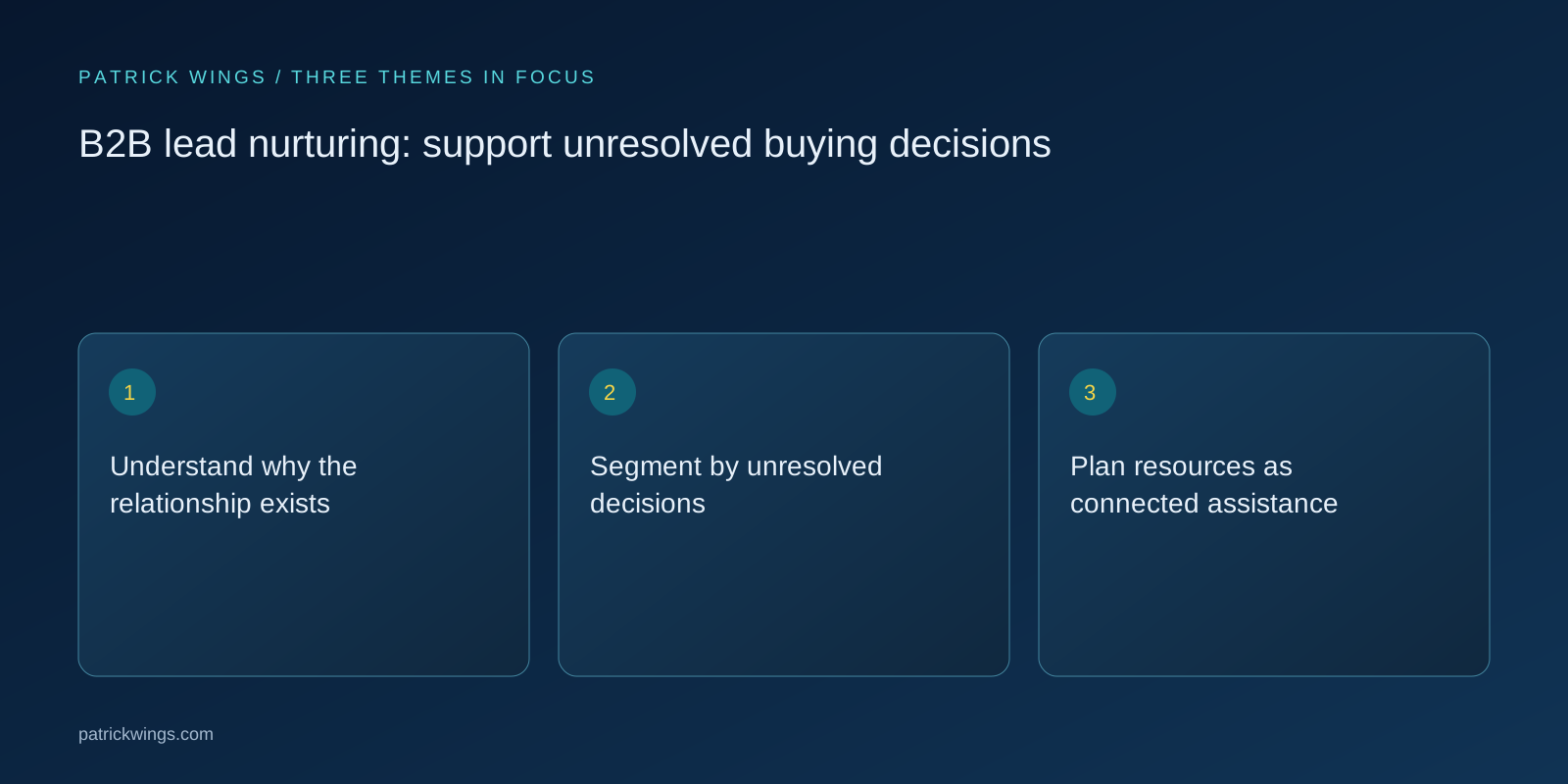
Plan resources as connected assistance
Each message should perform a useful job on its own. You might begin with a problem explanation, follow with a practical checklist and then address a common implementation concern. Product information belongs when it answers a specific question. Use genuine evidence you have permission to publish or clearly labelled illustrative scenarios. Explain where your solution is appropriate and where its limitations lie. This helps the reader make a better decision. Do not repeat the same meeting request in different wording throughout the sequence. Make a voluntary next step clear without turning every educational resource into an excuse for another sales pitch. Explore this further in the guide Marketing and sales alignment: clear handovers instead of MQL arguments.
Define triggers and exit rules together
Specify what starts a programme and which events interrupt or end it. These include unsubscribe requests, objections, sales ownership, customer status or confirmed lack of fit. Examine how multiple product interests and overlapping lists interact. A person should not receive contradictory messages from automation and a salesperson at the same time. Test these cases with controlled records before activation. Assign responsibility for technical failures and changes to the source material. Automation only saves useful effort when its rules remain understandable and the recipient does not become an involuntary test case for workflows nobody has evaluated as a complete experience.

Set frequency from context and substance
There is no universally correct interval for nurture messages. A requested technical guide may justify a timely follow-up, while someone researching a longer-term issue may need less frequent information. Expectations, relevance and available substance should drive the choice. Monitor unsubscribes, complaints and actual replies rather than relying only on opens. Technical factors can distort engagement signals, so interpret them carefully. If you have nothing new to contribute to an unresolved question, a pause may be more useful than another generic promotional message. Document the reasoning behind timing so future changes are deliberate rather than simply following an inherited template.
Evaluate meaningful progression
Check whether contacts use relevant resources, raise questions or agree a more useful next action. Connect those observations to qualified conversations and later opportunities without crediting every outcome entirely to the last message. For longer buying processes, use cohorts and individual contact journeys to understand the sequence. Ask sales which resources actually clarify common objections. Remove material that sets the wrong expectations or no longer performs a useful task. Maintenance does not mean adding more messages indefinitely. It means continuing the relationship coherently and moving into personal assistance when someone needs it, while recognising when the appropriate next action is to stop communicating.
INTERACTIVE / FROM READING TO ACTION
Three checkpoints for your implementation
Choose a checkpoint and track your reading progress. Checks are neither saved nor sent and do not score your business.
CHECKPOINT 01
Plan resources as connected assistance
Each message should perform a useful job on its own.
Explore in the article ↗CHECKPOINT 02
Define triggers and exit rules together
Specify what starts a programme and which events interrupt or end it.
Explore in the article ↗CHECKPOINT 03
Set frequency from context and substance
There is no universally correct interval for nurture messages.
Explore in the article ↗Frequently asked questions
How many emails should a nurture programme contain?
There is no fixed correct number. Plan around unresolved questions and stop when further messages add no independent value.
Is a whitepaper download enough to begin?
It can provide topic context. Further communication also needs an appropriate legal and operational basis.
When should sales take over?
When an explicit request, confirmed requirement or other agreed criteria make a personal conversation useful.
How can I put “Understand why the relationship exists” into practice?
Start by asking why the contact entered your system. A whitepaper request, a technical question and a previous sales discussion are different starting points. Record the subject, expressed interest and permitted communication clearly.
What matters when working on “Segment by unresolved decisions”?
Begin segmentation with the relevant problem and information need rather than a large collection of narrow demographic attributes. Common questions involve implementation, integration, internal agreement or commercial evaluation. For an illustrative project management product, one group might need to understand capacity planning while another is checking data migration.