
THE SHORT ANSWER
LinkedIn advertising starts with professional relevance. A precise audience alone does not create demand. You need a recognisable problem, credible content and a next step that fits the reader’s situation.
For the broader picture of how target customers, channels and sales handoffs work together, read the pillar guide B2B demand generation: from attention to qualified pipeline.
Derive audiences from the buying process
Start by listing the people who experience the problem, evaluate possible solutions and approve expenditure. Only then translate those roles into the professional attributes available on the platform. Job titles are approximations rather than complete descriptions of responsibility. A smaller company may use very different titles from a large enterprise. Test sensible representations and document which buying role each audience is intended to cover. For an illustrative recruiting product, you might address HR leadership separately from operational recruitment managers. This makes the message more specific and keeps later interpretation connected to an actual buying role rather than a targeting label. Explore this further in the guide B2B lead qualification: separate fit, interest and buying readiness.
Lead with a recognisable problem
A professional scrolling through a feed has not necessarily searched for your product. Explain a familiar work situation and its consequences before introducing a useful approach or product perspective. You might show the coordination required when applicant information moves between disconnected tools. Avoid artificial urgency and unsupported market claims. A strong advertisement needs an identifiable idea, readable design and a clear offer. Test different arguments rather than cosmetic colour changes alone. Keep the core proposition stable enough within each test to understand what you are learning and what might account for a change in response.
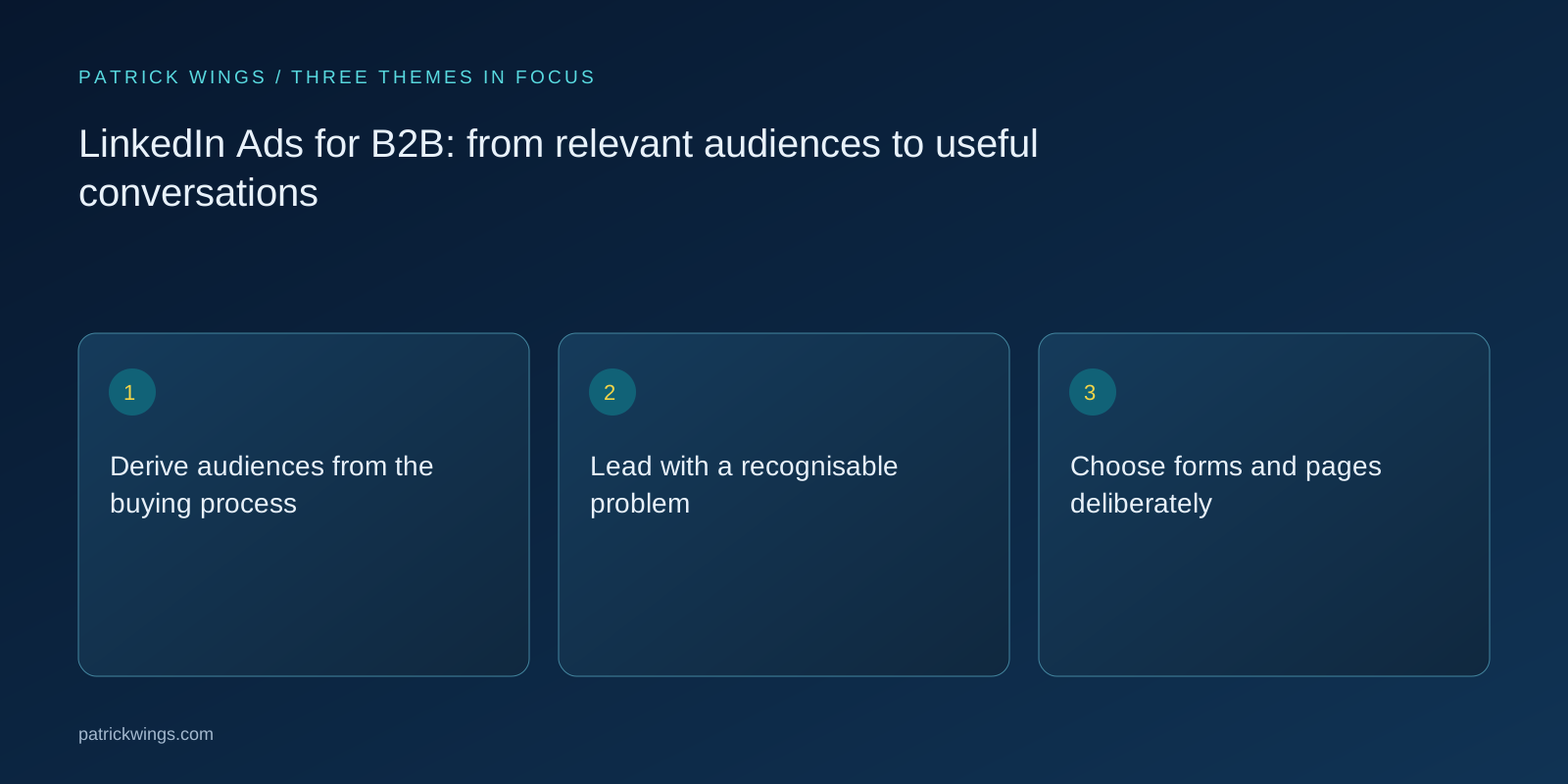
Choose forms and pages deliberately
Lead Gen Forms can prefill information from LinkedIn profiles. That reduces typing but does not qualify the person. A dedicated page provides more space for explanation, product evidence and objections. Choose the route according to what the reader needs to make a sound decision. A narrowly defined guide may suit an integrated form; a complex consulting offer may require more visible context. Request only useful information and explain its subsequent use. Test the advertisement, form heading, confirmation and delivered content as one experience rather than independent elements. Friction is worth reducing when the underlying promise remains clear and accurate.
FROM MY PROJECT EXPERIENCE
BanQu: evaluate LinkedIn within the full demand journey

At BanQu, a LinkedIn lead-generation strategy, multilingual landing pages and conversion tracking formed part of the preparation for European campaigns. Activation connected Google Search and LinkedIn with entry content, nurturing, daily lead handoff and reporting every two weeks.
Role & collaboration
Patrick, Arno and the GROWSaaS team added strategy and execution capacity to BanQu’s internal marketing. The case describes joint work for European target markets.
HISTORICAL PROJECT RESULTS
What this means for your planning
A new LinkedIn test therefore needs more planning than the ad alone. The offer, destination and next sales action form a shared evaluation path. The documented approach supports this sequence; it does not establish that one creative or targeting choice caused the entire improvement.
- Before launch, check that the ad and landing page explain the same offer.
- Validate conversion capture and sales handoff together.
- Evaluate channel metrics and downstream lead quality separately, then connect them in reporting.
Evidence and measurement limits
The reported 30% CPL reduction covers Google and LinkedIn together. The reference does not establish an isolated LinkedIn CPL, total budget or attributable revenue contribution. This figure is not a forecast for a new advertising package.
Source: GROWSaaS BanQu Case Study 2026, German client reference. Results: page 8; feedback from Jordan Wilson: page 9.
Read the case study, source & measurement context ↗Agree follow-up before launching
Determine who receives contacts, when a personal response is appropriate and which message reflects the promised offer. Someone requesting a guide expects the guide first. An immediate sales call without useful context can damage the relationship. Give sales the campaign, subject and any voluntarily supplied challenge information. Test technical delivery, ownership and duplicate handling with a controlled submission. A reliable handover matters especially when countries, teams or product lines share a CRM. Unreachable and unsuitable records need explicit treatment rather than silent storage. Make responsibility visible so a campaign cannot appear operational while enquiries remain unattended in an integration queue.

Give retargeting a useful next message
A subsequent advertisement should take the earlier interaction into account. Someone who opened an introductory document does not necessarily need the same opening message again. A specific use case or evaluation aid may be more useful. LinkedIn documents several Matched Audience options; verify availability and prerequisites in the account. Avoid designing elaborate sequences around segments that are too small to operate meaningfully. Respect permissions, platform rules and exclusions such as existing customers or active sales processes. Retargeting is another opportunity to be relevant, not a reason for indefinite repetition. Review frequency and whether the audience has exhausted the current idea. Explore this further in the guide B2B lead nurturing: support unresolved buying decisions.
Evaluate contact quality and learning together
Assess contact cost alongside audience suitability, responses and accepted conversations. A cheap download from an irrelevant role does not answer the commercial question. Investigate whether the offer attracts general professional development or a relevant solution need. Add CRM cohort analysis and a structured sample of sales conversations to platform reporting. With low volumes, documented observations are more useful than prematurely declaring a winner. Decide whether the next change concerns the audience, argument or offer. Change one meaningful factor at a time where possible, state the expected effect and preserve enough context for your team to interpret the result later.
INTERACTIVE / FROM READING TO ACTION
Three checkpoints for your implementation
Choose a checkpoint and track your reading progress. Checks are neither saved nor sent and do not score your business.
CHECKPOINT 01
Choose forms and pages deliberately
Lead Gen Forms can prefill information from LinkedIn profiles.
Explore in the article ↗CHECKPOINT 02
Agree follow-up before launching
Determine who receives contacts, when a personal response is appropriate and which message reflects the promised offer.
Explore in the article ↗CHECKPOINT 03
Give retargeting a useful next message
A subsequent advertisement should take the earlier interaction into account.
Explore in the article ↗LinkedIn Ads audit: review audience, offer and destination
Start with the ICP and whether targeting reflects the intended buying role. Review the offer and consistency between ad and landing page or Lead Gen Form. Record missing lead-quality evidence rather than inferring a working pipeline from clicks.
Evaluate LinkedIn Ads cost alongside lead quality
Separate platform spend, creation and management. Track which leads were handled, which fit and where delays occur before a conversation. An audit can identify prerequisites and weaknesses; it cannot guarantee lead counts or acquisition costs.
Build LinkedIn campaigns internally or commission preparation?
A campaign kit fits when internal access and delivery capacity exist but structure and materials are missing. Ongoing management also needs responsibility for spend, approval and evaluation. Agree handoff formats and who will actually operate the campaign after delivery.
Frequently asked questions
Are Lead Gen Forms better than landing pages?
Neither is universally better. Forms reduce typing, while pages offer more explanatory space. Offer complexity and subsequent contact quality should guide the choice.
Can targeting rely on job titles alone?
Titles can help but only approximate responsibility. Check them against your buying process and combine useful professional attributes where appropriate.
Which metric matters first?
Initially verify delivery and technical operation. Then evaluate suitability and meaningful progression rather than isolated contact costs.
How can I put “Derive audiences from the buying process” into practice?
Start by listing the people who experience the problem, evaluate possible solutions and approve expenditure. Only then translate those roles into the professional attributes available on the platform. Job titles are approximations rather than complete descriptions of responsibility.
What matters when working on “Lead with a recognisable problem”?
A professional scrolling through a feed has not necessarily searched for your product. Explain a familiar work situation and its consequences before introducing a useful approach or product perspective. You might show the coordination required when applicant information moves between disconnected tools.