
THE SHORT ANSWER
Outdated resources can mislead readers even when they still look professional. Retiring content therefore involves more than removing a file from a directory. Editors need to decide which need has changed, what replacement is suitable and who will inform existing users. This guide focuses on editorial lifecycle decisions and reader continuity. Redirects, indexing and URL migration are coordinated afterward with the people responsible for technical implementation and search operations.
To see how this step fits into your content strategy, read the pillar guide B2B content marketing: From useful expertise to qualified demand.
Evaluate what has become outdated
Identify what changed: individual examples, a product feature, the overall approach or the underlying reader need. An older publication date does not automatically make a resource wrong. Equally, a recently published guide can become inaccurate when an essential prerequisite changes. Record specific problematic statements and their possible consequences. Prioritize decision-critical material rather than sorting only by age. Questions from sales or support may provide useful signals. The editorial decision needs inspectable reasons, not merely a general instruction to remove as many old files as possible or make the resource library look newer. Explore this further in the guide Prioritizing substantive content updates.
Choose revision, replacement or historical preservation
A contained correction may justify updating the existing resource, while a fundamentally changed approach may require a replacement. Some material remains useful as historical documentation if its status is unmistakable. Decide from the reader task whether the old edition still has a defensible use. A new article is not automatically a replacement because its title sounds similar. Compare the questions answered, prerequisites and formats. Record the decision, reason and responsible person. That makes it possible to explain later why material was kept, replaced or removed from active use rather than relying on the memory of one editor.
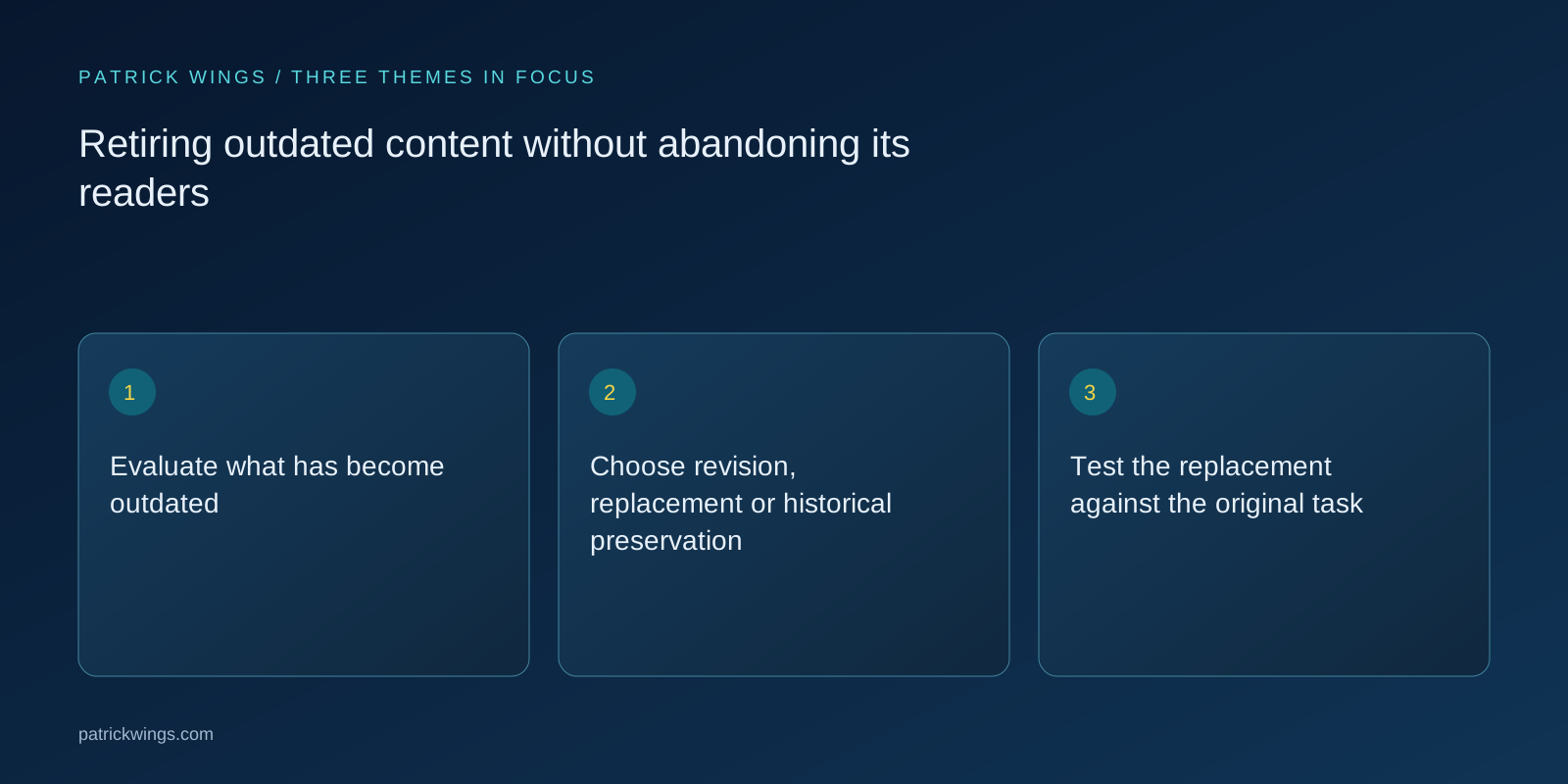
Test the replacement against the original task
Open the proposed replacement and attempt the task previously supported by the old material. Are steps, templates or explanations missing? If the new resource has a narrower purpose, explain that boundary in the transition. A general product page does not automatically replace a technical worksheet. Several references or a short transition note may be needed. Involve people who actually send or use the resource. They often know dependencies absent from the inventory, including training materials, customer emails and internal onboarding routines. A replacement is suitable when it preserves useful continuity, not simply when a newer publication exists.
A hypothetical retirement decision
Imagine a SaaS provider withdrawing an onboarding template because its role model has fundamentally changed. Editors check the tasks supported by the old template and develop a suitable successor. They identify existing email wording and internal training material that refer to it. The old edition is no longer promoted as current guidance; where retained for documentation, its historical status is clear. This hypothetical example illustrates responsible replacement. It does not prescribe a technical status code or claim that removing old content improves rankings. The editorial decision and its technical implementation require related but distinct judgments. Explore this further in the guide Editorial approvals with clear responsibilities and bounded review.

Inform readers and participating teams
Prepare a short explanation of the change, its reason and the appropriate replacement. The format depends on previous use. Internal colleagues may need a new use card, while partners need to review their references. Active projects may require individual clarification. Do not promise to retrieve every copy ever downloaded. Focus on reachable, meaningful uses and record unresolved dependencies. A responsible transition helps prevent colleagues from continuing to distribute obsolete advice while the website already shows something new. It also explains what changed rather than leaving users to infer that an unavailable resource has simply disappeared without a replacement.
Coordinate technical implementation separately
Give the technical owner the editorial decision, old resource, desired replacement and relevant usage situations. The treatment of URLs, files, search indexing and links must fit the actual case. An archive decision alone does not determine the implementation. Check preview images, delivery emails, language editions and distributed file copies as well. Where several systems are involved, assign responsibility for each transition. Record completed and outstanding tasks. That keeps the editorial intent visible while specialists assess and implement the technical consequences. It also avoids assuming that changing one resource-directory entry automatically updates every way people can encounter the old material.
Observe the transition after retirement
Check whether readers still request the old material or reach an unsuitable replacement. Such feedback can reveal a missing explanation or an overlooked use. Feed findings into the inventory and future review schedule. An archive is not a place where responsibility disappears: historical resources still need a recognizable status and, where relevant, an accountable owner. Evaluate retirement through understandable continuity and reduced risk of incorrect use. Organic visibility is a separate observation affected by several factors. Do not interpret every traffic change as proof that the editorial decision itself was either successful or mistaken.
INTERACTIVE / FROM READING TO ACTION
Three checkpoints for your implementation
Choose a checkpoint and track your reading progress. Checks are neither saved nor sent and do not score your business.
CHECKPOINT 01
Test the replacement against the original task
Open the proposed replacement and attempt the task previously supported by the old material.
Explore in the article ↗CHECKPOINT 02
A hypothetical retirement decision
Imagine a SaaS provider withdrawing an onboarding template because its role model has fundamentally changed.
Explore in the article ↗CHECKPOINT 03
Inform readers and participating teams
Prepare a short explanation of the change, its reason and the appropriate replacement.
Explore in the article ↗Frequently asked questions
When should a B2B resource be retired?
When it no longer reliably serves its current purpose and revision or an appropriate replacement has been assessed.
Is an old date sufficient reason?
No. Consider accuracy, the current reader task and the consequences of incorrect use.
Does the editor decide redirects?
Editors define the intent and suitable replacement. Technical treatment is coordinated with the responsible specialists for the specific case.
How can I put “Evaluate what has become outdated” into practice?
Identify what changed: individual examples, a product feature, the overall approach or the underlying reader need. An older publication date does not automatically make a resource wrong. Equally, a recently published guide can become inaccurate when an essential prerequisite changes.
What matters when working on “Choose revision, replacement or historical preservation”?
A contained correction may justify updating the existing resource, while a fundamentally changed approach may require a replacement. Some material remains useful as historical documentation if its status is unmistakable. Decide from the reader task whether the old edition still has a defensible use.