

THE SHORT ANSWER
Choose automation according to the decision freedom a task actually needs. Rules fit explicit conditions, defined workflows fit known steps, and agents fit tasks whose useful next step becomes clear during execution. This is an architectural distinction. It does not replace evidence of value or testing against your own data, exceptions and consequences of failure.
To connect individual AI applications with reliable marketing operations, read the pillar guide AI transformation in B2B marketing: from individual prompts to reliable operations.
Describe the decision before the product
Write down the task without naming software: what arrives, which decision is required and what verifiable result someone needs. A budget warning at an agreed threshold calls for a different solution from open research into buying barriers. Identify uncertainty caused by language separately from uncertainty caused by missing business rules. A model may interpret an unstructured request; it should not invent an unresolved company policy. If colleagues disagree about the permitted next step, settle that decision before selecting an automation architecture or comparing vendor demonstrations. Explore this further in the guide Make GTM assumptions visible and test them deliberately.
Use rules for explicit conditions
A rule is appropriate when the condition and consequence are agreed and machine-checkable. Examples include required fields, exact record identifiers and blocking an expired offer. State exceptions explicitly instead of hiding them in an expanding collection of special cases. Separate language interpretation from subsequent enforcement. A model might suggest a topic while code checks whether the proposed destination is allowed. The boundary then remains effective even when an incorrect classification is confidently worded. Also define what happens when the required information is absent rather than assigning a convenient default.
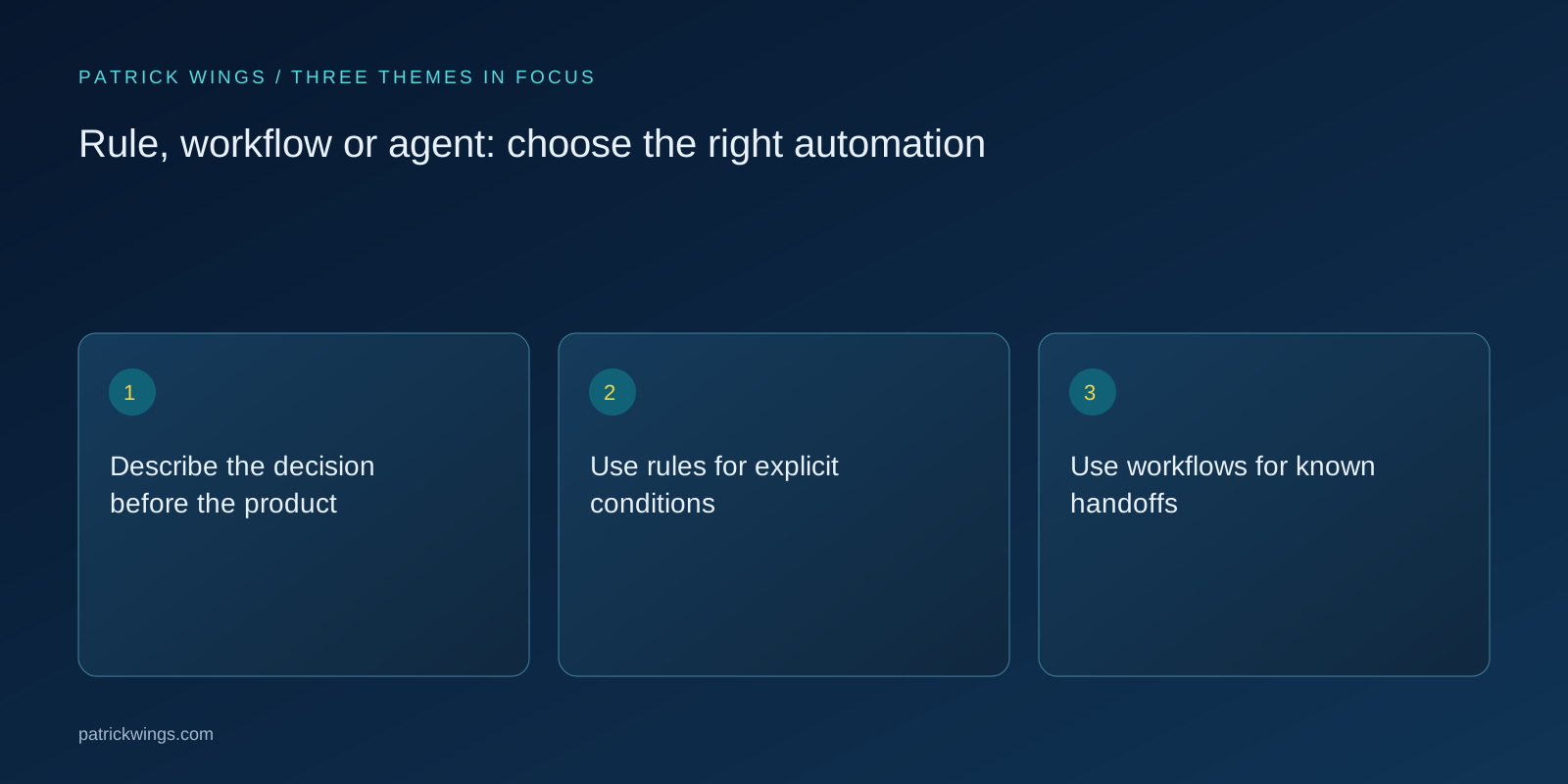
Use workflows for known handoffs
When the useful sequence is known, specify a fixed flow with entry and exit conditions. A research brief may proceed through source checking, drafting and professional review. Individual steps can use model judgment without granting freedom to plan the entire process. Define the evidence required at each transition. A failed source request should trigger a visible clarification or pause rather than silently advancing to writing. This makes unfinished work and responsibility for resolving the blockage visible. Reviewers can then inspect the relevant stage instead of reconstructing an opaque sequence afterwards. Explore this further in the guide AI agents in marketing: which tasks can be bounded usefully.
Justify each degree of agent freedom
An agent is worth investigating when search paths or tool sequences cannot be fully predicted in advance. Still bound its data domains, allowed actions, runtime and completion conditions. Permission to find another source does not imply permission to send a message afterwards. Check that the agent receives feedback from the actual environment and can substantiate its progress. Anthropic distinguishes predefined workflows from dynamically directed agents at this architectural level. That distinction provides vocabulary for your design discussion; it does not establish which option will deliver greater business value for your task.

Compare options in a fictional case
A fictional marketing team wants to process partnership enquiries. Rules check mandatory information. A workflow classifies complete enquiries, collects existing information and produces an internal draft. An unusual research question might justify a bounded agent. Sending external replies remains a separate approval step. This hypothetical example illustrates a combination of patterns rather than a measured performance improvement. If all enquiries follow the same known research path, the case for autonomous planning disappears. The team can simplify the design while preserving the useful language interpretation and evidence collection steps.
Test effort, behaviour and boundaries together
Run a simple and a more complex version against the same representative tasks. Assess accepted results, rework, elapsed time and attempted disallowed actions separately. Include missing information, conflicting sources and tool failures. A more complex architecture should demonstrate enough additional value to justify operating it. Prevent selective presentation of only successful agent runs. Record cases where rules or a better form were sufficient as well. Revisit the choice when workload, requirements or available data change, using the original acceptance conditions to distinguish an improvement from a moving target.
INTERACTIVE / FROM READING TO ACTION
Three checkpoints for your implementation
Choose a checkpoint and track your reading progress. Checks are neither saved nor sent and do not score your business.
CHECKPOINT 01
Use workflows for known handoffs
When the useful sequence is known, specify a fixed flow with entry and exit conditions.
Explore in the article ↗CHECKPOINT 02
Justify each degree of agent freedom
An agent is worth investigating when search paths or tool sequences cannot be fully predicted in advance.
Explore in the article ↗CHECKPOINT 03
Compare options in a fictional case
A fictional marketing team wants to process partnership enquiries.
Explore in the article ↗Frequently asked questions
Is every process using a language model an agent?
No. A model can operate inside a predefined sequence without dynamically directing the overall process.
Can rules and agents be combined?
Yes. Deterministic boundaries can control permitted data, actions and transitions.
When is more autonomy justified?
When variable task paths deliver demonstrable value and the extra freedom can be meaningfully bounded and tested.
How can I put “Describe the decision before the product” into practice?
Write down the task without naming software: what arrives, which decision is required and what verifiable result someone needs. A budget warning at an agreed threshold calls for a different solution from open research into buying barriers. Identify uncertainty caused by language separately from uncertainty caused by missing business rules.
What matters when working on “Use rules for explicit conditions”?
A rule is appropriate when the condition and consequence are agreed and machine-checkable. Examples include required fields, exact record identifiers and blocking an expired offer. State exceptions explicitly instead of hiding them in an expanding collection of special cases.