

THE SHORT ANSWER
Good AI routing sends tasks to an appropriate handling path and makes ambiguity visible. Define a small set of decision-relevant categories, a genuine exception path and verifiable handoffs. Sophisticated classification adds little when receiving teams do not know which work they own or how to return an incorrect assignment without creating another unresolved queue.
To connect individual AI applications with reliable marketing operations, read the pillar guide AI transformation in B2B marketing: from individual prompts to reliable operations.
Derive categories from different handling needs
Create categories where responsibility, information requirements or permitted actions actually differ. Product questions, contract questions and technical incidents may need different specialists. Ten similar subcategories add little if all reach the same inbox. Describe each receiver’s work assignment and include at least one counterexample. Review historical cases with the receiving teams. This reveals whether the categories support real work or simply reproduce organisation names as an elaborate labelling system. Also identify cases the organisation currently handles informally, because those hidden arrangements often become routing failures during automation.
Give ambiguity its own handling path
A request may contain multiple issues or fit none of the available categories. Decide whether to split it, ask for clarification or refer it to a named reviewer. Do not force a single answer when the evidence is insufficient. A model-generated confidence score is not automatically a calibrated probability. If thresholds are used, establish them against reviewed work samples and the consequences of misrouting. An uncertain internal question may warrant different treatment from a potential contract change sent to an unauthorised destination with access to sensitive information.
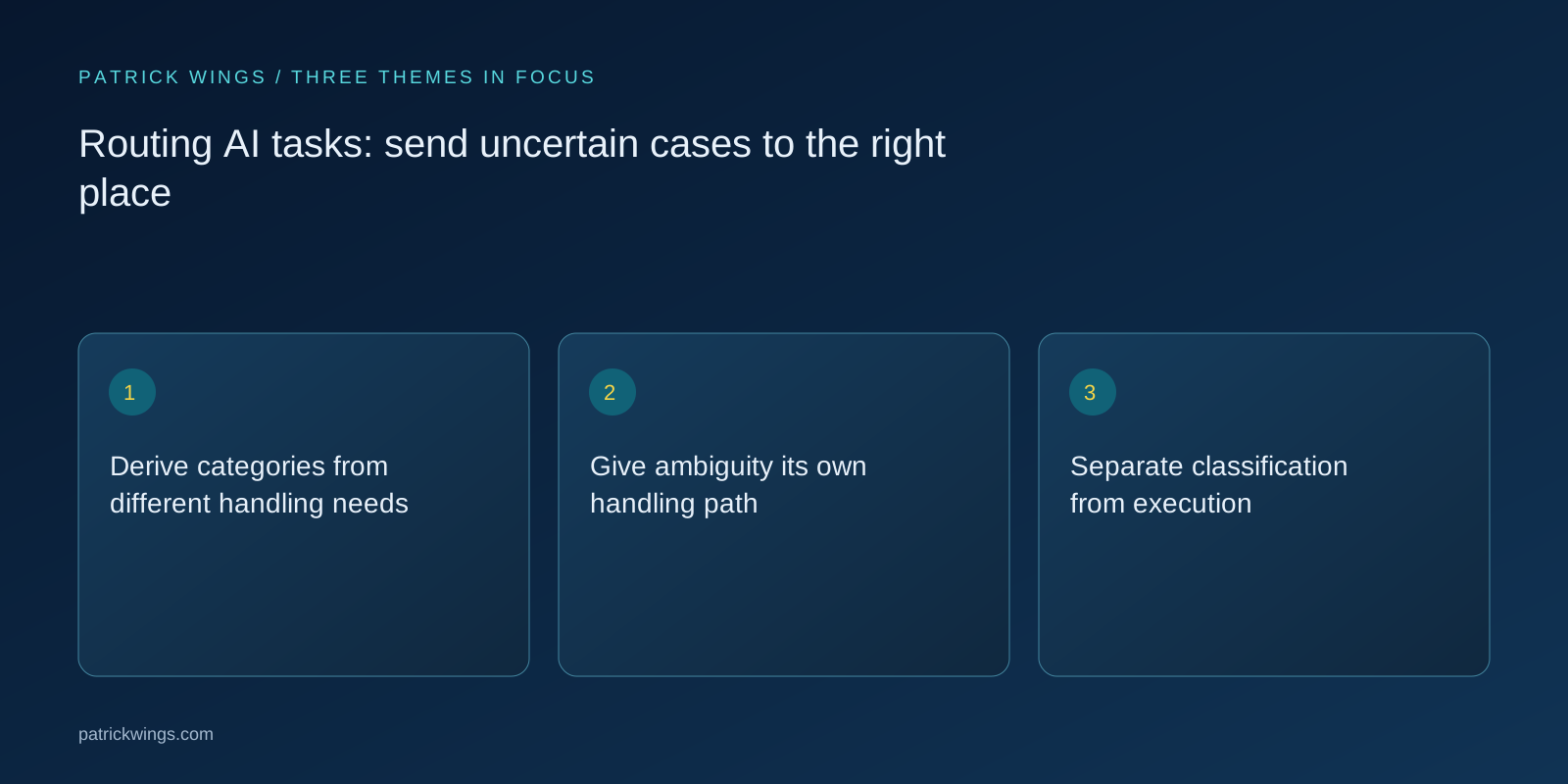
Separate classification from execution
Initially ask the router for a category, a short reference to the relevant input and the next permitted step. Execute only after validating the proposed route. Classifying a request as a simple reply must not create new sending permissions. Validate technical destination identifiers independently of the model and reject destinations outside the agreed scope. Routes involving external communication or record changes retain their own permission requirements. This keeps an incorrect classification recoverable before it causes wider consequences in another system or reaches a recipient who should not see the request.
Design the handoff for its receiver
Provide the original request, assigned category, relevant evidence and unresolved questions in a compact handoff. State the work required rather than merely attaching a label. Receivers should be able to return a misclassification with a reason. Prevent endless movement between two categories by assigning a person after an agreed limit on unsuccessful transfers. Watch waiting time per route as well. An apparently accurate router can worsen delivery if it reliably sends work into a permanently overloaded queue that nobody owns, reviews or has capacity to clear. Explore this further in the guide Recording agent state: what has actually been completed?.

Walk through a fictional mixed request
A fictional customer asks about a new integration and a contract renewal in the same message. The router identifies two concerns and creates separate internal review tasks linked to the original request. It makes no independent product roadmap commitment. If the organisation cannot support split handling, the request goes to a named coordinator. This hypothetical case reveals an architectural decision: adding multiple labels does not create shared customer ownership. The handoffs still need reconciliation before the team prepares a coordinated response and confirms what can actually be promised.
Evaluate misroutes through their consequences
Measure more than matching labels. Inspect missed urgent cases, unnecessary escalations, returned assignments and time until the correct owner receives the work. Build a small confusion table showing which categories are mistaken for each other. Add new products, unusual wording and incomplete context to the test set. When one category repeatedly fails, inspect its definition before selecting a larger model. A useful acceptance test checks that difficult cases reach their intended exception path and that no disallowed follow-on action is triggered simply because the router produced a confident classification. Explore this further in the guide Lead routing: assign every suitable enquiry an owner.
INTERACTIVE / FROM READING TO ACTION
Three checkpoints for your implementation
Choose a checkpoint and track your reading progress. Checks are neither saved nor sent and do not score your business.
CHECKPOINT 01
Separate classification from execution
Initially ask the router for a category, a short reference to the relevant input and the next permitted step.
Explore in the article ↗CHECKPOINT 02
Design the handoff for its receiver
Provide the original request, assigned category, relevant evidence and unresolved questions in a compact handoff.
Explore in the article ↗CHECKPOINT 03
Walk through a fictional mixed request
A fictional customer asks about a new integration and a contract renewal in the same message.
Explore in the article ↗Frequently asked questions
How many routing categories do we need?
Enough to reflect different handling paths. Start with a small number of clearly distinguishable categories.
Is high confidence sufficient?
No. Compare confidence values with actual classification correctness on labelled cases.
What happens with multiple concerns?
Explicitly define split handling or a coordinator; randomly selecting one category is insufficient.
How can I put “Derive categories from different handling needs” into practice?
Create categories where responsibility, information requirements or permitted actions actually differ. Product questions, contract questions and technical incidents may need different specialists. Ten similar subcategories add little if all reach the same inbox.
What matters when working on “Give ambiguity its own handling path”?
A request may contain multiple issues or fit none of the available categories. Decide whether to split it, ask for clarification or refer it to a named reviewer. Do not force a single answer when the evidence is insufficient.