
THE SHORT ANSWER
A paid media country test examines more than cheap clicks in a new region. It should show whether suitable companies respond to a clear offer and whether your team can serve that demand. Assess market response and sales readiness together before treating a low CPL as an expansion decision.
For the broader picture of how target customers, channels and sales handoffs work together, read the pillar guide B2B demand generation: from attention to qualified pipeline.
State a specific country hypothesis
Describe the target company, task and offer for each country. Research familiar local alternatives and the evidence buyers expect. Existing English copy does not guarantee a clear proposition in every market. Decide whether the test should justify further research, a larger acquisition trial or a provisional stop. Separate that question from the full market-entry decision. A small advertising test can provide demand clues, but it cannot establish every contractual requirement, delivery arrangement or long-term retention condition. Put those unresolved prerequisites explicitly into the plan. This prevents a useful but limited experiment from being presented as approval for an entire international expansion programme.
Check offer and sales readiness before launch
Clarify language, accessible working hours, appropriate contacts and supported use cases. Review price presentation, contracting and available implementation support with responsible specialists. A function should not be promised merely because it is common in your home market. Apply the same qualification framework across countries and document local adaptations. If one country receives a short consultation and another a substantial technical demo, you are comparing different offers. That may be a deliberate and sensible choice, but it must remain visible. The country landing page should explain the next step that can actually be delivered locally or remotely rather than implying a local service operation that does not exist. Explore this further in the guide Connect marketing and sales across borders.
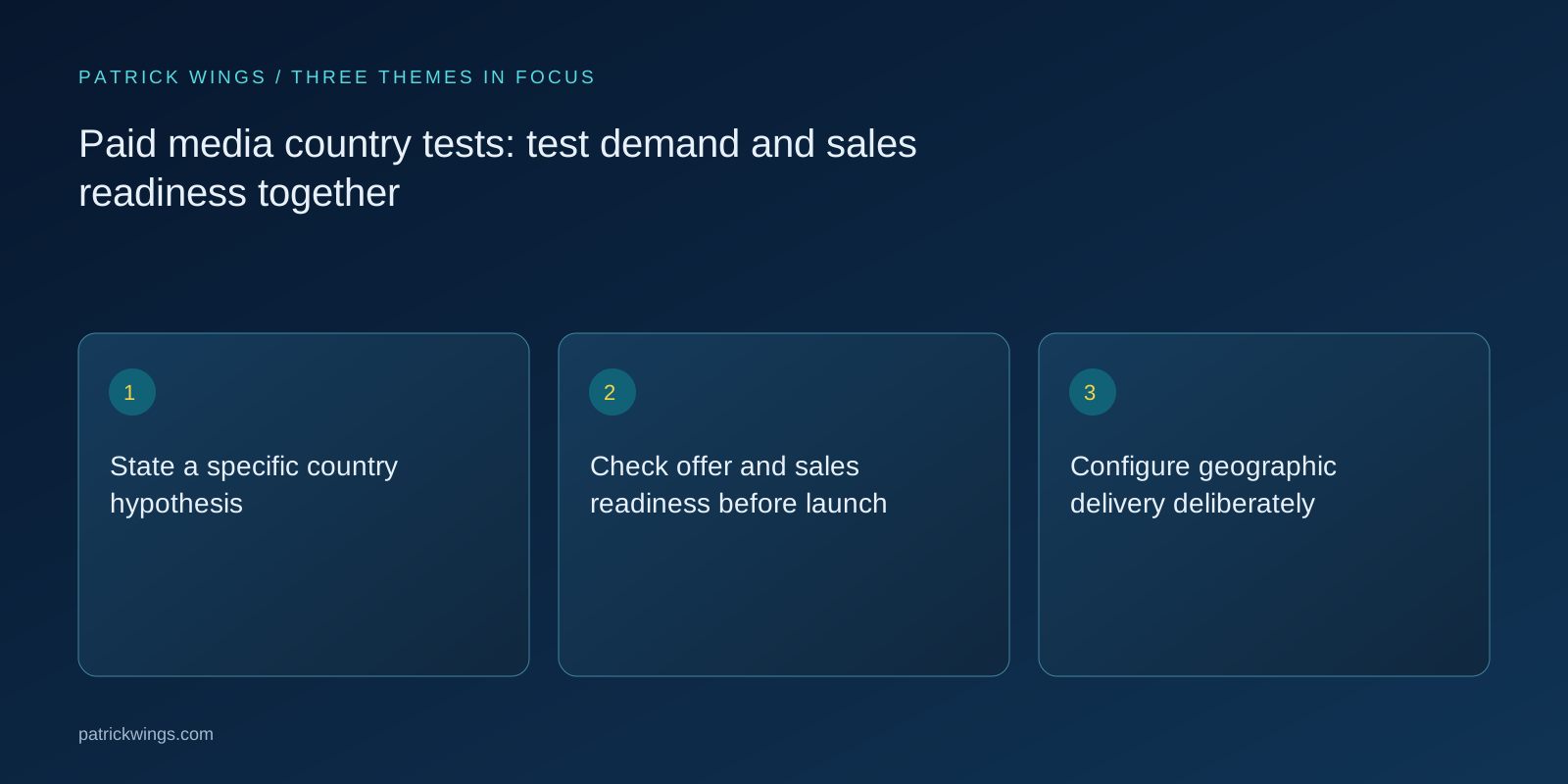
Configure geographic delivery deliberately
Inspect current location options in the advertising system. Depending on configuration, Google distinguishes presence in an area from interest in it; geographic signals do not perfectly identify a company’s registered or operating location. Its official documentation describes this limitation. Choose settings that fit the test question and inspect geographic reports. Separately collect the relevant business territory confirmed by the enquirer. A travelling contact or international procurement function can sit outside the intended region. Advertising report location, contact location and solution deployment location may therefore differ. Keep them as separate fields rather than automatically standardising them into apparently exact market information that the observed evidence cannot support.
Compare a hypothetical country pair fairly
An invented IT supplier tests a comparable offer in two countries. The first produces twelve enquiries and the second seven. Joint qualification identifies four and five respectively as suitable for the supported use case. Several first-market cases also wait for language expertise that is unavailable. Enquiry counts alone do not establish a sensible spending priority. These invented figures are too small for a general market forecast. They illustrate the next questions: does messaging differ, is the offer locally understandable and can the team reliably move suitable enquiries into a specialist review? A media result without that operational context is an incomplete basis for deciding where to expand.

Check comparability and evidence maturity
Report effort, delivery time, suitable enquiries and subsequent handling for each country. Matching calendar windows does not ensure comparable observation when campaigns ramp up differently or qualification takes different lengths of time. Review search terms and actual questions for local differences in meaning. Transparently remove applications, support requests and requirements you cannot serve. A low CPL may reflect misunderstanding of the offer. Conversely, a few suitable enquiries may be more useful than broad irrelevant reach. State remaining uncertainty rather than converting small counts into precise national demand or close-rate forecasts that the test cannot support. Preserve enough context for the next reviewer to understand why the countries differed.
Bound the expansion decision
Finish with a concrete next investigation: better localisation, additional specialist coverage, different target-company selection or a larger bounded test. State which finding applies to which offer and what remains unresolved. Marketing owns delivery and understandable messaging; sales confirms serviceability and conversation context. Before increasing spend, the most important observed obstacle must be addressable. Declaring an entire country unsuitable is as premature as broad expansion based on a few cheap leads. A sound country test reduces one named uncertainty and deliberately limits the reach of its conclusion. That clarity makes the next investment decision more defensible than a country ranking built from submission costs alone. Explore this further in the guide B2B paid media budgets: plan learning costs and sales capacity.
INTERACTIVE / FROM READING TO ACTION
Three checkpoints for your implementation
Choose a checkpoint and track your reading progress. Checks are neither saved nor sent and do not score your business.
CHECKPOINT 01
Configure geographic delivery deliberately
Inspect current location options in the advertising system.
Explore in the article ↗CHECKPOINT 02
Compare a hypothetical country pair fairly
An invented IT supplier tests a comparable offer in two countries.
Explore in the article ↗CHECKPOINT 03
Check comparability and evidence maturity
Report effort, delivery time, suitable enquiries and subsequent handling for each country.
Explore in the article ↗Frequently asked questions
Does a low CPL justify a new market?
No. Check suitability, serviceability, local offer clarity and subsequent conversation quality.
Does ad location establish company location?
Not reliably. Geographic signals, contact location and deployment location can differ.
Must every country receive the same landing page?
A comparable task matters. Necessary localisation should be explicitly documented.
How can I put “State a specific country hypothesis” into practice?
Describe the target company, task and offer for each country. Research familiar local alternatives and the evidence buyers expect. Existing English copy does not guarantee a clear proposition in every market.
What matters when working on “Check offer and sales readiness before launch”?
Clarify language, accessible working hours, appropriate contacts and supported use cases. Review price presentation, contracting and available implementation support with responsible specialists. A function should not be promised merely because it is common in your home market.