
THE SHORT ANSWER
Pricing changes for existing SaaS customers require their own change process. Customers need to understand what happens to service scope, invoices and available choices. Plan contract review, affected groups, clear communication and technical implementation together. A new pricing page is insufficient when existing agreements and established usage patterns also need to be considered.
To connect this decision with positioning, market entry and growth, read the pillar guide Go-to-market for B2B SaaS: turn market insight into an executable growth strategy.
Describe the reason and actual change
Record the problem the new model should solve: an unsuitable charging unit, inconsistent historical packages or changed service scope. Describe the change without euphemisms. A higher price remains a financial change even when features are added. Separate the supplier’s economic rationale from value an individual customer actually receives. This prevents contradictory messages. Communication should ultimately explain what applies, when it applies and which decisions the customer needs to make. Additional marketing terminology cannot substitute for a clear reason or an accurate account of the financial consequences.
Map agreements and usage
Inventory current agreements, renewal dates, individual commitments and actual usage. Have the appropriate specialists review amendment, cancellation and notification conditions; this article is not a contract assessment. Group customers by impact rather than revenue alone. One may face little financial change but lose an important capability. Another may need additional preparation because of internal budget cycles. Keep unresolved cases visible. Only a traceable view of the starting position allows you to decide whether a shared transition or different routes are appropriate. Avoid assuming the standard terms describe every historical customer relationship.
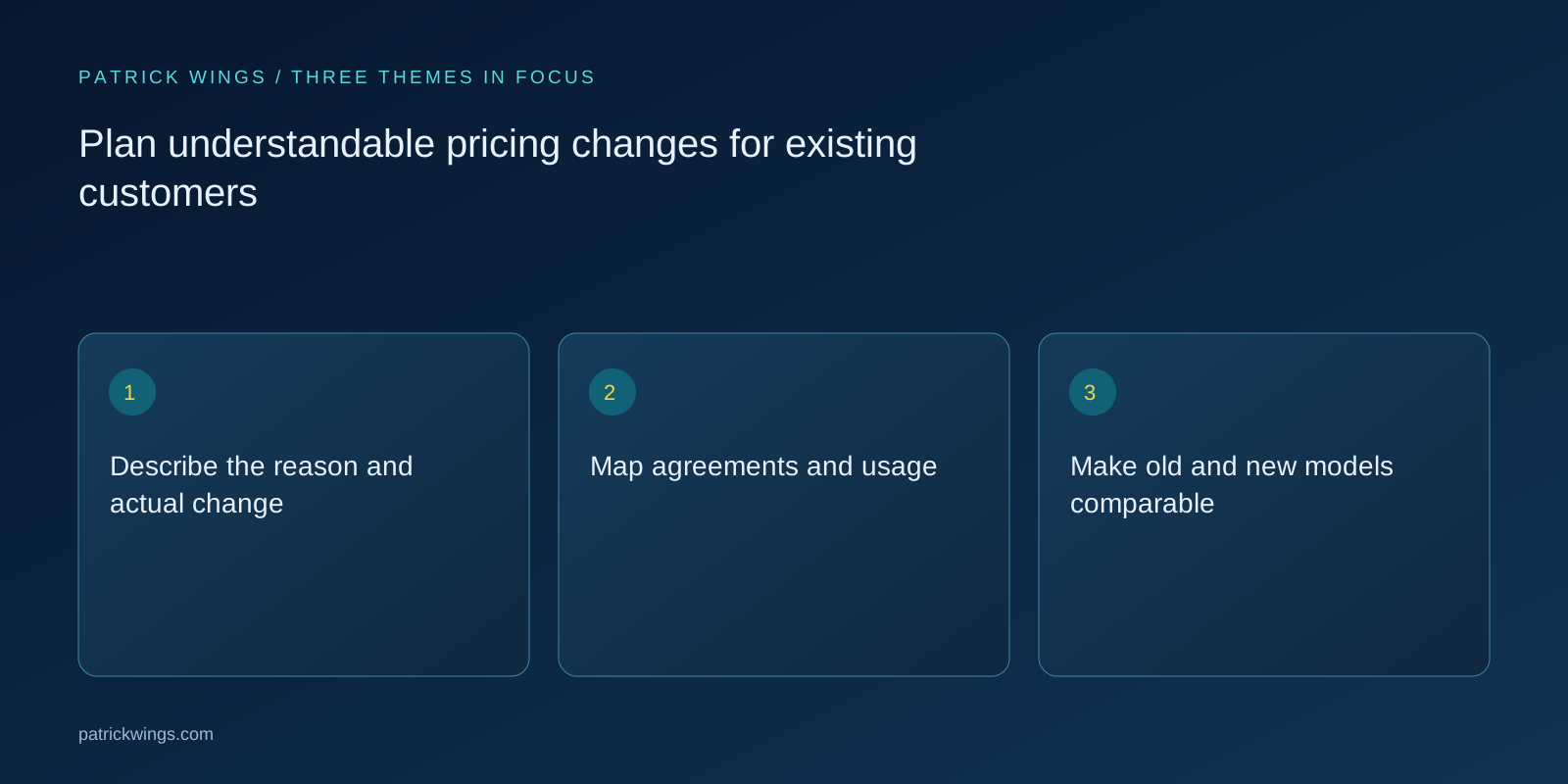
Make old and new models comparable
Use transparent usage scenarios to examine changes in invoices and entitlements. Identify variable assumptions and avoid precise-looking forecasts for highly fluctuating usage. Explain package changes, alternatives and treatment of existing data. Billing platforms can support scheduled phases and price changes; Stripe documents Subscription Schedules, for example. That functionality does not establish contractual rights or replace customer communication. Finance and product should verify that the planned technical state matches the communicated agreement. Include discounts and individual exceptions in the comparison rather than leaving them for support to discover later. Explore this further in the guide SaaS pricing strategy: connect packaging, billing and customer value.
Hypothetical example: historical seat pricing
A fictional supplier plans to move from seats to locations. Some customers would pay more while others would see similar costs. Simulations using documented account data reveal a customer that consolidates locations seasonally. The team clarifies the definition of an active location and an appropriate change rule before announcing dates. Special contractual situations receive separate transition routes. This example predicts neither acceptance nor revenue impact. It shows why actual usage and existing commitments should be investigated before treating a model change as a simple update to the billing system. Explore this further in the guide Find a suitable SaaS value metric.

Prepare communication and support
Write an understandable explanation with individual context where effects differ. Show previous and future conditions, timing and an accessible contact. Prepare support and sales for common questions, including difficult cases. Conversations should not generate improvised promises that make the model inconsistent again. Assign authority for exceptions and complaints. Test the explanation against realistic customer questions without presuming approval. Transparency means recipients can understand their options, not simply that the wording sounds positive. Ensure colleagues can locate the agreement relevant to a question and explain how unresolved cases will be handled.
Monitor the transition deliberately
Verify technical behaviour before activation, then inspect invoices, entitlements and feedback. Distinguish misunderstanding, actual error and reasoned rejection; each requires a different response. Document corrections and whether general rules need changing. Do not judge migration only through immediate revenue. Lost trust, extra support and unsuitable package assignments may also matter. A responsible transition ends when agreed conditions operate reliably and open exceptions have traceable ownership. Otherwise the company has merely transferred the complexity from a pricing project to the customers and the teams who must resolve their questions afterwards.
INTERACTIVE / FROM READING TO ACTION
Three checkpoints for your implementation
Choose a checkpoint and track your reading progress. Checks are neither saved nor sent and do not score your business.
CHECKPOINT 01
Make old and new models comparable
Use transparent usage scenarios to examine changes in invoices and entitlements.
Explore in the article ↗CHECKPOINT 02
Hypothetical example: historical seat pricing
A fictional supplier plans to move from seats to locations.
Explore in the article ↗CHECKPOINT 03
Prepare communication and support
Write an understandable explanation with individual context where effects differ.
Explore in the article ↗Frequently asked questions
Can everyone move at once?
Only when agreements, notification conditions and impacts allow it. Examine different starting situations.
Is a generic email enough?
Different impacts often require an understandable individual explanation or comparison.
What if an invoice is wrong?
Correct the case and investigate whether the same cause affects other customers.
How can I put “Describe the reason and actual change” into practice?
Record the problem the new model should solve: an unsuitable charging unit, inconsistent historical packages or changed service scope. Describe the change without euphemisms. A higher price remains a financial change even when features are added.
What matters when working on “Map agreements and usage”?
Inventory current agreements, renewal dates, individual commitments and actual usage. Have the appropriate specialists review amendment, cancellation and notification conditions; this article is not a contract assessment. Group customers by impact rather than revenue alone.