
THE SHORT ANSWER
SaaS packages should represent recognisable usage situations and make selection understandable. They are more than three columns containing progressively more features. Connect customer tasks, necessary capabilities, service scope and explicit boundaries. A useful package helps buyers understand what they need now, when changing would make sense and which commitments accompany that choice throughout the relationship.
To connect this decision with positioning, market entry and growth, read the pillar guide Go-to-market for B2B SaaS: turn market insight into an executable growth strategy.
Start with different usage situations
Investigate which tasks and operating conditions genuinely vary within your audience. A small team may have demanding security needs; a large organisation may initially pursue a simple use case. Company size alone therefore does not establish meaningful boundaries. Describe typical situations through required capabilities and responsible roles. Add what you can deliver as a standard service and what creates extra work. The distinction should explain a real choice rather than artificially push as many buyers as possible into the highest package. Check these situations against specific conversations and actual experiences of using the product. Explore this further in the guide SaaS pricing strategy: connect packaging, billing and customer value.
Distinguish essential scope from extension
Identify the capabilities required to fulfil the basic promise reliably. Do not distribute them so an entry package appears attractive but cannot meaningfully complete the promised task. Additional packages can cover different tasks, further control or broader service. Document the practical reason for every boundary. Different product and pricing models are technically available, as Stripe illustrates, but strategic scope remains your decision. Evaluate it from the customer perspective and against the effort additional scope creates. A package is clearer when its reason can be explained through work rather than the supplier’s desire to differentiate columns. Explore this further in the guide Find a suitable SaaS value metric.
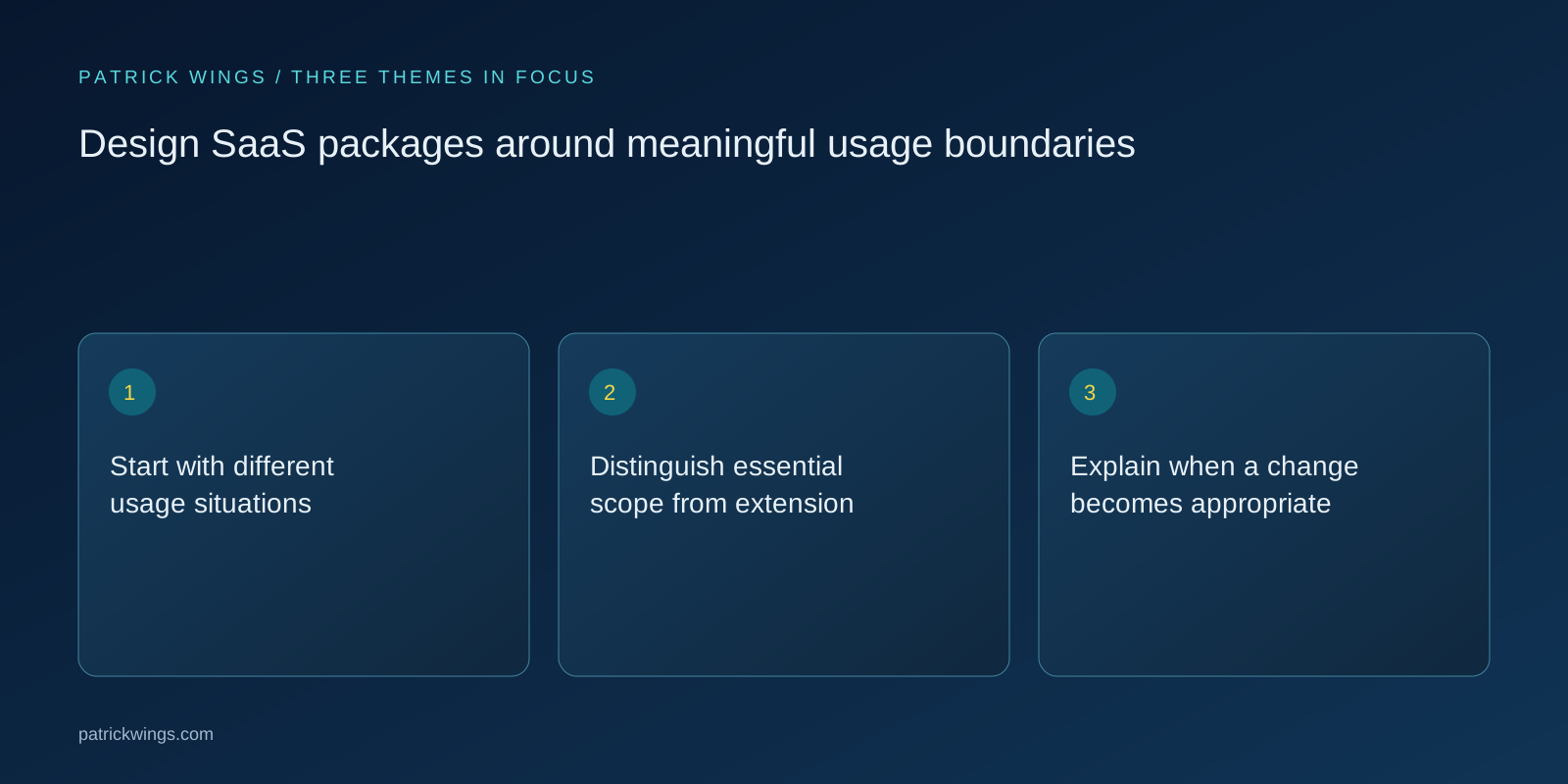
Explain when a change becomes appropriate
Describe how a customer outgrows a package. The reason might be a new task, more usage or a different operating requirement. Avoid hidden limits that appear only after successful adoption. Explain what happens when demand declines and which data or capabilities a change would affect. An understandable structure need not put every imaginable exception on the pricing page, but important conditions should be discoverable before purchase. Test whether buyers can choose a package for a concrete situation and explain their reasoning. Correct choices matter more than whether people say that the table looks straightforward at first glance.
Hypothetical example: external participation
A fictional supplier designs an entry package for internal approvals and an expanded package for external project participants. It initially wants to charge for every external guest. Interviews reveal that guest participation is irregular, making planning difficult. The team therefore investigates a clear boundary around supported approval workflows and an understandable guest policy. It also checks security and support consequences. The example offers no universally correct package structure. It shows how an additional usage situation can create a reasoned boundary that must subsequently be tested for clarity, incentives and feasibility before being treated as a finished commercial model.

Handle exceptions deliberately
Record deviations requested during negotiations and look for their shared context. Individual exceptions do not automatically represent a new segment. Recurring requirements may indicate a situation the packages do not cover. Define who can authorise special commitments and how they are recorded in operations, contracts and support. A tailored arrangement can be commercially sensible when its effort is understood. It becomes problematic when each conversation creates unofficial entitlements unknown to product and customer success. Package clarity therefore requires internal rules and dependable handovers as well as a polished pricing page. Otherwise the published structure soon stops describing the actual service.
Assess selection quality rather than package share
Monitor whether buyers choose appropriate packages, expectations are met and conflicts emerge during changes. A large share of expensive packages does not by itself demonstrate a good structure. Essential capabilities may be missing from entry scope, or sales may promise additional services. Connect findings from proposals, usage and support. Change boundaries for a documented reason, with a separate plan for existing customers. Useful packages simplify decisions and keep delivery economically manageable. They should become neither an incomprehensible feature puzzle nor a collection of historical exceptions that nobody can fully explain or consistently support.
INTERACTIVE / FROM READING TO ACTION
Three checkpoints for your implementation
Choose a checkpoint and track your reading progress. Checks are neither saved nor sent and do not score your business.
CHECKPOINT 01
Explain when a change becomes appropriate
Describe how a customer outgrows a package.
Explore in the article ↗CHECKPOINT 02
Hypothetical example: external participation
A fictional supplier designs an entry package for internal approvals and an expanded package for external project participants.
Explore in the article ↗CHECKPOINT 03
Handle exceptions deliberately
Record deviations requested during negotiations and look for their shared context.
Explore in the article ↗Frequently asked questions
Do we need three packages?
No. The number should follow distinct usage situations rather than a fixed presentation rule.
Should every feature support an upsell?
No. Capabilities required to fulfil the basic promise need consistent treatment.
When does a custom package make sense?
When there is a real situation and its scope, effort and ownership remain clear.
How can I put “Start with different usage situations” into practice?
Investigate which tasks and operating conditions genuinely vary within your audience. A small team may have demanding security needs; a large organisation may initially pursue a simple use case. Company size alone therefore does not establish meaningful boundaries.
What matters when working on “Distinguish essential scope from extension”?
Identify the capabilities required to fulfil the basic promise reliably. Do not distribute them so an entry package appears attractive but cannot meaningfully complete the promised task. Additional packages can cover different tasks, further control or broader service.