
THE SHORT ANSWER
A useful SEO and AI report identifies the decision that needs attention now. Metrics alone cannot do that. Connect each material finding with context, uncertainty and a next action. The structure below describes a practical review pack. It assumes sound measurement definitions rather than combining answer visibility, website visits and sales opportunities into one apparently comprehensive success number.
For the broader picture of technical foundations, useful content and visibility measurement, read the pillar guide SEO, GEO and AEO for SaaS: visibility that supports buying decisions.
Define the decision before the charts
Identify the audience and decision scope. Executives allocating resources need something different from technical editors correcting a particular failure. State the questions at hand, such as whether to deepen a topic, resolve an access conflict or review a weak service page. Decide which information is necessary and which belongs in background material. The report need not display every available metric, but it should not conceal important counterevidence. Start with the proposed decision and its rationale, marking where further investigation is needed. This creates a working document rather than a collection of selectively favourable dashboard screenshots.
Use a compact finding card
Each prioritised card contains the question, observation, period, comparison, source, uncertainty and next action. Include affected page or question identifiers so that someone can locate the evidence again. Separate observed facts from interpretation. A technical failure may be directly demonstrable while its commercial consequence remains uncertain; describe both layers. When a number looks surprising, first inspect filters, measurement scope and classification changes. A valid finding may also state that current evidence does not support a decision. Specify the additional check that could reduce uncertainty and identify who will carry it out rather than filling the gap with a confident narrative. Explore this further in the guide Interpreting AI referrals in analytics and CRM.
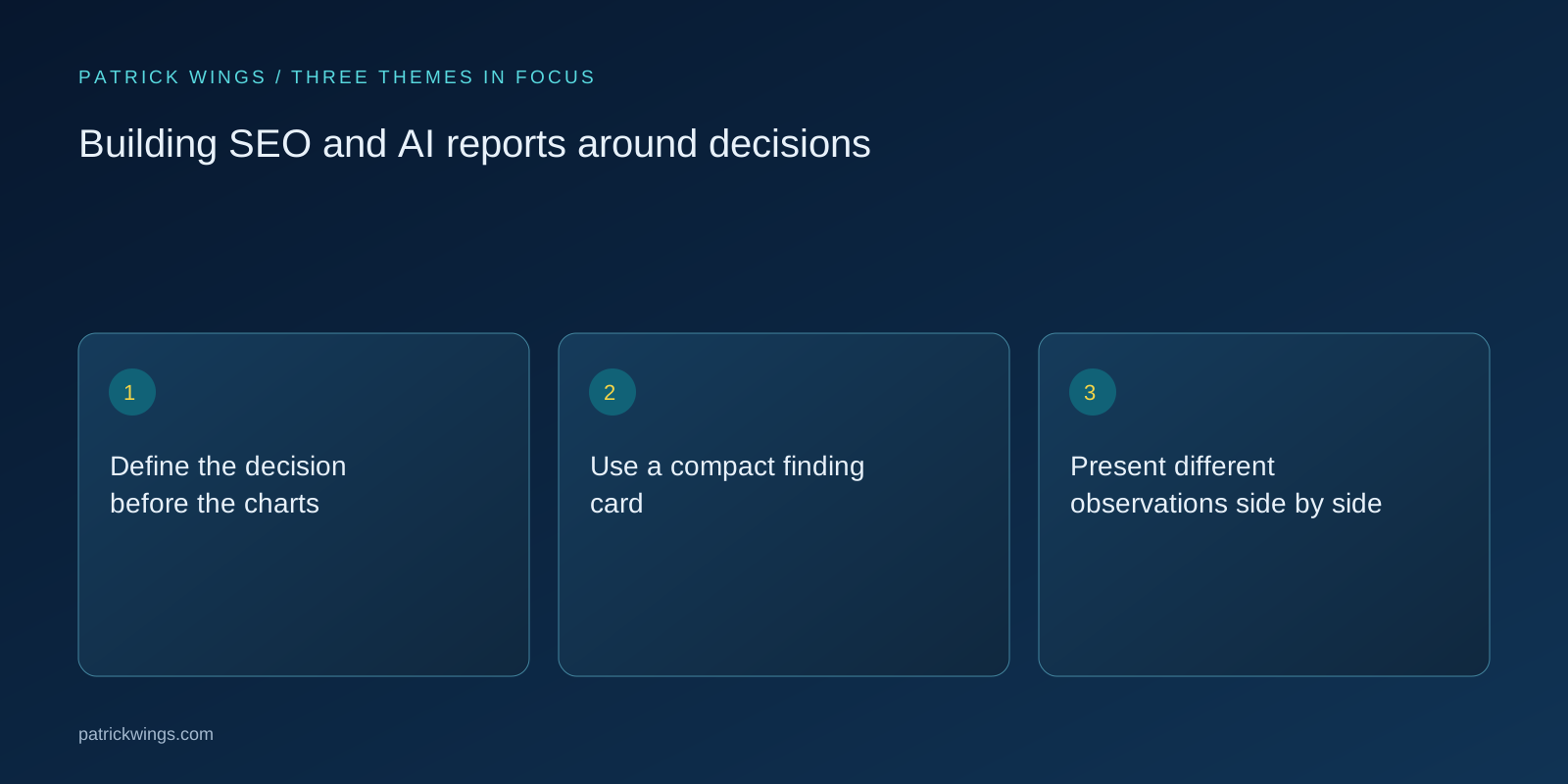
Present different observations side by side
Show technical access, search performance, question-panel findings and business signals as separate perspectives. Search Console describes its own search data; analytics observes website behaviour under collection conditions. A question panel samples selected AI responses, while CRM records reflect the known sales process. These sources can complement one another without representing identical samples. Mark different periods and definitions. One total score may conceal important contrasts, such as more citations alongside inaccurate service attribution. The decision may then prioritise factual accuracy over a higher combined number. Explain which relationships between datasets are actually observed and which remain assumptions requiring further investigation. Explore this further in the guide Measuring GEO and AEO: what AI visibility tells you about your business.
Example of a completed review pack
A hypothetical monthly review contains three cards. First, a demonstrated access challenge affecting important guides is assigned to the technical owner. Second, the question panel reveals an inaccurate service attribution; editors inspect the public explanation and preserve the external finding. Third, a small number of observed AI visits is insufficient to assess opportunity quality. The team gathers further appropriate evidence without claiming a revenue lever. Every card names an owner and next review date. This example shows concrete decisions with different evidence strengths. It does not report measured outcomes for this website or introduce invented growth figures and success rates.

Set justified investigation triggers
Define what observation should trigger investigation. This may be a confirmed access failure on an important destination or a recurring false product claim. For fluctuating volumes, use suitable comparison periods and data-quality checks rather than a universal percentage threshold. A trigger should fit the decision and the consequence of a false alarm. Record who may change it and why. Do not modify the website in response to every unfavourable AI run. Repetition and substantive significance support interpretation. Reporting should direct attention without turning normal variation into a permanent optimisation programme justified by unsupported promises of impact or arbitrary alert numbers.
Follow decisions through to an outcome
Begin the next review with unresolved decisions from the previous report. Check whether agreed actions were implemented and which outcomes are genuinely observable. A completed task and a demonstrated commercial effect remain different things. Preserve decisions against additional work when evidence or usefulness does not justify it. Keep measurement definitions and version changes in an accessible appendix so that readers do not repeat the same foundational discussion every time. The report becomes an inspectable sequence of observation, decision and review. Its value is appropriate prioritisation rather than the largest possible metric collection or an uninterrupted positive growth narrative.
INTERACTIVE / FROM READING TO ACTION
Three checkpoints for your implementation
Choose a checkpoint and track your reading progress. Checks are neither saved nor sent and do not score your business.
CHECKPOINT 01
Present different observations side by side
Show technical access, search performance, question-panel findings and business signals as separate perspectives.
Explore in the article ↗CHECKPOINT 02
Example of a completed review pack
A hypothetical monthly review contains three cards.
Explore in the article ↗CHECKPOINT 03
Set justified investigation triggers
Define what observation should trigger investigation.
Explore in the article ↗Frequently asked questions
How many metrics belong in the report?
As many as the decisions require; definitions and actions matter more than a fixed count.
Should SEO and AI share one total score?
A joint review pack can help, but different measures should remain distinguishable.
What is useful with small samples?
Report concrete observations and uncertainty, then define the next appropriate check.
How can I put “Define the decision before the charts” into practice?
Identify the audience and decision scope. Executives allocating resources need something different from technical editors correcting a particular failure. State the questions at hand, such as whether to deepen a topic, resolve an access conflict or review a weak service page.
What matters when working on “Use a compact finding card”?
Each prioritised card contains the question, observation, period, comparison, source, uncertainty and next action. Include affected page or question identifiers so that someone can locate the evidence again. Separate observed facts from interpretation.