
THE SHORT ANSWER
A visibility change following a GEO intervention does not prove that the intervention caused it. Platforms, competitors and demand may change simultaneously. A cautious test therefore bounds the hypothesis and intervention, records comparison opportunities and names uncertainty. Its purpose is a better decision about further work rather than a retrospective success story for every copy revision.
For the broader picture of technical foundations, useful content and visibility measurement, read the pillar guide SEO, GEO and AEO for SaaS: visibility that supports buying decisions.
Formulate a checkable hypothesis
Describe one specific change and the observable result expected. For example, selected pages may receive a clearer explanation of a missing technical prerequisite. A hypothesis could examine whether a defined question panel subsequently reproduces that prerequisite more accurately. This is more precise than seeking to improve AI visibility in general. State which observation would count against the idea. Separate user value from test value as well: a necessary factual correction should be made even when it offers no measurable visibility effect. Not every editorial improvement needs a controlled experiment to be justified on its substantive merits. Explore this further in the guide Testing AI visibility with reproducible question panels.
Bound the intervention and comparison in advance
Choose suitable pages or question groups and document why they appear comparable. Avoid changing structure, topic, delivery and linking simultaneously when trying to assess their individual contributions. A comparison without random assignment remains vulnerable to group differences; state that limitation. NIST’s experimental-design material provides a foundation for planned experimentation, but applying it to external AI search needs additional caution. The team does not control those systems’ models or source selection. Another page group is therefore not a perfect substitute for the unobserved outcome that would have occurred without the change. Preserve that distinction in the test design.
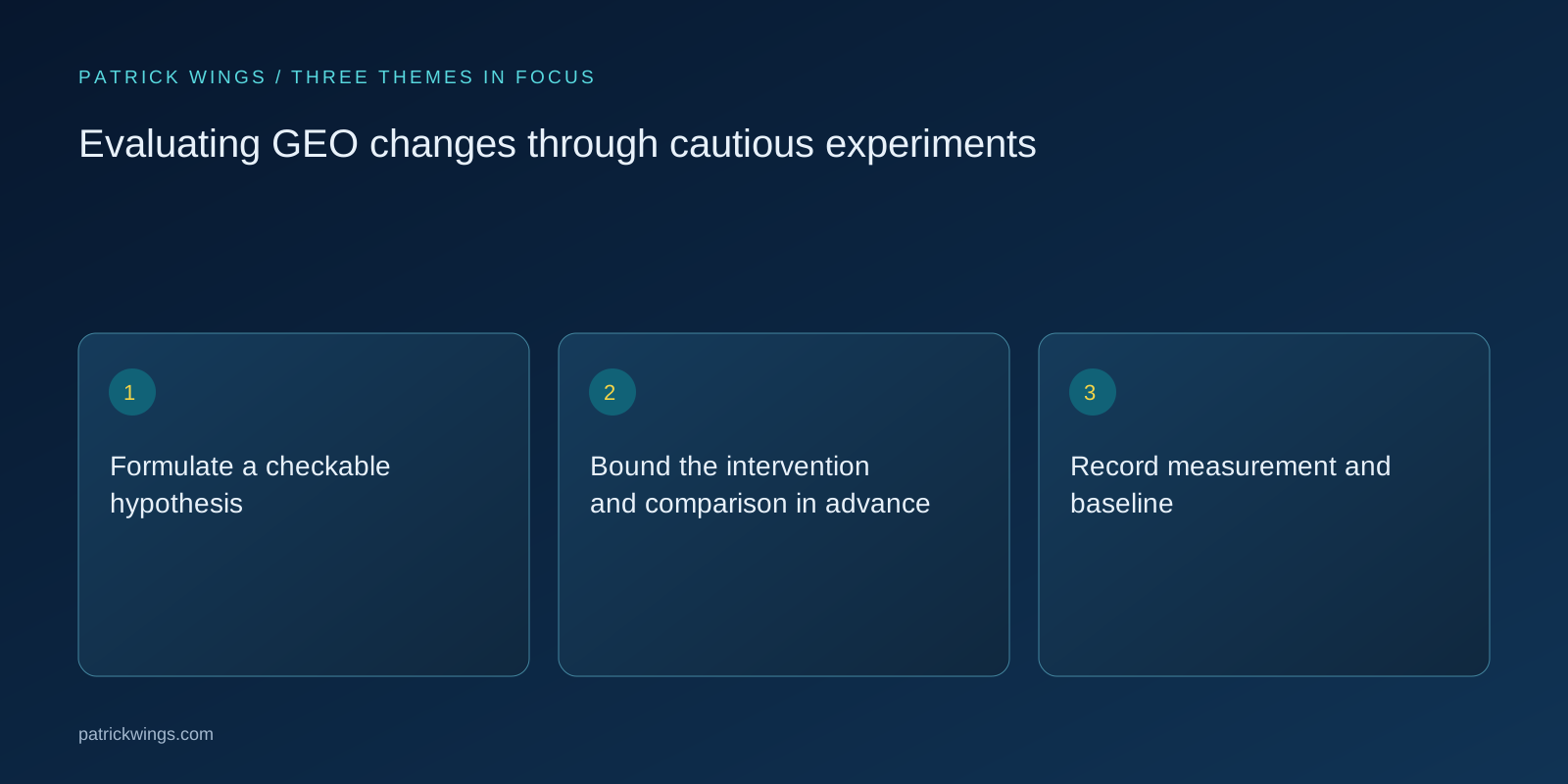
Record measurement and baseline
Preserve the affected content and appropriate baseline observations before implementation. Use the same questions, languages, platform modes and coding criteria at the planned measurement points. Decide how to record technical failures, missing answers and source changes. Website visits and CRM outcomes are separate observations rather than interchangeable substitutes for citation measurement. Assess whether enough relevant information is likely to support a decision at all. With very small samples, a qualitative case record may be more honest than a percentage change carrying apparent numerical precision. A documented baseline at least prevents memory from determining the eventual interpretation of what changed. Explore this further in the guide Auditing AI citations for source and claim accuracy.
Maintain a record of confounding changes
Record platform updates, competitor publications, campaigns and owned technical changes where known. A complete register of external factors is impossible, but visible events should not be ignored. Check that revised destinations are actually reachable and that observed answers reference the intended source. Processing delays may make a short observation period ambiguous. Do not extend the test indefinitely until a preferred result appears. Instead define a sensible review window and a response to inconclusive findings in advance. This reduces dependence on a conclusion the team already wants to reach while retaining an honest account of uncontrolled conditions.

Example: a clearer prerequisite notice
A hypothetical IT team adds a missing version qualification to selected guides. A documented panel checks whether relevant answers identify the correct version before and after the change. During observation, one provider changes its search mode. The team can describe the findings but cannot separate the influences cleanly. It retains the useful factual qualification and labels the visibility effect unresolved. That is not a failed report; it is a reasonable outcome from limited observation. The example supplies no invented success rate and does not support a general claim that version notices increase the frequency of AI citations.
Decide with appropriate confidence
Compare findings with the original hypothesis and alternative explanations. Separate clear substantive usefulness from uncertain visibility observations. A cautious decision may retain the change, investigate further or decline to roll it out. Record undesirable effects such as reduced clarity as well. Avoid deriving a universal GEO rule from one bounded test. Repetition and different contexts may change the assessment later. The closing account should explain what was observed, what plausibly follows and what remains unproven. Experimentation then supports editorial learning without portraying external AI search as a completely controllable acquisition channel or treating every correlation as a validated optimisation technique.
INTERACTIVE / FROM READING TO ACTION
Three checkpoints for your implementation
Choose a checkpoint and track your reading progress. Checks are neither saved nor sent and do not score your business.
CHECKPOINT 01
Record measurement and baseline
Preserve the affected content and appropriate baseline observations before implementation.
Explore in the article ↗CHECKPOINT 02
Maintain a record of confounding changes
Record platform updates, competitor publications, campaigns and owned technical changes where known.
Explore in the article ↗CHECKPOINT 03
Example: a clearer prerequisite notice
A hypothetical IT team adds a missing version qualification to selected guides.
Explore in the article ↗Frequently asked questions
Does a before-and-after comparison prove impact?
No. Concurrent changes may explain the observed difference.
What if the result is inconclusive?
State the uncertainty and decide using user value, effort and appropriate further investigation.
Does every correction need an experiment?
No. Necessary factual corrections do not depend on a promised visibility effect.
How can I put “Formulate a checkable hypothesis” into practice?
Describe one specific change and the observable result expected. For example, selected pages may receive a clearer explanation of a missing technical prerequisite. A hypothesis could examine whether a defined question panel subsequently reproduces that prerequisite more accurately.
What matters when working on “Bound the intervention and comparison in advance”?
Choose suitable pages or question groups and document why they appear comparable. Avoid changing structure, topic, delivery and linking simultaneously when trying to assess their individual contributions. A comparison without random assignment remains vulnerable to group differences; state that limitation.