
THE SHORT ANSWER
An input contract specifies what an AI process needs, how information is checked and when clarification is required. Treat missing information as an explicit state. A well-written prompt cannot replace clear field definitions, versioning and permitted sources. A small, testable contract helps prevent plausible assumptions from quietly becoming the basis for work and subsequent decisions.
To connect individual AI applications with reliable marketing operations, read the pillar guide AI transformation in B2B marketing: from individual prompts to reliable operations.
Define fields through the decision they support
Start with the required result and work backwards. A campaign brief may require the audience, approved offer, market and intended action. Define each field by meaning, format and permitted provenance. A free-text field called goal is often ambiguous: does it mean reach, qualified conversations or a delivery date? Include a valid and an invalid example. Avoid collecting fields simply because they were present in an earlier form. Every additional context item creates review work and can introduce outdated information into an otherwise well-defined request. Explore this further in the guide Routing AI tasks: send uncertain cases to the right place.
Distinguish missing, unknown and inapplicable
An empty string does not explain why information is absent. Define separate states for not supplied, genuinely unknown and unnecessary for this case. Specify whether the workflow pauses, proceeds with an explicit limitation or asks a focused question. Defaults are appropriate only when professionally agreed and visible. A missing market should not silently become the company’s home market. Otherwise the system creates a technically complete record containing an unsupported business assumption. That error may be harder to notice later because downstream users assume required fields have already been verified.
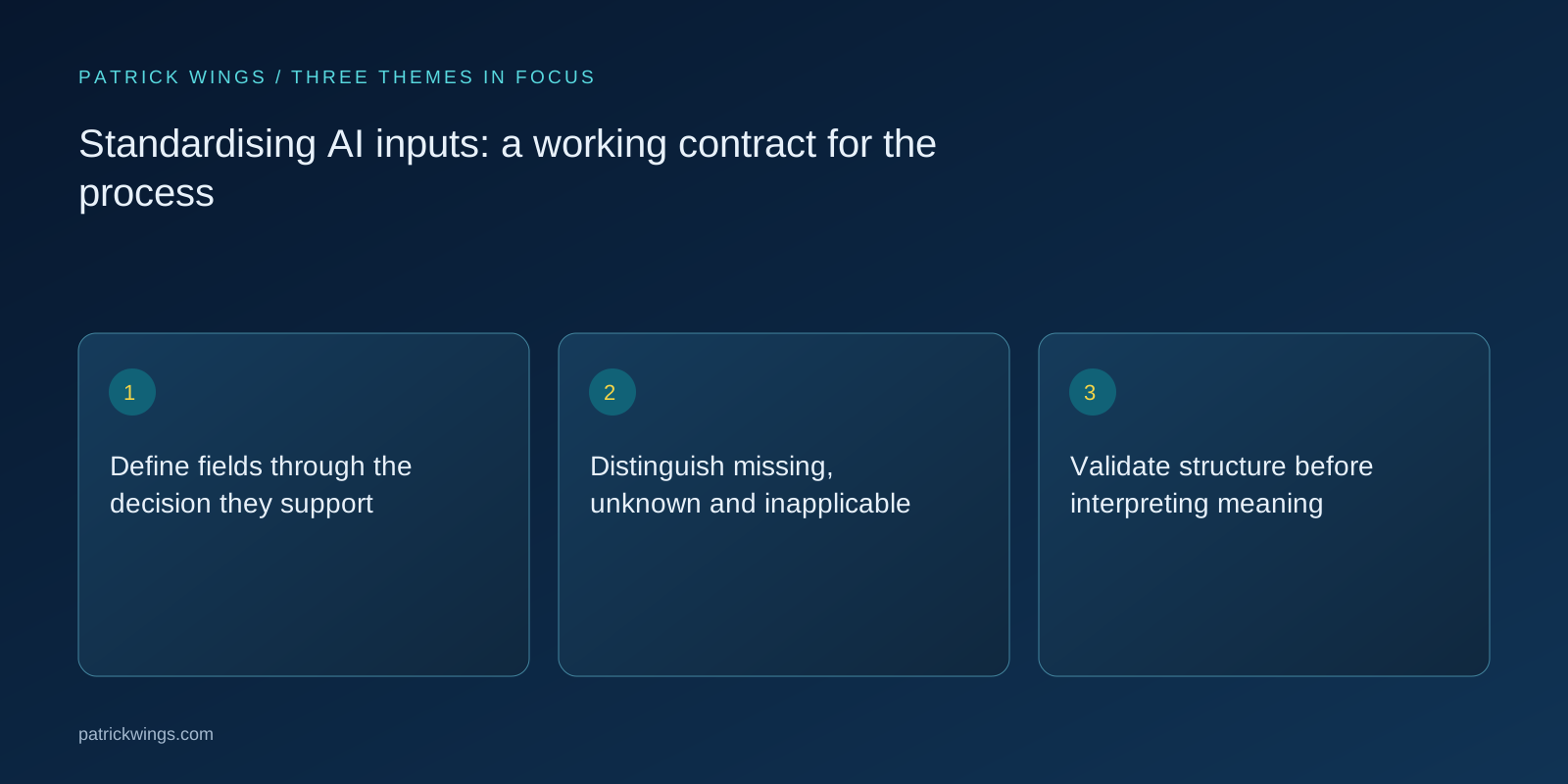
Validate structure before interpreting meaning
Check required fields, types, allowed values and references outside the model where practical. A model can then interpret unstructured descriptions or flag contradictions. Preserve the original input separately from the proposed interpretation. An industry inferred from a description remains a suggestion with evidence. Pass both to the next stage when necessary. A valid schema does not prove factual correctness, so add business consistency checks, such as whether an offer is approved for the named market and whether its referenced product information is still the authorised version.
Manage contract changes deliberately
Assign a contract version and document which consumers support it. Renaming a category can affect existing rules even if the intake form still works. Test changes against historical work samples and downstream handoffs. Decide whether open requests finish under their original version or are deliberately migrated. Name owners for field meaning and technical validation separately. This prevents integration defects being misdiagnosed as prompt problems and business meaning changes being hidden inside technical adjustments. Retain a short migration note showing what changed, who approved it and which existing requests require attention.

Practise clarification using a fictional brief
A fictional team submits a request to generate more leads but provides neither an audience nor an approved offer. The workflow identifies those two gaps and asks who the intended buyers are and where the authorised offer can be found. It does not create a finished campaign from guessed details. Once the answer arrives, the original request and supplement remain linked. This hypothetical example illustrates the contract’s purpose: obtain the missing information needed for a sound next decision, rather than maximise questions or make every form field compulsory.
Test malformed and contradictory inputs
Include invalid dates, conflicting markets, expired offer identifiers and apparently complete but ambiguous text alongside valid requests. Check whether each material gap produces its specified response. A useful error names the affected field and a concrete corrective action without exposing internal secrets. Also observe whether people understand the contract or repeatedly enter placeholder values. When legitimate tasks are frequently blocked, reconsider the fields and their conditions. Improving the contract may solve the problem more directly than adding an increasingly long model instruction to compensate for confusing or unnecessary requirements. Explore this further in the guide Describing agent tools: clear inputs and verifiable results.
INTERACTIVE / FROM READING TO ACTION
Three checkpoints for your implementation
Choose a checkpoint and track your reading progress. Checks are neither saved nor sent and do not score your business.
CHECKPOINT 01
Validate structure before interpreting meaning
Check required fields, types, allowed values and references outside the model where practical.
Explore in the article ↗CHECKPOINT 02
Manage contract changes deliberately
Assign a contract version and document which consumers support it.
Explore in the article ↗CHECKPOINT 03
Practise clarification using a fictional brief
A fictional team submits a request to generate more leads but provides neither an audience nor an approved offer.
Explore in the article ↗Frequently asked questions
Must every input be structured?
No. Free text can be useful, but distinguish it from binding fields and derived suggestions.
Can the model fill missing information?
Only as an explicitly labelled suggestion when the workflow allows it, rather than silently treating it as confirmed fact.
Who owns the input contract?
The process owner owns its business meaning; integration and operations own technical enforcement.
How can I put “Define fields through the decision they support” into practice?
Start with the required result and work backwards. A campaign brief may require the audience, approved offer, market and intended action. Define each field by meaning, format and permitted provenance.
What matters when working on “Distinguish missing, unknown and inapplicable”?
An empty string does not explain why information is absent. Define separate states for not supplied, genuinely unknown and unnecessary for this case. Specify whether the workflow pauses, proceeds with an explicit limitation or asks a focused question.