
THE SHORT ANSWER
Support questions reveal where people get stuck with a real task. To turn them into public content, identify a generalisable question, a reproducible answer and explicit boundaries. Do not copy tickets into a blog. First decide whether a help article, a product-page section or an independent guide best resolves the underlying problem.
For the broader picture of technical foundations, useful content and visibility measurement, read the pillar guide SEO, GEO and AEO for SaaS: visibility that supports buying decisions.
Investigate problems rather than ticket volume
Group cases by task, product area and cause. Several tickets may concern one incident and therefore do not constitute independent demand signals. Separate usage questions, defects, missing features and unclear communication. Record successful answers as well as failed attempts. Frequency alone should not determine publication: a rare but consequential setup obstacle may deserve more attention than a common question about a temporary outage. Ask support colleagues which cases are representative and which depend on customer-specific conditions. Preserve the selection rationale so that a special case does not later become an apparently universal product claim.
Write a safe public question
Remove names, contractual details, screenshots containing live records and internal access information from editorial material. Then describe the task in the user’s language. Record the required role, product version and prerequisites separately. If the answer requires sensitive architecture details or individual commitments, keep it within the appropriate controlled process. A nominally anonymous question may still identify a customer through a distinctive combination of details. Review the whole context. Public guidance should resolve a recurring problem without reproducing the original ticket history. Prepare separate example data for any screenshots and demonstrations. Explore this further in the guide Turning sales questions into a searchable editorial library.
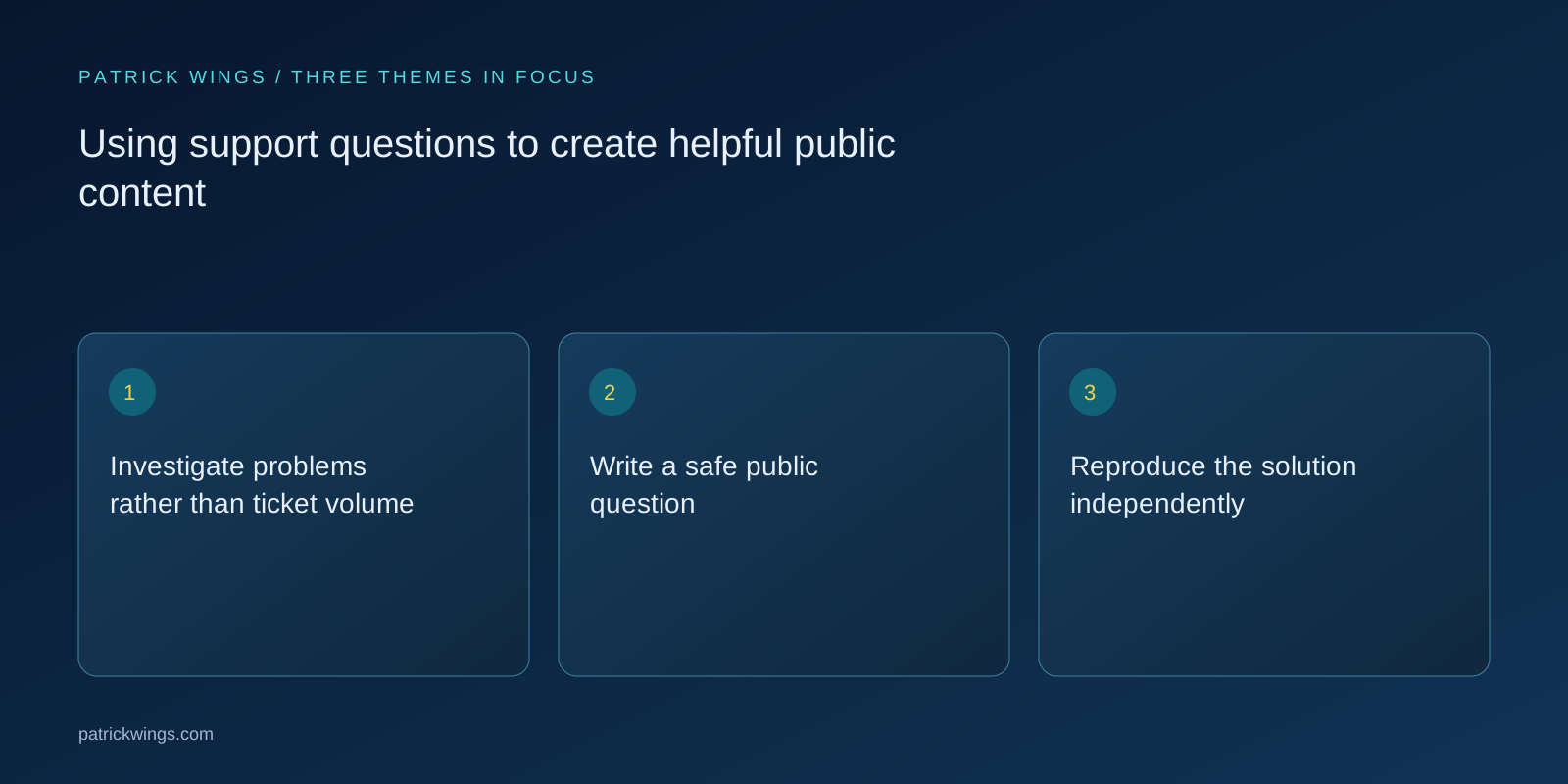
Reproduce the solution independently
Have another person follow the proposed procedure using suitable test data. Include the starting state, action, expected result and a safe stopping point. Explain permission failures and missing prerequisites where they affect the described workflow. Avoid instructions whose consequences readers cannot assess. For changes to important settings, identify the responsible role and link to current product documentation. The public explanation should also show when the procedure does not apply. In that case, provide a focused route to support and specify the diagnostic information needed without asking readers to disclose passwords or confidential material publicly.
Choose the appropriate destination
Check existing help articles and product pages before creating another page. A missing short explanation may be easier to find within an established guide than in a separate blog post. Link deeper background where the next action requires it. Name the destination after the problem rather than an internal ticket category. Readers should recognise the task from the title. Provide the essential solution as text, with video or screenshots supporting it. This keeps the answer usable when media cannot be consumed and lets reviewers assess the instructions independently of the visual presentation or the original support conversation.

Example: a failing import
In a hypothetical SaaS team, several questions concern unsuccessful data imports. Investigation distinguishes an invalid file structure, missing permissions and an actual product defect. The team publishes a structure guide with a synthetic example file and a verifiable outcome. Permission questions go to the appropriate administrator, while the defect receives a separate status explanation. Three similar symptoms therefore do not become one inaccurate universal fix. Support links to the relevant explanation after publication and collects feedback about unclear steps. This example describes a possible working process; it does not demonstrate reduced support costs or promise any search-ranking improvement. Explore this further in the guide SaaS knowledge and support agents: reliable answers need maintained foundations.
Maintain published answers in operation
Connect each public explanation to its internal subject owner and originating problem groups. Product changes may affect several guides simultaneously. Trigger review through relevant releases and recurring failures as well as scheduled checks. Examine feedback and follow-up requests: these may reveal a missing prerequisite rather than poor writing. A declining ticket count alone does not prove that guidance works, particularly if product usage also falls. Assess whether people can complete the described task dependably and find an appropriate next contact when their situation differs. Retire or revise explanations whose underlying procedure is no longer supported.
INTERACTIVE / FROM READING TO ACTION
Three checkpoints for your implementation
Choose a checkpoint and track your reading progress. Checks are neither saved nor sent and do not score your business.
CHECKPOINT 01
Reproduce the solution independently
Have another person follow the proposed procedure using suitable test data.
Explore in the article ↗CHECKPOINT 02
Choose the appropriate destination
Check existing help articles and product pages before creating another page.
Explore in the article ↗CHECKPOINT 03
Example: a failing import
In a hypothetical SaaS team, several questions concern unsuccessful data imports.
Explore in the article ↗Frequently asked questions
Should every ticket become public?
No. Publish generalisable, verified answers that do not depend on confidential context.
Is a screenshot enough?
Provide important steps and prerequisites in understandable text as well.
How should usefulness be assessed?
Review task completion and follow-up questions; interpret ticket volume in the context of usage.
How can I put “Investigate problems rather than ticket volume” into practice?
Group cases by task, product area and cause. Several tickets may concern one incident and therefore do not constitute independent demand signals. Separate usage questions, defects, missing features and unclear communication.
What matters when working on “Write a safe public question”?
Remove names, contractual details, screenshots containing live records and internal access information from editorial material. Then describe the task in the user’s language. Record the required role, product version and prerequisites separately.