
THE SHORT ANSWER
Build a sales-question library around real recurring buyer tasks, with context, approved answers and clear ownership. Preserve the original question separately from its editorial version, then decide which answers belong on the public website. The library should help sales and editors find dependable material; it is not a requirement to publish every objection as a separate article.
For the broader picture of technical foundations, useful content and visibility measurement, read the pillar guide SEO, GEO and AEO for SaaS: visibility that supports buying decisions.
Define a useful intake record
Collect the question as asked, the role asking it, the buying context and the consequence of leaving it unanswered. Record where the question came from without copying unnecessary customer details into a broad-access system. Include the answer currently used, its source and any uncertainty. Distinguish product capability, commercial policy, implementation and competitive comparison because different experts must review them. Make intake easy enough that salespeople use it after real conversations. A long mandatory form can produce incomplete retrospective guesses instead of useful observations tied to an actual decision. Explore this further in the guide Finding unanswered buyer questions in search data.
Group by task without erasing differences
Deduplicate questions that seek the same answer, while retaining different language and context as examples. A pricing question about budget predictability differs from a procurement question about contract structure, even if both mention cost. Separate factual questions from objections and requests for customer-specific commitments. Give each cluster a stable identifier and a plain description of its purpose. Preserve contradictory responses found across teams as review tasks. Do not choose the most confident answer as the canonical one until the responsible owner verifies what the business can actually promise.
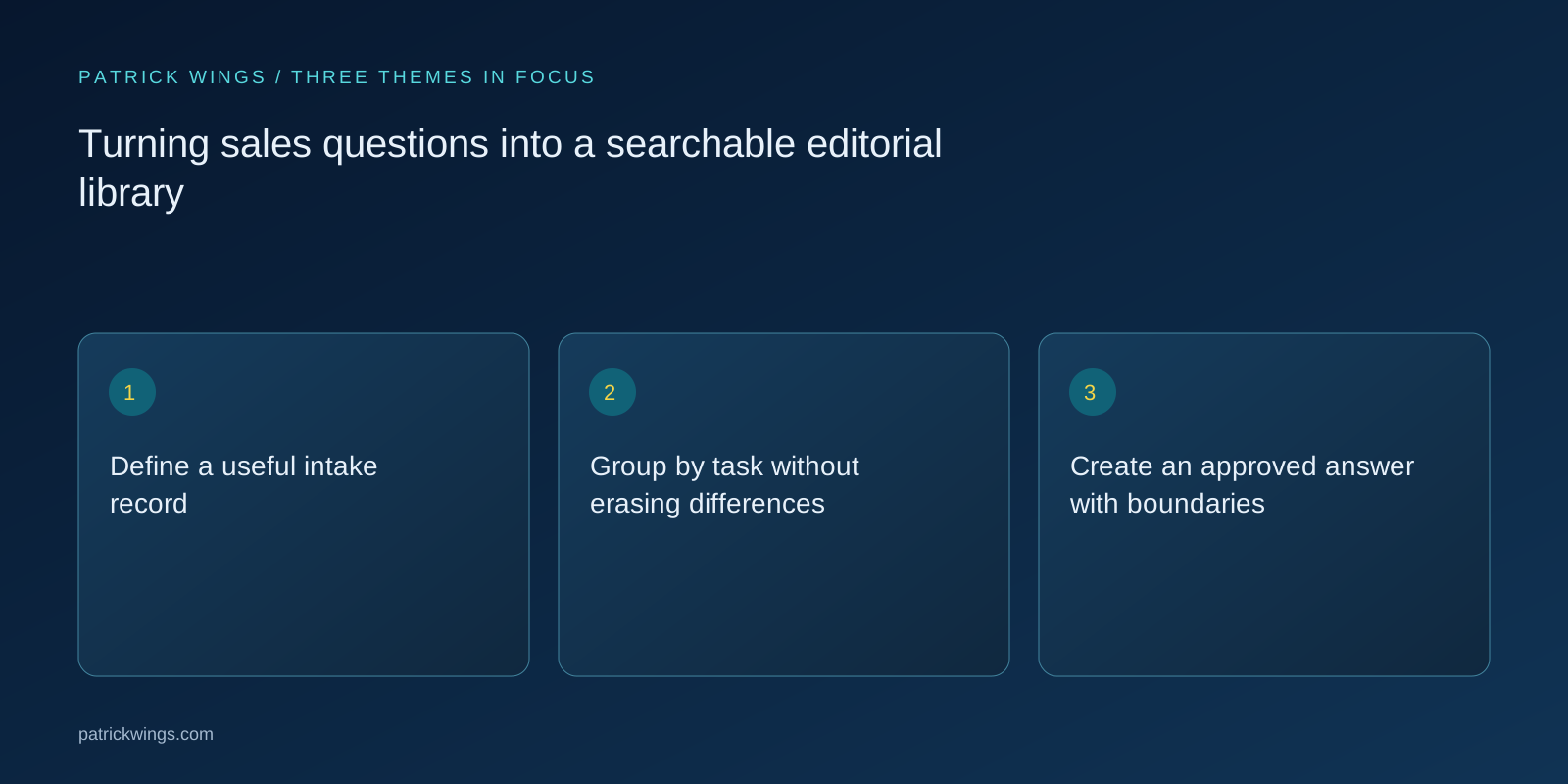
Create an approved answer with boundaries
For each priority cluster, write a direct answer, conditions, supporting source and next step. Name the reviewer and review date. Identify when sales should ask a clarifying question or involve a specialist rather than reuse the answer verbatim. Avoid comparative claims that rely only on internal opinion. If a policy varies by contract or region, make that limit explicit. The record should be usable in a conversation but should not flatten a complex requirement into an unconditional promise merely to create a short snippet that is easy to copy. Explore this further in the guide Sales enablement for B2B SaaS: support buying decisions with relevant evidence.
Decide the right public destination
Map approved questions to existing pages before commissioning new content. Some belong as a useful section in a product page, some need documentation, and some remain controlled sales material because the answer depends on private context. Create an independent article only when there is a distinct substantial task. Use language variants deliberately and check whether the same answer is valid in each market. Link the library record to the published destination so a salesperson can find the current source and editors can see which conversations the answer was intended to support.

Illustrative example: a security-review cluster
Imagine an illustrative library receiving several questions about access control. One asks whether a feature exists, another asks how administrators configure it, and a third requests a customer-specific assurance. The team creates linked but distinct records, verifies product facts and publishes an appropriate configuration explanation. The assurance stays with the responsible review process. This scenario shows why topic similarity does not equal answer equivalence. It does not claim a conversion effect or imply that a public security article can replace the assessment a particular buyer’s organisation requires.
Keep discovery and corrections practical
Let users search by question wording, topic, role and destination rather than requiring them to remember an internal category scheme. Add a visible route for flagging a stale or unclear answer. When a product or policy changes, update affected records and public pages together. Review usage and feedback to identify missing questions, while recognising that frequent reuse is not proof of correctness. Success means people can find an appropriate current answer and recognise its boundaries. An expanding record count is not useful if ownership, sources and publication links are missing.
INTERACTIVE / FROM READING TO ACTION
Three checkpoints for your implementation
Choose a checkpoint and track your reading progress. Checks are neither saved nor sent and do not score your business.
CHECKPOINT 01
Create an approved answer with boundaries
For each priority cluster, write a direct answer, conditions, supporting source and next step.
Explore in the article ↗CHECKPOINT 02
Decide the right public destination
Map approved questions to existing pages before commissioning new content.
Explore in the article ↗CHECKPOINT 03
Illustrative example: a security-review cluster
Imagine an illustrative library receiving several questions about access control.
Explore in the article ↗Frequently asked questions
Does every question need a blog post?
No. Match the task to an existing page, documentation, a section or a controlled answer where appropriate.
Should similar wording be merged?
Merge equivalent answer needs, not merely questions sharing words.
Who approves commercial claims?
The responsible policy or commercial owner should verify the promise and its limits.
How can I put “Define a useful intake record” into practice?
Collect the question as asked, the role asking it, the buying context and the consequence of leaving it unanswered. Record where the question came from without copying unnecessary customer details into a broad-access system. Include the answer currently used, its source and any uncertainty.
What matters when working on “Group by task without erasing differences”?
Deduplicate questions that seek the same answer, while retaining different language and context as examples. A pricing question about budget predictability differs from a procurement question about contract structure, even if both mention cost. Separate factual questions from objections and requests for customer-specific commitments.