
THE SHORT ANSWER
Use B2B buyer interviews to discover the questions, language and evidence needs behind a real decision. Ask about a specific recent buying episode, then translate observations into testable editorial hypotheses. Interviews reveal context and missing answers; they do not establish search volume or prove that every buyer shares the same journey.
For the broader picture of technical foundations, useful content and visibility measurement, read the pillar guide SEO, GEO and AEO for SaaS: visibility that supports buying decisions.
Recruit contrasting decision experiences
Define the decision you want to understand before recruiting. Include different roles and relevant contrasts such as successful purchases, abandoned evaluations and decisions against your offer. Avoid relying only on enthusiastic customers introduced by account managers. Record the recruitment route and important gaps so the sample’s limits remain visible. Seek appropriate consent for notes or recordings and explain how material will be used. A small qualitative sample can reveal useful patterns, but a count of mentions should not be presented as a representative market percentage or search-demand estimate. Explore this further in the guide SME interviews that turn expertise into useful editorial material.
Reconstruct a real buying episode
Ask the participant to describe what happened when the need emerged, what they tried first and where they looked for help. Follow their sequence rather than imposing your funnel vocabulary. Request concrete examples of terms, documents and comparisons they remember. Ask what made information credible and which answer they could not find. Do not suggest your planned article title and ask whether it sounds useful; that invites agreement without revealing behaviour. Separate what they actually did from what they believe they might do in a future hypothetical purchase.
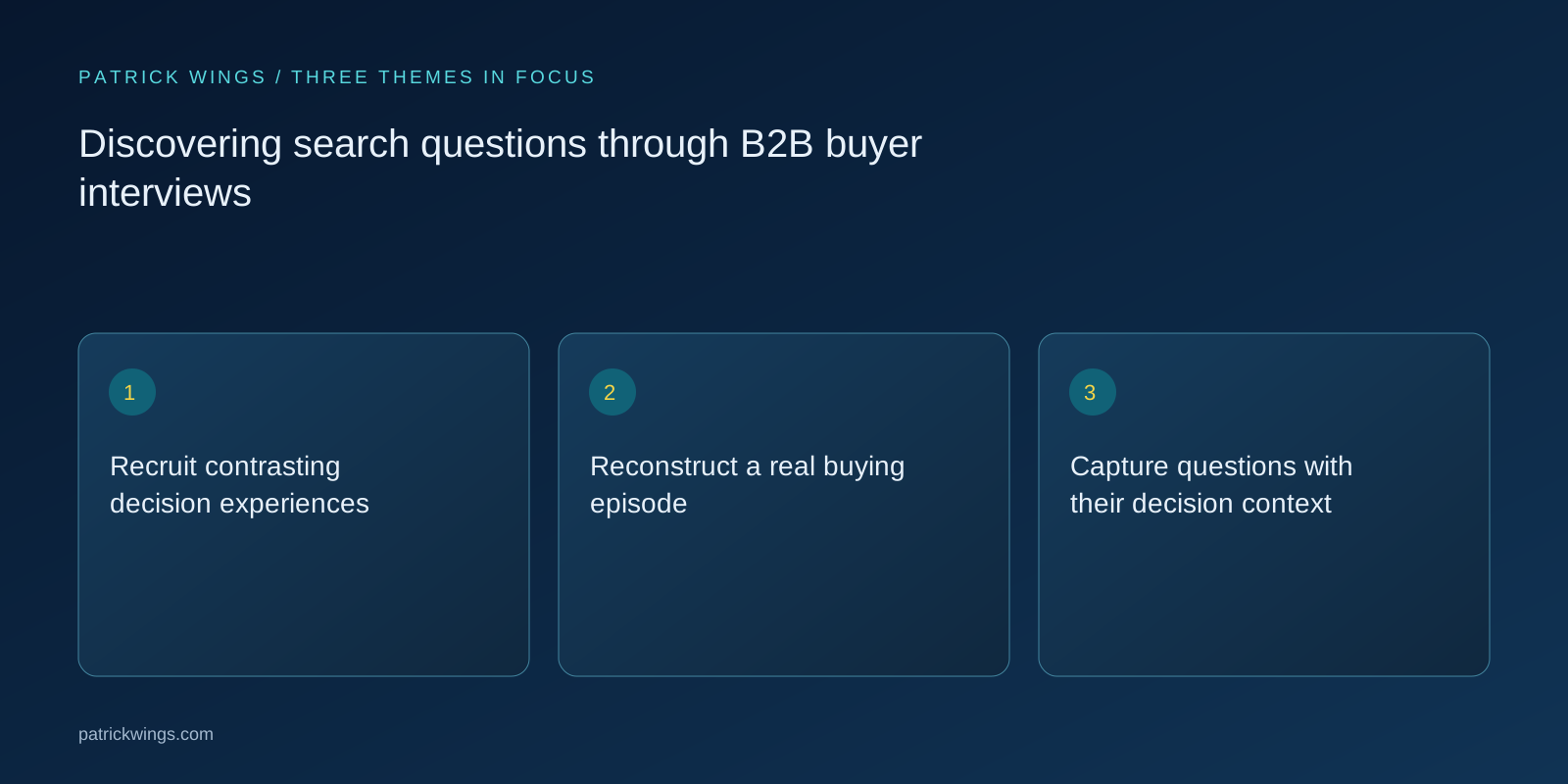
Capture questions with their decision context
Record the participant’s wording alongside role, stage, constraint and consequence. A question about integration may concern engineering effort for one person and implementation risk for another. Note whether the missing answer required a definition, proof, worked process or access to a specialist. Preserve uncertainty when memory is incomplete. Do not convert every remark into a keyword immediately. The contextual record is what helps an editor choose an appropriate answer, depth and example, rather than producing another broad article that contains the right nouns but fails the underlying task.
Translate findings into editorial hypotheses
Cluster observations by reader task and retain meaningful disagreements. Compare them with existing pages, sales questions and available search data. Write a hypothesis such as buyers evaluating access controls need a concrete permissions example, then define how to check it. Choose whether the best response is a public article, a product clarification, a support improvement or a sales resource. Some questions cannot be answered responsibly without customer-specific information. Do not publish speculative advice merely to fill a content gap that interviews happened to reveal. Explore this further in the guide Finding unanswered buyer questions in search data.

Illustrative example: a procurement question
Imagine an illustrative interview where an IT evaluator recalls searching for deployment prerequisites while procurement needed an explanation of renewal responsibilities. The team records two different tasks instead of combining them under software buying advice. It checks whether existing documentation answers the first and asks the commercial owner to verify the second before commissioning content. This example demonstrates interpretation, not a research finding about the market. Neither participant’s phrasing becomes a guaranteed keyword opportunity, and private details from the purchasing episode remain excluded from public examples.
Review briefs against the original evidence
For each proposed brief, preserve the supporting observation, contradictory cases and unanswered assumptions. Ask someone uninvolved in the interview whether the promised answer follows from the evidence. Validate terminology through additional sources where useful and keep search-volume claims separate. After publication, compare reader feedback and subsequent interviews with the original hypothesis. Success means more faithful questions and more useful answers, not simply more interview-derived articles. Revisit weak hypotheses rather than defending them because they came from a named customer or a memorable quote in a recording.
INTERACTIVE / FROM READING TO ACTION
Three checkpoints for your implementation
Choose a checkpoint and track your reading progress. Checks are neither saved nor sent and do not score your business.
CHECKPOINT 01
Capture questions with their decision context
Record the participant’s wording alongside role, stage, constraint and consequence.
Explore in the article ↗CHECKPOINT 02
Translate findings into editorial hypotheses
Cluster observations by reader task and retain meaningful disagreements.
Explore in the article ↗CHECKPOINT 03
Illustrative example: a procurement question
Imagine an illustrative interview where an IT evaluator recalls searching for deployment prerequisites while procurement needed an explanation of renewal responsibilities.
Explore in the article ↗Frequently asked questions
How many interviews prove search demand?
No fixed interview count establishes search volume. Use interviews for context and validate demand with separate evidence.
Should we interview only customers?
Relevant non-buyers and abandoned evaluations can reveal different questions and missing evidence.
Can we publish interview quotes?
Use appropriate consent and verify that quotes do not expose confidential or identifying details.
How can I put “Recruit contrasting decision experiences” into practice?
Define the decision you want to understand before recruiting. Include different roles and relevant contrasts such as successful purchases, abandoned evaluations and decisions against your offer. Avoid relying only on enthusiastic customers introduced by account managers.
What matters when working on “Reconstruct a real buying episode”?
Ask the participant to describe what happened when the need emerged, what they tried first and where they looked for help. Follow their sequence rather than imposing your funnel vocabulary. Request concrete examples of terms, documents and comparisons they remember.