
THE SHORT ANSWER
A useful whitepaper develops one argument that a buyer can inspect, challenge and apply. Start with a contested decision, organize the evidence behind alternative approaches, and finish with criteria for action. Page count follows that reasoning. The practical result is an argument map before a manuscript, followed by a source-aware editorial review.
To see how this step fits into your content strategy, read the pillar guide B2B content marketing: From useful expertise to qualified demand.
Define the decision boundary
Write down who must decide what, under which constraints and by when. A paper on cloud modernization becomes manageable when it addresses migration sequencing for a team with limited operations capacity. Explicitly exclude adjacent subjects such as vendor procurement if you cannot cover them properly. Ask sales which decision remains difficult after existing conversations. This boundary keeps an attractive title from concealing a resource that attempts to answer everything and resolves nothing.
Build an argument map
Place the proposed conclusion at the bottom of a working document. Above it, list the claims required to reach that conclusion, then attach the evidence each claim needs. Distinguish observations, interpretations and recommendations. A product capability does not by itself prove an organizational outcome. Where a link depends on customer resources or a particular configuration, write that condition beside the claim. Missing evidence becomes a research task rather than an invitation to stronger adjectives.
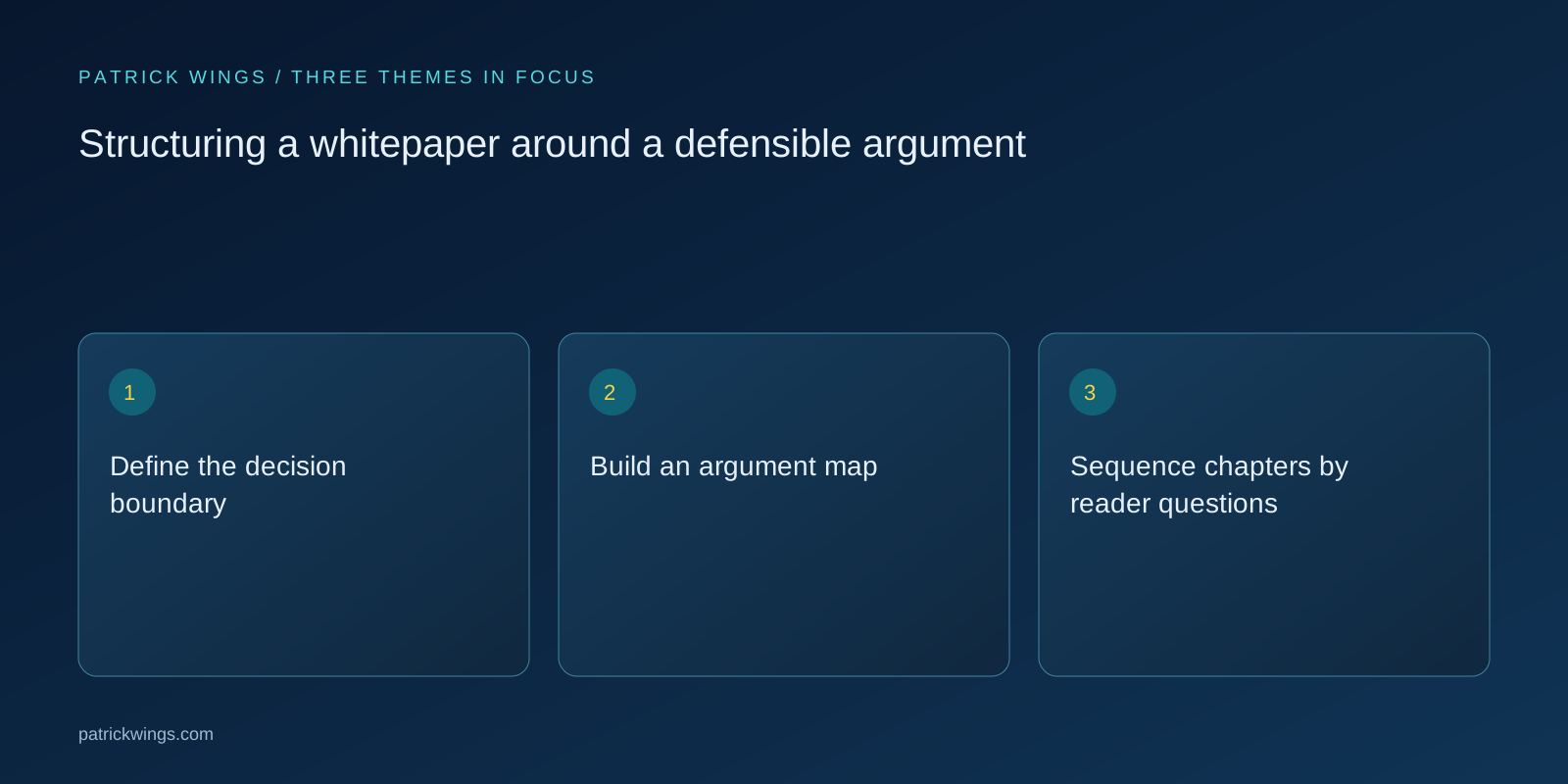
Sequence chapters by reader questions
Develop chapter headings from the questions needed to assess the argument: what is happening, why existing approaches struggle, what alternatives exist, and how to choose. Give each chapter a short conclusion that advances the overall reasoning. Introduce terms before relying on them. W3C writing guidance supports descriptive headings and clear language; these principles also make an editorial outline easier to inspect. Keep detailed methods accessible without interrupting the main decision sequence. Explore this further in the guide Editing SEO articles around verifiable evidence.
Work through an explicitly hypothetical example
Imagine a fictional IT team choosing between migrating everything together and moving one workload at a time. Show how dependency mapping changes the recommendation, then explain what additional information would reverse it. Use invented organization names only when their fictional status is unmistakable. The example should demonstrate the method rather than pretend to provide client proof. A counterexample, such as a tightly coupled legacy platform, reveals the limits of the preferred approach.

Separate evidence from visual emphasis
Brief charts only after deciding what comparison the reader needs. Preserve the source, population, date and important caveats beside a visual. Do not turn a selected anecdote into a market-wide conclusion. For complex diagrams, provide an accompanying explanation that remains useful without the image. Pull quotes should repeat supported conclusions rather than introduce new claims. Readers should be able to reconstruct why the recommendation follows without relying on dramatic design.
Review the weakest link first
Ask a subject expert to challenge the most consequential assumption before reviewing punctuation. Give reviewers specific questions: does this condition actually hold, is this alternative represented fairly, and could a reader mistake a possibility for a promise? Record disagreements and the editorial decision. Avoid asking every stakeholder to rewrite every paragraph. If evidence remains unavailable, narrow the claim or describe the uncertainty instead of hiding it in an inconspicuous footnote. Explore this further in the guide Designing expert webinars around a useful learning outcome.
Publish with an ownership checklist
Before release, check decision scope, source traceability, alternative explanations, example labels, meaningful headings, accessible descriptions and the next useful resource. Assign an owner and an update trigger, such as a product architecture change. Provide a brief web summary so buyers can judge relevance before opening the document. Evaluate whether subsequent conversations refer to the reasoning, not merely whether the download count increased. Downloads alone do not establish understanding or commercial impact.
INTERACTIVE / FROM READING TO ACTION
Three checkpoints for your implementation
Choose a checkpoint and track your reading progress. Checks are neither saved nor sent and do not score your business.
CHECKPOINT 01
Sequence chapters by reader questions
Develop chapter headings from the questions needed to assess the argument: what is happening, why existing approaches struggle, what alternatives exist, and how to choose.
Explore in the article ↗CHECKPOINT 02
Work through an explicitly hypothetical example
Imagine a fictional IT team choosing between migrating everything together and moving one workload at a time.
Explore in the article ↗CHECKPOINT 03
Separate evidence from visual emphasis
Brief charts only after deciding what comparison the reader needs.
Explore in the article ↗Frequently asked questions
Do we need original research?
No. A transparent synthesis of credible existing evidence can be useful; do not imply that it is original research.
Should the conclusion mention our product?
It can, provided the argument and its limitations remain useful independently of the product.
Can a whitepaper be short?
Yes. Completeness of the decision argument matters more than an arbitrary page target.
How can I put “Define the decision boundary” into practice?
Write down who must decide what, under which constraints and by when. A paper on cloud modernization becomes manageable when it addresses migration sequencing for a team with limited operations capacity. Explicitly exclude adjacent subjects such as vendor procurement if you cannot cover them properly.
What matters when working on “Build an argument map”?
Place the proposed conclusion at the bottom of a working document. Above it, list the claims required to reach that conclusion, then attach the evidence each claim needs. Distinguish observations, interpretations and recommendations.