
THE SHORT ANSWER
Segment nurturing by unresolved buyer task rather than industry or job title alone.
For the broader picture of how target customers, channels and sales handoffs work together, read the pillar guide B2B demand generation: from attention to qualified pipeline.
Segment by unresolved buyer task
Segment nurturing by unresolved buyer task rather than industry or job title alone. Two similar companies may need different support: one is checking technical feasibility while another needs an internal financial case. Relevance comes from the question, not from increasingly elaborate demographic subdivisions in a marketing database.
Begin with questions from real conversations: technical feasibility, internal value or implementation prerequisites. Record an explicitly stated task before a workflow assumes a stage. Two contacts with identical titles may be addressing different questions. A segment description should therefore explain in one sentence which particular uncertainty its resources are intended to reduce. Explore this further in the guide Buying committees: reach several roles in demand development.
Define tasks and uncertain signals
Define a few workable tasks such as understanding the problem, comparing options, technical validation and internal approval. Associate signals cautiously and preserve uncertainty. Webinar attendance does not establish a particular buying stage; an explicitly stated objection usually offers more useful context for deciding what help is appropriate.
A task matrix contains the confirmed question, useful resource, specialist reviewer and exit condition. Unknown tasks do not receive apparently precise buying stages. For inferred assignments, preserve the signal source. When conversation disproves the question, automation must be able to remove that assignment instead of repeatedly recreating it from later clicks.
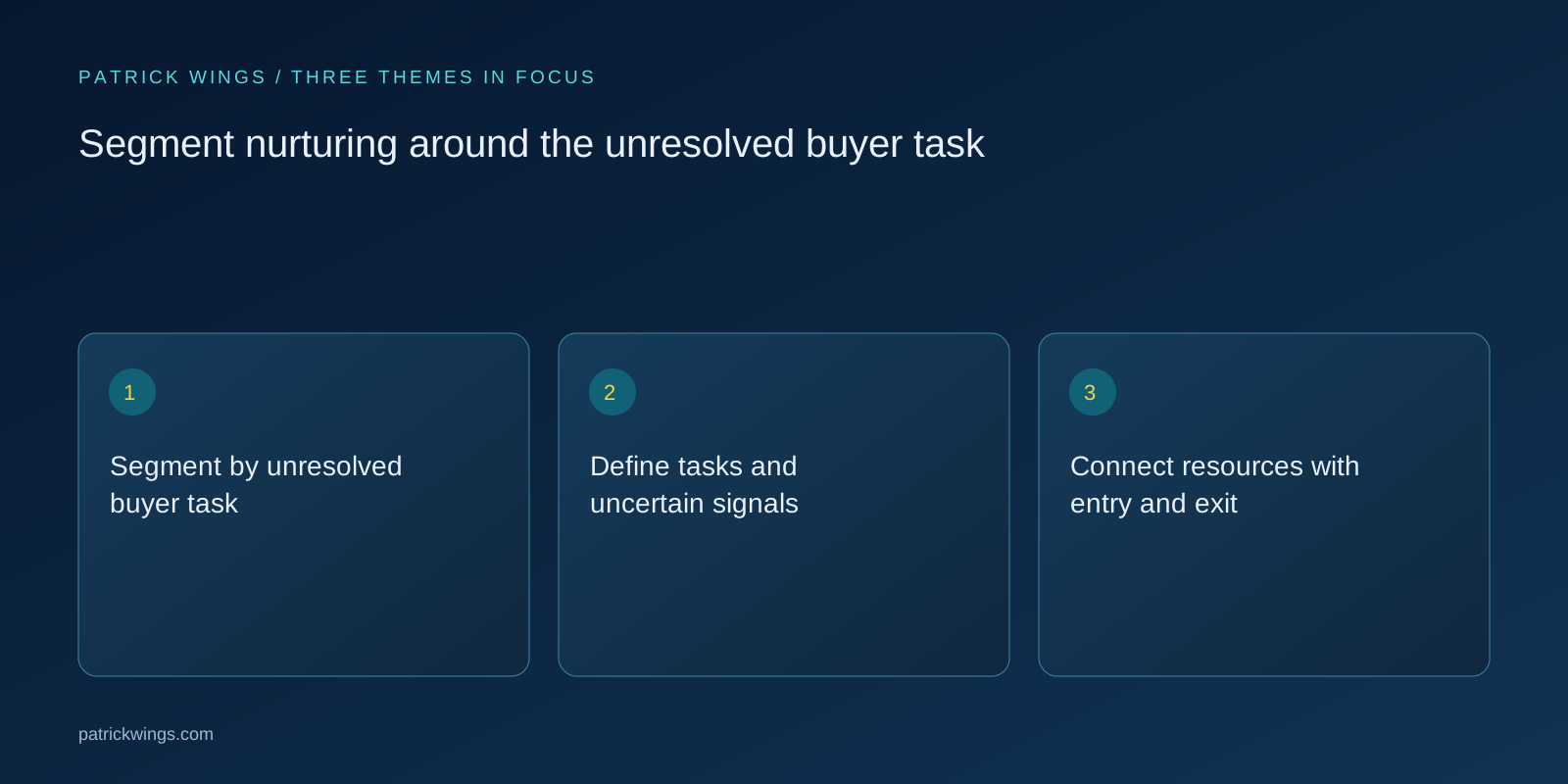
Connect resources with entry and exit
Connect each task with useful content, an appropriate channel and an exit condition. Check existing sales communication to avoid contradictory parallel sequences. When the task is unknown, seek restrained clarification rather than launching a long automated series of supposedly personalised recommendations based on little reliable evidence.
Before activation, inspect the ongoing sales conversation and other sequences. Specify which programme takes precedence when they overlap. One relevant guide with an optional question may be more appropriate than several scheduled messages. A confirmed meeting or resolved question ends the old path and prevents reminders that no longer fit the actual conversation.
Split one industry segment in an example
An invented supplier has eighty contacts in one industry. Twenty are investigating integration, fifteen need an internal business case and the rest remain unclear. Instead of one industry sequence, the first groups receive appropriate resources. The unknown group remains explicit rather than being assigned an invented decision stage.
For the invented eighty contacts, the technical path could offer an interface overview while the financial path provides a transparent value calculation. The remainder receive no invented personalised problem claim. Voluntary feedback may refine their assignment. The example illustrates operating logic rather than ideal group sizes or a promised effect from segmented communication.

Control assignment and overlaps
Too many segments create empty rules and stale content. Too few send the same pitch to everyone. Signals can also conflict when several colleagues research one account. Avoid treating an individual click as definitive proof of the task currently facing the entire company or every stakeholder involved in its purchase.
Check conflicts at person and account level. An IT specialist may examine technical details while a colleague prepares budget approval. Both tasks are legitimate and require materials that can be coordinated. Avoid an account rule that collapses every participant into one individual question simply because one contact most recently viewed a particular resource.
Review useful clarification rather than volume
Check whether resources resolve questions and enable useful next steps. Opens and clicks offer clues but do not replace substantive confirmation. Inspect exits, follow-up questions and repeated misfit. A shorter helpful sequence may serve buyers better than a long series generating activity without progress toward a decision.
Collect specific feedback about which information helped and which question remains. A short confirmed clarification is more informative than additional automatically recorded opens. Review unnecessary overlap and abandoned paths too. When recipients repeatedly ask for information already promised, content or handoff probably needs revision rather than simply increasing message frequency in an unchanged sequence.
Maintain sequences and resources together
Assign a content owner and freshness review for each task area. Sales reports resolved or changed questions. Define precedence when several tasks coexist so contacts do not enter multiple independent automations and receive unnecessary messages or conflicting advice from different parts of the same organisation.
Each task path needs a specialist content owner and a process owner. When the product changes, they jointly review affected materials and exit rules. Sales reports resolved questions or new tasks. Nurturing then remains tied to an actual information need instead of becoming permanent scheduled communication whose original reason has already disappeared. Explore this further in the guide B2B nurturing content: Answer the next buying question.
INTERACTIVE / FROM READING TO ACTION
Three checkpoints for your implementation
Choose a checkpoint and track your reading progress. Checks are neither saved nor sent and do not score your business.
CHECKPOINT 01
Connect resources with entry and exit
Connect each task with useful content, an appropriate channel and an exit condition.
Explore in the article ↗CHECKPOINT 02
Split one industry segment in an example
An invented supplier has eighty contacts in one industry.
Explore in the article ↗CHECKPOINT 03
Control assignment and overlaps
Too many segments create empty rules and stale content.
Explore in the article ↗Frequently asked questions
Should industry no longer be used?
Use it when it changes substantive content; it does not replace the buyer task.
How many segments?
Only as many as you can support with relevant content and clear rules.
What if the task is unknown?
Preserve uncertainty and offer an appropriate clarification step.
How can I put “Segment by unresolved buyer task” into practice?
Segment nurturing by unresolved buyer task rather than industry or job title alone. Two similar companies may need different support: one is checking technical feasibility while another needs an internal financial case. Relevance comes from the question, not from increasingly elaborate demographic subdivisions in a marketing database.
What matters when working on “Define tasks and uncertain signals”?
Define a few workable tasks such as understanding the problem, comparing options, technical validation and internal approval. Associate signals cautiously and preserve uncertainty. Webinar attendance does not establish a particular buying stage; an explicitly stated objection usually offers more useful context for deciding what help is appropriate.