
THE SHORT ANSWER
An email course helps people complete a task through manageable steps. Plan backwards from the intended output: what must participants understand, prepare and try? Every message needs a recognizable contribution and a feasible exercise. The course should remain useful even when participation never leads to a sales conversation or a purchase.
To see how this step fits into your content strategy, read the pillar guide B2B content marketing: From useful expertise to qualified demand.
Set a verifiable learning goal
Choose an outcome visible in everyday work, such as an initial question list for selecting a system. “Know more about digital transformation” is too vague to guide a course. Describe the background knowledge, time and material participants need. Ask potential learners where they regularly get stuck. Their answers help you select a realistic goal and move unnecessary foundations elsewhere. Explain at registration what the course covers and which deeper assessments remain necessary, so completing the sequence does not imply expertise or approval it cannot reasonably provide.
Break the task into dependencies
Sequence messages around what each step requires. Evaluating options requires criteria, and meaningful criteria require a defined problem. Give each email one working step and a tangible output. Provide a way back for people who skipped an earlier lesson. A short recap and a link to the previous material may be sufficient. Choose the delivery rhythm around the exercises and your support capacity rather than treating a particular number of days as a universal formula or silently assuming participants can perform additional work every day.
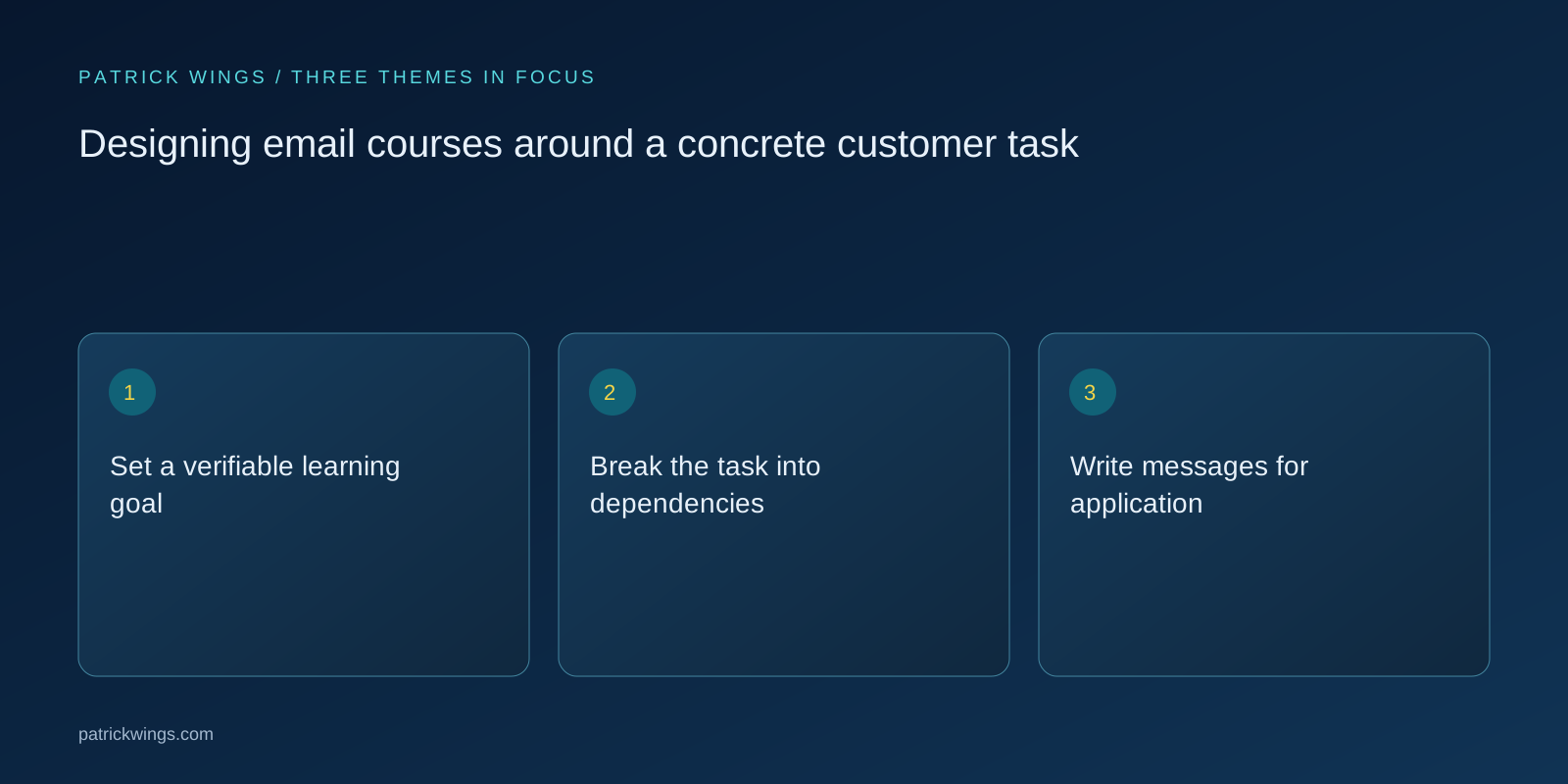
Write messages for application
Open with the question the lesson answers. Explain the principle, show a small example and then give instructions for the exercise. Identify the inputs and a simple criterion for checking the result. Descriptive links make supporting material easier to locate, consistent with W3C's writing guidance. Avoid competing calls to action. If every email simultaneously promotes a booking, blog, download and product, participants may struggle to identify the actual task and the promised learning sequence loses the practical connection that made it worth joining in the first place. Explore this further in the guide Writing B2B calls to action with clear consequences.
Walk through a hypothetical course
Suppose you offer a course on preparing a data project. The first message asks participants to state a concrete data question. Later exercises inventory available sources, identify responsible people and formulate unresolved quality questions. The final task assembles those outputs into a draft project outline. A completed sample demonstrates how to flag unknown information. This hypothetical course promises neither a finished data strategy nor automatic project approval. It provides a structured preparation that participants can take into a discussion with the specialists responsible for their actual working environment. Explore this further in the guide B2B workbooks that turn information into decisions.

Explain access and support
Before registration, explain which messages will arrive and how participants can stop them. Coordinate technical and organizational sending requirements with the responsible people. Decide whether replies will receive expert attention. Offered support needs a named role and a workable process. Make core worksheets retrievable so that losing one email link does not make the entire course unusable. Test presentation, links and exercises through real test messages before launch, including the route a participant would follow when returning to the material after a break of several days.
Review use rather than opening alone
An opening signal does not reliably establish whether someone understood or completed an exercise. Ask focused questions about applicability and examine work participants voluntarily share. Look for recurring misunderstandings: are examples missing, prerequisites unclear or exercises too large? Revise those points first. Plan maintenance of linked resources and review when the subject changes. A course has meaningful editorial ownership only when someone knows what to do about outdated instructions and how participants already enrolled in the sequence will receive the corrected explanation rather than continuing through obsolete material.
INTERACTIVE / FROM READING TO ACTION
Three checkpoints for your implementation
Choose a checkpoint and track your reading progress. Checks are neither saved nor sent and do not score your business.
CHECKPOINT 01
Write messages for application
Open with the question the lesson answers.
Explore in the article ↗CHECKPOINT 02
Walk through a hypothetical course
Suppose you offer a course on preparing a data project.
Explore in the article ↗CHECKPOINT 03
Explain access and support
Before registration, explain which messages will arrive and how participants can stop them.
Explore in the article ↗Frequently asked questions
How many lessons should there be?
Derive the number from the required steps and check that every lesson contributes distinct value.
Does every message need an offer?
No. The exercise carries the course; place an offer at a relevant transition.
What if someone misses a lesson?
Provide recaps and accessible earlier resources so participants can resume.
How can I put “Set a verifiable learning goal” into practice?
Choose an outcome visible in everyday work, such as an initial question list for selecting a system. “Know more about digital transformation” is too vague to guide a course. Describe the background knowledge, time and material participants need.
What matters when working on “Break the task into dependencies”?
Sequence messages around what each step requires. Evaluating options requires criteria, and meaningful criteria require a defined problem. Give each email one working step and a tangible output.