
THE SHORT ANSWER
An international marketing-to-sales handoff needs more than translated CRM fields. It must establish who understands local enquiries, how context travels and how market feedback returns to the central team. A shared handoff card helps prevent prospects from becoming stuck between countries, languages and responsibilities when they try to take a meaningful next step.
To connect this decision with positioning, market entry and growth, read the pillar guide Go-to-market for B2B SaaS: turn market insight into an executable growth strategy.
Describe the complete enquiry journey
Map the route from a local contact request to the next agreed action. Include time zones, languages, cover arrangements and actual sales capacity. Central routing achieves little if nobody can hold a relevant conversation in the language requested. Assign an accountable role and visible working status to each handoff point. Also define when an enquiry should not move forward, such as when the offer does not fit. The objective is a functioning process for real prospects. An organisation chart may identify departments, but it does not explain what should happen to a particular request or how the next person knows it is their responsibility.
Transfer context beyond contact fields
The receiving person needs the trigger, specific question and any steps already promised. Include the source, preferred language, relevant product version and materials the prospect has seen. Distinguish an expressed requirement from a marketing inference. Do not transfer unnecessary personal details from conversations. The receiving team should understand why this request belongs with them and what remains unresolved. Avoid internal abbreviations understood only in the home market. Briefly explain expressions with a specific local meaning. A good transfer reduces repetition for the prospect while preventing an unverified product promise from acquiring apparent authority simply because it has been copied into another team's system. Explore this further in the guide Keeping translated SEO content current together.
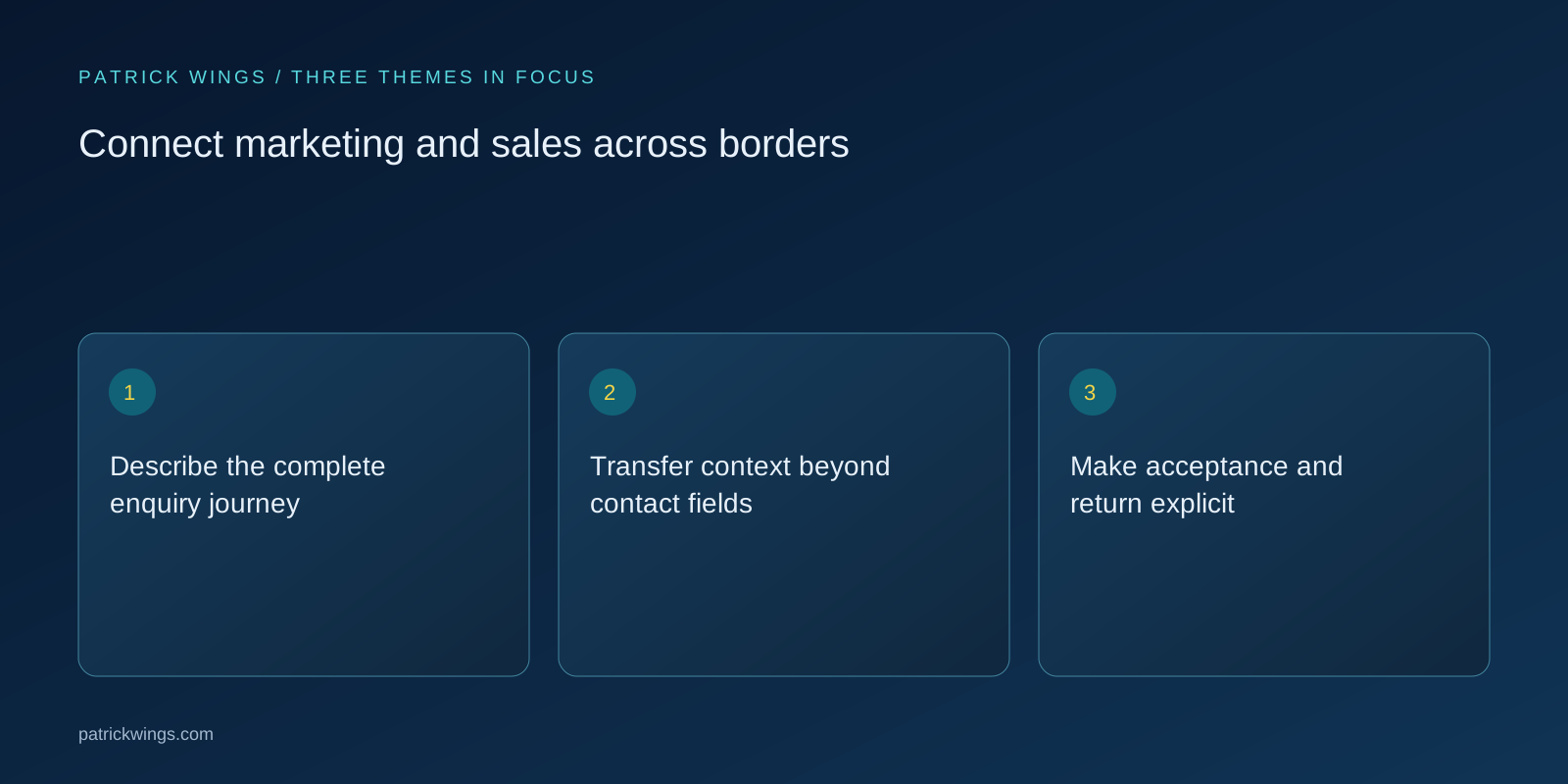
Make acceptance and return explicit
Agree how the local team confirms receipt, requests clarification or returns an enquiry with a reason. Automated assignment is not the same as actual acceptance. Set an achievable internal handling commitment based on capacity rather than borrowing an arbitrary industry target. Requests for missing information should contain a specific question. Unsuitable enquiries need a usable reason, such as an unavailable integration or an unsupported country. Those reasons later inform targeting and content decisions. Arrange cover for leave and events as well. Without cover, a responsibility that looks clear on paper can become a queue that remains invisible to the central team and to the person expecting a response.
Rehearse a difficult cross-border case
Suppose a German-speaking prospect asks for local implementation assistance while the product team currently provides support only in English. This is a hypothetical example. The handoff card records the exact expectation and the published service boundary. Sales investigates a workable path before selling a meeting as local implementation support. If a partner might help, check its responsibilities and actual availability separately. The case should not disappear into an optimistic note sent to another team. It needs a responsible owner, a reply to the prospect and a decision about whether the local website makes current support arrangements sufficiently clear for future visitors.

Return market feedback in a usable form
Collect repeated questions, rejection reasons and misunderstood terminology in one feedback format. Connect observations with specific cases and their context; one salesperson's impression is not a national market characteristic. Group similar reports without merging different causes. Marketing assesses whether content or targeting needs to change. Product and delivery teams assess capability questions. The GOV.UK interview guide helps formulate open, experience-based follow-up questions. Your handoff design remains a separate operating proposal. The important point is that feedback receives a visible response: adopted, investigated further or declined for now with a reason. Otherwise collecting more feedback simply creates another unowned queue between central and local teams. Explore this further in the guide Marketing and sales alignment: clear handovers instead of MQL arguments.
Test actual cases and revise the workflow
Before launch, rehearse typical and difficult enquiries, including returns, language switches and absences. Check what information arrives and whether the next action is understandable. After launch, review outstanding handoffs, return reasons and repeated clarification requests. Add conversation observations so a quick status change is not mistaken for effective support. Use regular reviews for cases requiring a process decision rather than reading every update aloud. Record changes to forms, routing and service descriptions together. This creates a cross-border workflow whose quality is judged by the next step it enables and whose failures lead to concrete improvements instead of competing explanations from different regional teams.
INTERACTIVE / FROM READING TO ACTION
Three checkpoints for your implementation
Choose a checkpoint and track your reading progress. Checks are neither saved nor sent and do not score your business.
CHECKPOINT 01
Make acceptance and return explicit
Agree how the local team confirms receipt, requests clarification or returns an enquiry with a reason.
Explore in the article ↗CHECKPOINT 02
Rehearse a difficult cross-border case
Suppose a German-speaking prospect asks for local implementation assistance while the product team currently provides support only in English.
Explore in the article ↗CHECKPOINT 03
Return market feedback in a usable form
Collect repeated questions, rejection reasons and misunderstood terminology in one feedback format.
Explore in the article ↗Frequently asked questions
What should an international handoff contain?
The trigger, question, language, existing promises, relevant materials, unresolved points and accountable receiving role.
When is a handoff complete?
When the receiving team has deliberately accepted it and the next action is clear. Automatic assignment alone is insufficient.
How does local learning return to marketing?
Through case-based feedback, clear categories, an accountable review and a visible decision about the response.
How can I put “Describe the complete enquiry journey” into practice?
Map the route from a local contact request to the next agreed action. Include time zones, languages, cover arrangements and actual sales capacity. Central routing achieves little if nobody can hold a relevant conversation in the language requested.
What matters when working on “Transfer context beyond contact fields”?
The receiving person needs the trigger, specific question and any steps already promised. Include the source, preferred language, relevant product version and materials the prospect has seen. Distinguish an expressed requirement from a marketing inference.