
THE SHORT ANSWER
A B2B sales deck should prepare a decision: which problem deserves attention, which approach fits and what needs clarification before working together? Build a sequence that makes those judgments possible. Slides support a conversation through evidence and explicit questions; a document sent afterwards needs more explanation than the version presented live in a meeting.
To see how this step fits into your content strategy, read the pillar guide B2B content marketing: From useful expertise to qualified demand.
Define the meeting context
Before writing slides, establish who will attend and what they already know. An introductory conversation needs different material from a technical evaluation involving procurement and operations. Record the intended meeting outcome, such as choosing a suitable pilot area. Identify the objection most likely to block that step. This determines the deck's scope. A complete company history belongs only where it helps the audience make a relevant judgment or resolves a specific uncertainty that would otherwise prevent the next discussion from taking place.
Connect the problem to work
Describe the issue through everyday tasks: who needs to accomplish what, and what makes that difficult today? Separate observations from suspected causes and avoid unsupported cost estimates. Where information is missing, show the questions you would use to establish a baseline. That can open a conversation without pretending to know the customer's circumstances. Before moving to the solution, the audience should be able to confirm whether the description fits or explain which important parts of the situation require a different interpretation.
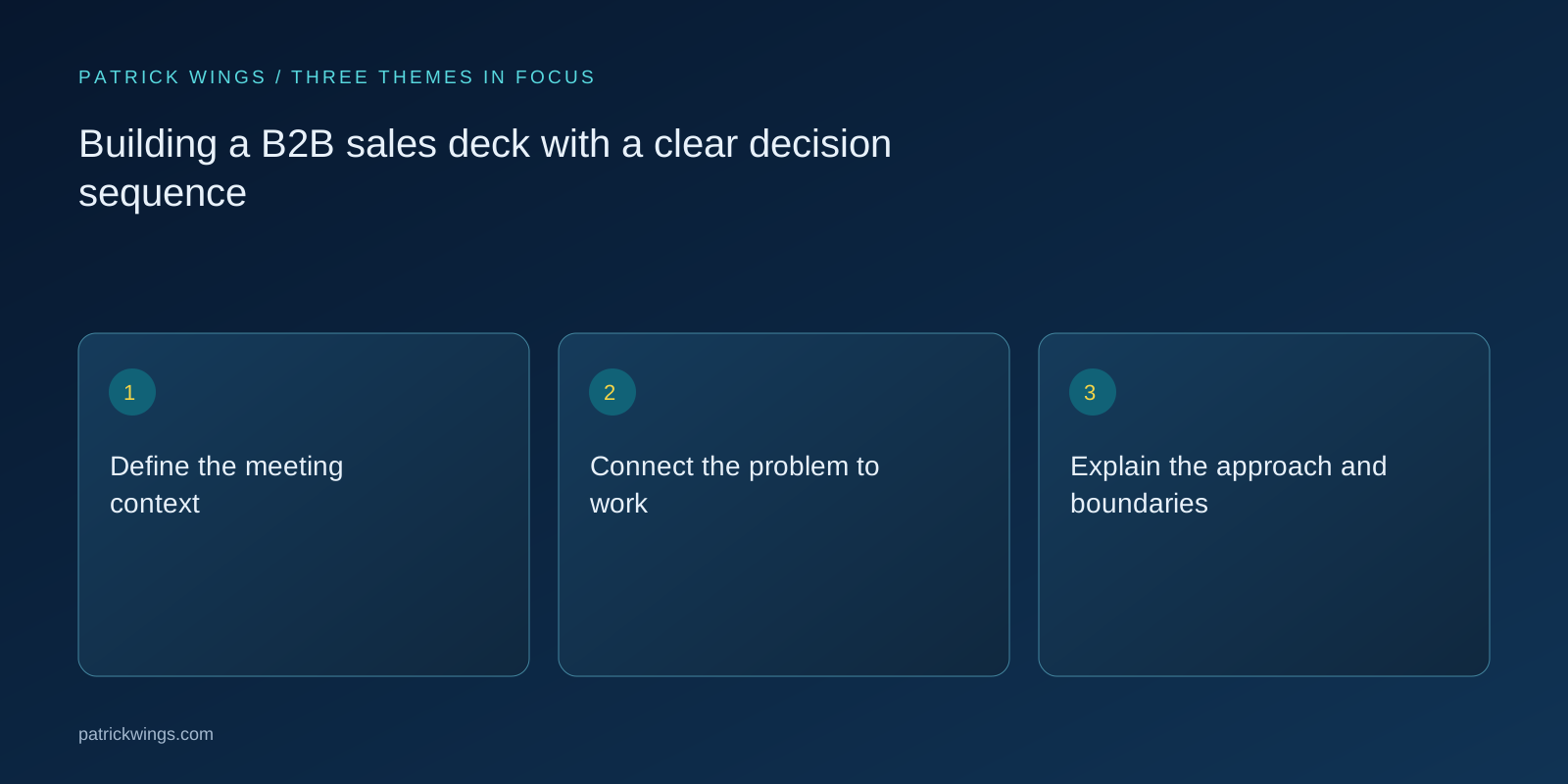
Explain the approach and boundaries
Show how the proposed approach addresses the problem. Use a comprehensible sequence or a small diagram with defined terms. Identify prerequisites such as data availability, internal participation and technical interfaces. Explain which activities sit outside the offer as well. These boundaries make alternatives easier to evaluate. A slide containing only benefits gives buyers little basis for judgment because it leaves unclear which conditions make delivery possible and what work their own team must still undertake before the proposal becomes a realistic option.
Match evidence to claims
Place evidence beside the statement it supports. A case study can demonstrate a method, a product view can show a feature and an approved quotation can describe someone's experience. These are different kinds of support. Record the source, context and permission in the working document. For results, explain what was measured and under which conditions. A genuine number can mislead without that context. Customer logos cannot replace a clear connection between the challenge, the work performed and the outcome that was actually observed. Explore this further in the guide Placing credible evidence on B2B service pages.

Build a hypothetical conversation
Imagine a provider selling an interface assessment. Its deck starts with the problem of undefined data handoffs, then shows an example investigation and explains the system access required. A sample report page makes the deliverable tangible. The final discussion asks which system would be suitable for an initial assessment. This hypothetical story contains no invented savings. It illustrates how each slide prepares the next question and how the starting point follows the work involved, rather than a generic introduction to the provider's entire product portfolio. Explore this further in the guide Sales enablement for B2B SaaS: support buying decisions with relevant evidence.
Separate presenting from sending
Create a follow-up version that remains understandable without a presenter. Add short explanations, source notes and a contact for questions. Remove internal prompts and confidential information that must not circulate. Use descriptive headings and a sensible reading order. A screenshot or decorative symbol should never carry the only explanation of an important point. Inspect the exported file because links, fonts and diagrams may differ from the editing version, making a previously understandable claim difficult to read or disconnecting a reference from the evidence it describes.
Improve through observed questions
Rehearse the deck against a specific meeting scenario. Ask someone outside the project to explain which decision each passage enables and what remains missing. Separate feedback into comprehension, suitability and risk. Revise places where the reasoning breaks; adding more slides may not solve the underlying issue. After real conversations, ask sales to record the information buyers needed but could not find. This creates a focused improvement process with a named owner instead of an ever-growing collection of optional slides that gradually contradict one another.
INTERACTIVE / FROM READING TO ACTION
Three checkpoints for your implementation
Choose a checkpoint and track your reading progress. Checks are neither saved nor sent and do not score your business.
CHECKPOINT 01
Explain the approach and boundaries
Show how the proposed approach addresses the problem.
Explore in the article ↗CHECKPOINT 02
Match evidence to claims
Place evidence beside the statement it supports.
Explore in the article ↗CHECKPOINT 03
Build a hypothetical conversation
Imagine a provider selling an interface assessment.
Explore in the article ↗Frequently asked questions
How many slides are needed?
Use enough to support the intended meeting outcome and test every slide against that purpose.
Should pricing appear?
Include it when scope is sufficiently defined; otherwise explain what information a quote requires.
Can the same file be sent afterwards?
Only if it stands alone and contains no confidential meeting material.
How can I put “Define the meeting context” into practice?
Before writing slides, establish who will attend and what they already know. An introductory conversation needs different material from a technical evaluation involving procurement and operations. Record the intended meeting outcome, such as choosing a suitable pilot area.
What matters when working on “Connect the problem to work”?
Describe the issue through everyday tasks: who needs to accomplish what, and what makes that difficult today? Separate observations from suspected causes and avoid unsupported cost estimates. Where information is missing, show the questions you would use to establish a baseline.