
THE SHORT ANSWER
A new guide does not become useful to sales simply because its link appears in a team chat. Colleagues need to understand which buyer question it helps answer, which statements it supports and where its limits lie. A useful handoff supplies that context in a compact form. It connects editorial quality with real conversations without forcing every resource into a mandatory sales sequence or assuming that publication alone creates adoption.
To see how this step fits into your content strategy, read the pillar guide B2B content marketing: From useful expertise to qualified demand.
Name the buyer question and moment
Start with the specific situation in which a salesperson might use the material. A comparison guide supports a different question from a technical introduction or customer story. Avoid assigning every resource to all leads. Instead, record the trigger, the unresolved question and the useful response you expect. A resource does not need to produce an immediate meeting to help a conversation. It may support an internal discussion or reveal information needed for the next step. That practical context is the core handoff, rather than a list of features or a generic announcement that new content exists. Explore this further in the guide Sales enablement for B2B SaaS: support buying decisions with relevant evidence.
Create a compact use card
Summarize purpose, audience, useful sections and known limitations on a short use card. Link the current public edition and, where appropriate, approved internal guidance. A sample introduction can make sending easier, but label it as adaptable wording. Do not add claims the resource itself cannot support. If the document includes a hypothetical calculation, preserve that status in the use card. Colleagues should be able to choose the material without reading the entire production brief or privately asking the editor what every section means. The card makes the intended use inspectable and repeatable.
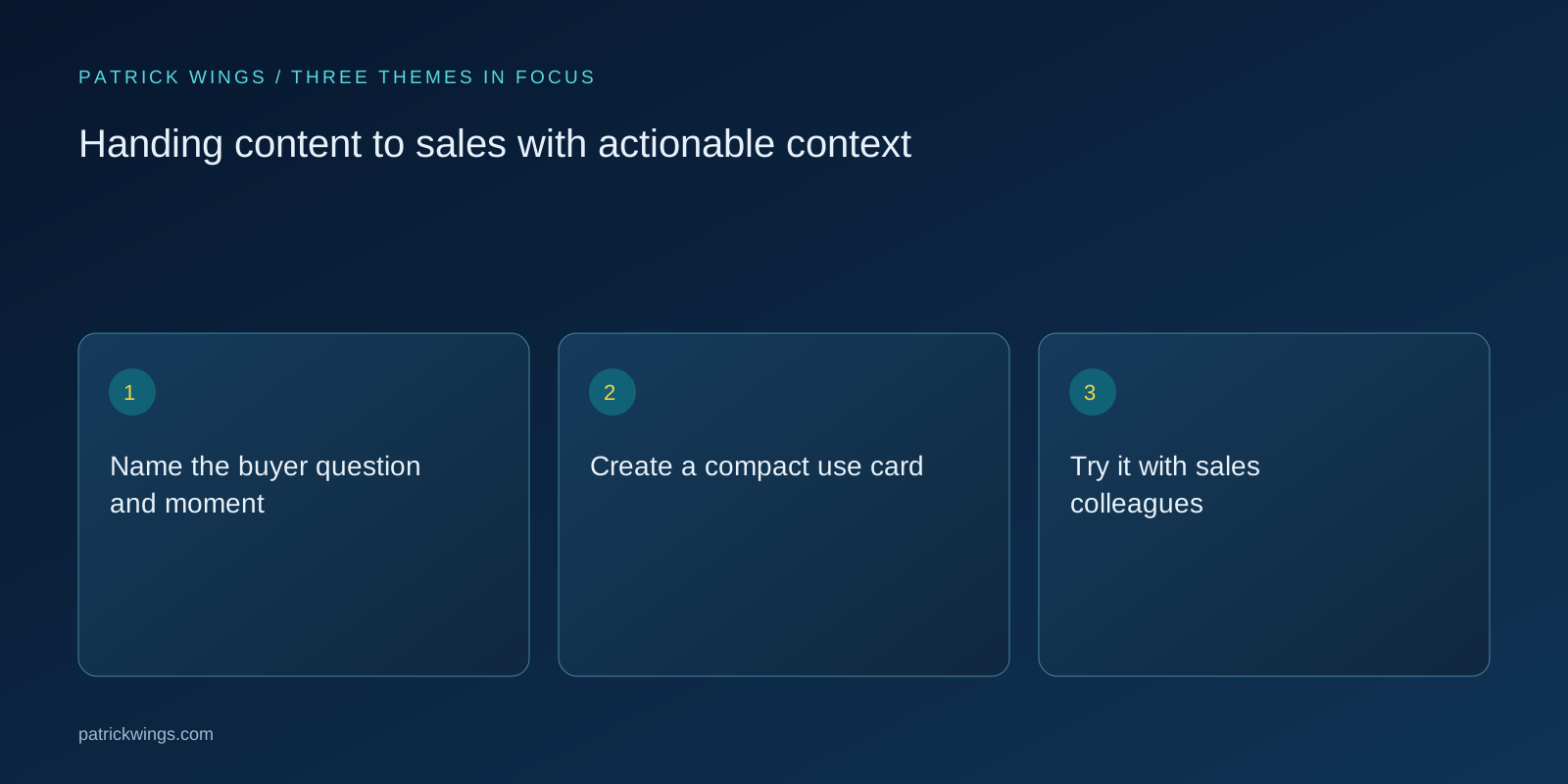
Try it with sales colleagues
Discuss a realistic conversation and decide together whether the resource fits. Ask for specific feedback: is a term missing, a statement confusing or the question different from the one buyers ask? “Too long” is not yet an actionable editing request. Perhaps the team needs a direct route to one useful section instead of shortening the whole guide. Invite colleagues to explain its value in their own words. Difficulty doing so may reveal an unclear use card, or it may indicate that the resource has no suitable role in the current sales process.
A hypothetical handoff package
Imagine an IT provider publishing a guide to migration preparation. The use card identifies a buyer question: what existing-system information should be gathered before an effort estimate? It points to a worksheet and explains that the worksheet does not replace an individual technical assessment. A sample message invites the buyer to mark unresolved questions. Sales also receives a route to the responsible subject specialist. This hypothetical package illustrates contextual handoff. It makes no claim about closing rates and does not imply that every organization requires identical preparation or that sending the guide establishes technical project readiness.

Make edition and approval visible
Use a dependable source location rather than several unmarked file copies. Record ownership, applicability and the last substantive review. For statements about functionality, pricing or integrations, the applicable edition matters. When a document is replaced, active users need a clear notification and a suitable replacement. Update the public resource and its internal use card together. Otherwise, sales may accurately remember wording that has become wrong since publication. A recognizable edition is part of the material’s meaning because it tells colleagues whether the promised capability or process still applies to the buyer in front of them. Explore this further in the guide Editorial approvals with clear responsibilities and bounded review.
Return feedback through a usable route
Provide a simple feedback mechanism that records the buyer question, relevant section and observed problem. Keep sensitive conversation information limited to what is needed and store it in the appropriate system. Separate preference requests from demonstrated errors and new topic ideas. An objection may require clarification in the existing resource, while a fundamentally different question deserves a separate asset. Tell sales colleagues what happened to their feedback. This closes the loop and prevents repeated informal reports of the same issue when nobody can tell whether a change has already been reviewed or rejected.
Evaluate use without inventing attribution
First check whether colleagues can find the material and explain an appropriate use. Then examine concrete conversations and recurring clarification needs. Sending a file does not prove that it was read or that it caused a purchase. Revenue relevance needs a defensible context and often remains ambiguous in long B2B processes. Use evidence to improve selection and the use card. A rarely used document can be valuable for a specialized technical question, while a frequently sent brochure may contribute little to understanding. Frequency alone should not determine which resources deserve maintenance or replacement.
INTERACTIVE / FROM READING TO ACTION
Three checkpoints for your implementation
Choose a checkpoint and track your reading progress. Checks are neither saved nor sent and do not score your business.
CHECKPOINT 01
Try it with sales colleagues
Discuss a realistic conversation and decide together whether the resource fits.
Explore in the article ↗CHECKPOINT 02
A hypothetical handoff package
Imagine an IT provider publishing a guide to migration preparation.
Explore in the article ↗CHECKPOINT 03
Make edition and approval visible
Use a dependable source location rather than several unmarked file copies.
Explore in the article ↗Frequently asked questions
What belongs in a content handoff?
The buyer question, suitable moment, relevant sections, limitations, current edition and a feedback contact.
Does every asset need a sales use case?
No. Some resources mainly support discovery or existing users. Do not force a sales application that does not fit.
How can sales usefulness be evaluated?
Combine findability and observed use with specific conversation feedback. Sending a resource alone does not prove revenue impact.
How can I put “Name the buyer question and moment” into practice?
Start with the specific situation in which a salesperson might use the material. A comparison guide supports a different question from a technical introduction or customer story. Avoid assigning every resource to all leads.
What matters when working on “Create a compact use card”?
Summarize purpose, audience, useful sections and known limitations on a short use card. Link the current public edition and, where appropriate, approved internal guidance. A sample introduction can make sending easier, but label it as adaptable wording.