
THE SHORT ANSWER
Plan webinar follow-up around participation, questions and expressed intent.
For the broader picture of how target customers, channels and sales handoffs work together, read the pillar guide B2B demand generation: from attention to qualified pipeline.
Separate participation from contact requests
Plan webinar follow-up around participation, questions and expressed intent. Registration is not a request for a sales conversation, and attendance does not automatically mean buying readiness. Fulfil the event promise first, then offer suitable depth rather than placing every participant into the same persistent sales sequence. Explore this further in the guide Designing expert webinars around a useful learning outcome.
Review the registration promise: recording, slides, specialist answers or an optional discussion. Those commitments determine the first follow-up. A sales offer can supplement them but should not replace promised materials. Someone wanting the recording should not need to accept an artificially mandatory meeting to receive the content originally advertised.
Capture registration and questions correctly
Separate registration, attendance, specific questions and explicit requests for advice. Check which activity data is actually available and reliable. Attendance duration may include technical disruption. Add substantive question context without distributing sensitive or unnecessary details through campaign lists that do not need them. Explore this further in the guide Lead response: answer enquiries reliably and appropriately.
The participant record needs event ID, registration status, confirmed attendance, submitted question and explicitly requested contact. Technical presence alone does not show which passage was heard or understood. Leave unavailable information unresolved. Across several events, keep each question associated with the correct session so subsequent messages do not attribute an unrelated topic to the recipient.
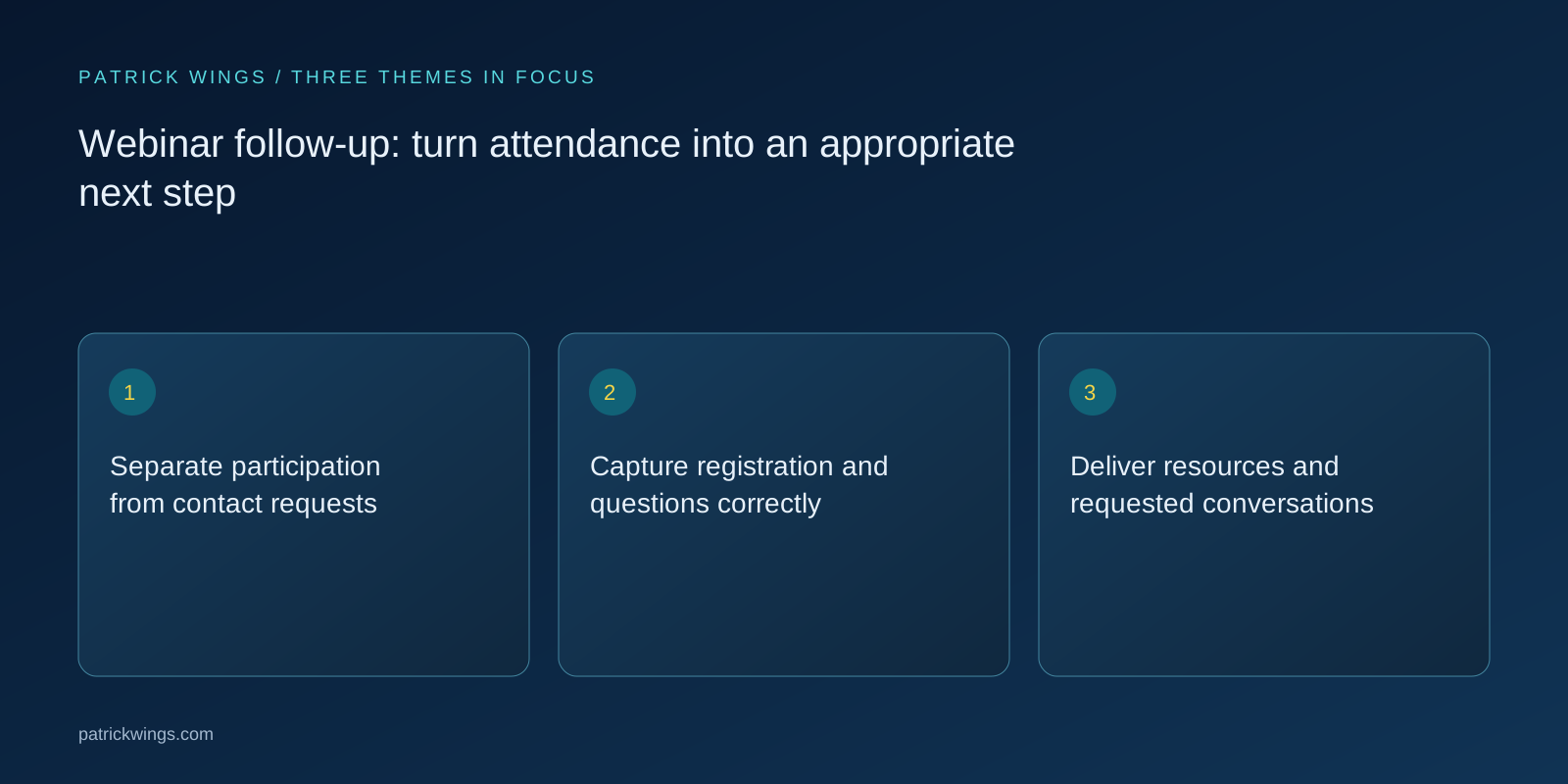
Deliver resources and requested conversations
Prepare the recording, materials, answers and optional contact route before the event. Route explicit advisory requests directly. Other attendees often need a useful recap and relevant resources. Offer an alternative to absent registrants rather than sending a message that incorrectly assumes they attended or heard a particular discussion.
Divide operational follow-up into resource delivery, specialist answers and advisory appointments. Give each an owner and appropriate recipients. A question about general requirements may support a reviewed summary for everyone. Individual project details belong only in the necessary specific exchange rather than being copied uncritically into a message distributed to the whole attendee list.
Route seven advisory requests in an example
A hypothetical webinar receives one hundred registrations, fifty-five attendees and seven explicit consultation requests. The team routes those seven relevant conversation opportunities and provides resources to the others. It does not count all attendees as opportunities. Later conversations remain traceable to the circumstances in which they actually arose.
For the invented seven advisory requests, sales needs the particular question, expected help and materials already promised. Exporting fifty-five attendees as a ready-made opportunity list would lose that context. People without advisory requests can first receive the recording and useful further detail. Later voluntary discussions are then recorded with the circumstances and time when they actually arose.

Avoid false personalisation and attendance claims
An attendance score can overstate commercial relevance. Buyers may watch the recording later or share materials internally, while others attend purely to learn. Avoid false personalisation such as your question when no question was recorded. Verify participation mapping before sending a large batch of supposedly individual follow-up messages.
Before batch delivery, check whether absence and attendance were matched correctly. Wording such as your contribution can be misleading when the person never spoke. Explain the actual connection instead. If only interest in a topic is known, state that interest accurately rather than inventing a personal challenge supposedly discussed together during the event.
Review learning and demand separately
Evaluate material delivery, answered questions, voluntary conversations and suitable projects after sufficient maturity. Compare topics and audiences separately. A topic can attract engaged participants without creating immediate buying intent; that distinction helps determine whether it belongs in education, account support or a direct acquisition programme.
Track delivery of promised resources and answers to outstanding specialist questions. Treat requested conversations and suitable projects as additional, separate outcomes. An educational format can fulfil its purpose without immediately creating many demos. Future topic planning should therefore consider repeated knowledge gaps rather than rewarding only directly scheduled sales meetings and ignoring whether the audience received the help it expected.
Hand over questions with specialist ownership
Assign responsibility for technical questions, resources and consultation requests. Give sales the specific question rather than an attendance flag alone. Use the review for editorial planning too: repeated unresolved points can identify where a focused technical article helps more than another general event invitation.
Assign technical questions to specialists before the event and agree which statements require approval. Marketing maintains resource links and the question register; sales coordinates requested advice. An unresolved question remains visible with a status until answered or explicitly transferred. This prevents promised information disappearing between event operations and individual follow-up ownership after the session ends.
INTERACTIVE / FROM READING TO ACTION
Three checkpoints for your implementation
Choose a checkpoint and track your reading progress. Checks are neither saved nor sent and do not score your business.
CHECKPOINT 01
Deliver resources and requested conversations
Prepare the recording, materials, answers and optional contact route before the event.
Explore in the article ↗CHECKPOINT 02
Route seven advisory requests in an example
A hypothetical webinar receives one hundred registrations, fifty-five attendees and seven explicit consultation requests.
Explore in the article ↗CHECKPOINT 03
Avoid false personalisation and attendance claims
An attendance score can overstate commercial relevance.
Explore in the article ↗Frequently asked questions
Should all attendees go to sales?
Only with a substantive reason and suitable next step.
Should absent registrants be ignored?
No. A recording or alternative resource may be useful.
What information does sales need?
The specific question, expressed request and materials already promised.
How can I put “Separate participation from contact requests” into practice?
Plan webinar follow-up around participation, questions and expressed intent. Registration is not a request for a sales conversation, and attendance does not automatically mean buying readiness. Fulfil the event promise first, then offer suitable depth rather than placing every participant into the same persistent sales sequence.
What matters when working on “Capture registration and questions correctly”?
Separate registration, attendance, specific questions and explicit requests for advice. Check which activity data is actually available and reliable. Attendance duration may include technical disruption.