

THE SHORT ANSWER
Pricing interviews help explain how buyers weigh value, budgets and procurement. They cannot produce a reliable price list from a few suggested amounts. Separate experienced decisions from hypothetical reactions and investigate the complete offer. The aim is a reasoned pricing hypothesis that can later be examined through appropriate commercial decisions, with its uncertainties still visible.
To connect this decision with positioning, market entry and growth, read the pillar guide Go-to-market for B2B SaaS: turn market insight into an executable growth strategy.
Bound the pricing decision
Clarify whether you are investigating a new offer, a package boundary or a potential charging unit. Each question needs a defined scope and an appropriate audience. An amount without contract duration, implementation conditions and usage limits is hard to interpret. Record the decision you need to make and the missing information. Discuss costs and delivery capacity internally as well. Customer interest does not make a model economically workable. Interviews can reveal inappropriate assumptions, but they replace neither your own cost analysis nor investigation of actual contracting decisions made when real expenditure is at stake.
Understand previous purchases first
Begin with a recent purchase of a comparable service. Who identified the need, who controlled the budget and which costs were considered internally? Ask about trade-offs, approval and alternatives without demanding confidential details. GOV.UK interview guidance favours concrete experiences over general speculation; this is useful for pricing research too. Investigate the context around the amount: implementation effort, additional services, commitment and available alternatives. This helps distinguish a limit caused by unclear value from one arising through a budget process or a fundamentally different understanding of what the supplier is offering the organisation. Explore this further in the guide Find a suitable SaaS value metric.
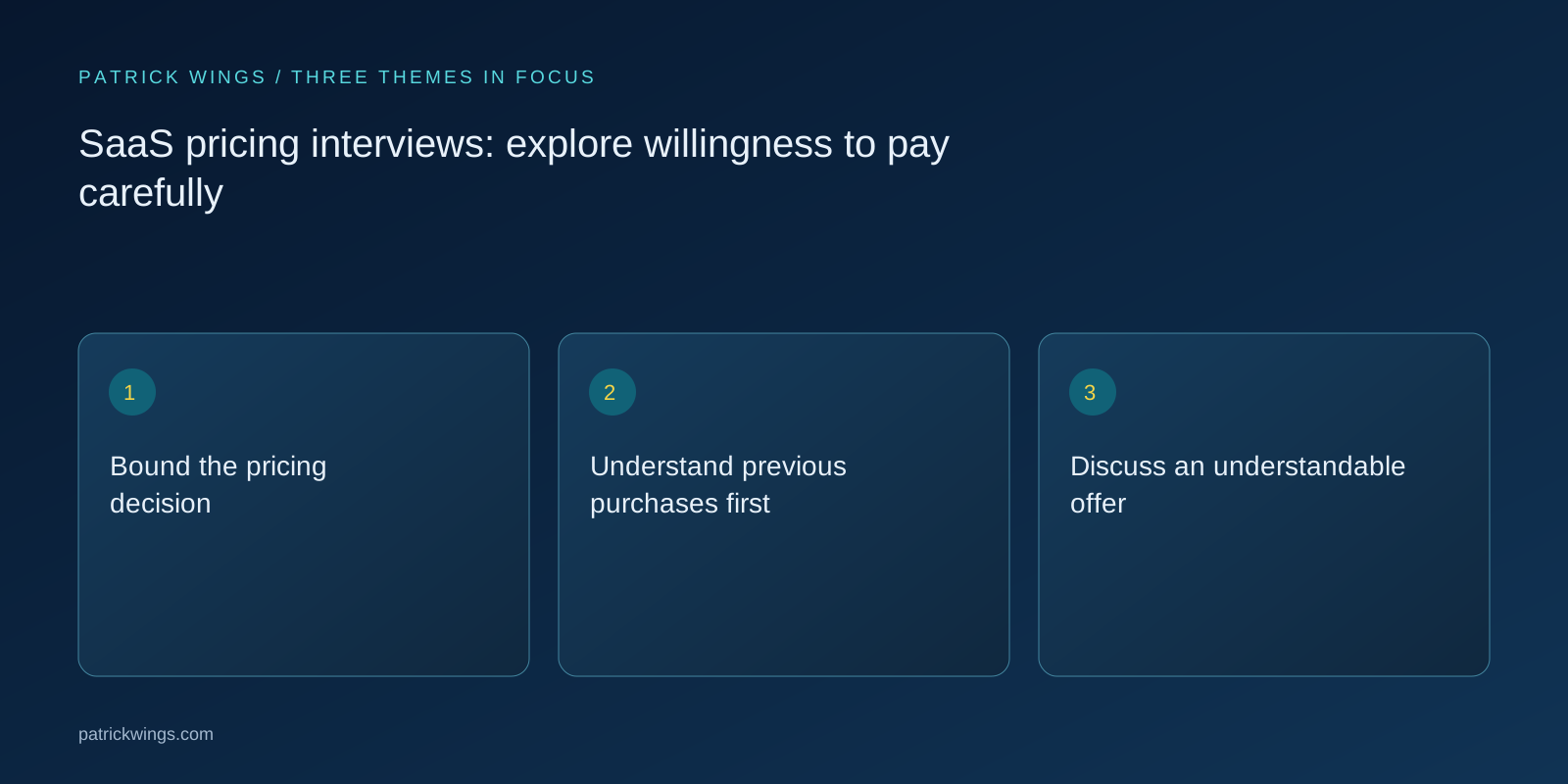
Discuss an understandable offer
Describe a bounded service and first check whether the participant interprets it correctly. Only then discuss possible pricing logic and purchasing feasibility. Ask how the organisation would evaluate the offer, which comparison it would use and what uncertainty would block a decision. Avoid questions that reward agreement or suggest a preferred amount. Record reactions as statements made under the conditions shown. People answering hypothetical questions do not have to commit real resources. Their responses should therefore not be represented as confirmed orders or binding willingness to pay, however enthusiastic or commercially experienced they appear.
Hypothetical example: people or locations
A fictional workforce-planning supplier examines two charging units: participating people and operating locations. Interviews indicate that occasional participation fluctuates while managers budget by location. This is a reason to investigate location-based pricing, not a final decision. A large location may need substantially more support than a small one. The team therefore examines usage boundaries, cost distribution and comprehension in concrete offer discussions. It does not copy a universal price recommendation from the interviews. The example illustrates why buyer preferences and economic delivery conditions must be considered together before a charging structure is selected.

Interpret statements in context
Compare similar customers and record differences in need, purchasing role and understanding of the offer. A high suggested amount from someone without budget authority differs from a detailed description of an actual approval process. Even the latter is not proof of purchase. Look for contradictory cases and investigate whether an apparent pricing problem is really uncertainty about scope. Avoid averaging heterogeneous, small interview groups into an apparently precise number. A traceable account of decision conditions and unresolved hypotheses is usually more useful than a single figure combining situations that should not have been treated as equivalent.
Plan the next commercial check
Turn interview findings into specific questions for proposals or bounded tests. You may need to explain a package boundary, investigate a cost assumption or include a different budget owner. Decide beforehand what you want to learn from actual decisions and which other influences need recording. Changes to existing contracts require a separate process with clear conditions. After each round, check that the model remains understandable, deliverable and commercially plausible. Sound pricing research reduces uncertainty progressively. It does not turn polite reactions into evidence of revenue, margins or general market acceptance simply because an interview produced a compelling quotation. Explore this further in the guide B2B buyer research: use customer interviews to make better market decisions.
INTERACTIVE / FROM READING TO ACTION
Three checkpoints for your implementation
Choose a checkpoint and track your reading progress. Checks are neither saved nor sent and do not score your business.
CHECKPOINT 01
Discuss an understandable offer
Describe a bounded service and first check whether the participant interprets it correctly.
Explore in the article ↗CHECKPOINT 02
Hypothetical example: people or locations
A fictional workforce-planning supplier examines two charging units: participating people and operating locations.
Explore in the article ↗CHECKPOINT 03
Interpret statements in context
Compare similar customers and record differences in need, purchasing role and understanding of the offer.
Explore in the article ↗Frequently asked questions
Should we ask for a preferred price?
You can explore reactions, but interpret them alongside offer comprehension, real comparable purchases and budget conditions.
Is the user perspective sufficient?
It explains value and workflow. Purchasing feasibility also requires the relevant budget and procurement perspective.
Does a stated budget establish intent?
No. Available budget proves neither priority nor agreement to the specific offer.
How can I put “Bound the pricing decision” into practice?
Clarify whether you are investigating a new offer, a package boundary or a potential charging unit. Each question needs a defined scope and an appropriate audience. An amount without contract duration, implementation conditions and usage limits is hard to interpret.
What matters when working on “Understand previous purchases first”?
Begin with a recent purchase of a comparable service. Who identified the need, who controlled the budget and which costs were considered internally? Ask about trade-offs, approval and alternatives without demanding confidential details.