
THE SHORT ANSWER
The status quo competes with your SaaS offer whenever an organisation can continue doing the job with its existing resources. A better feature may therefore be insufficient reason to buy. Investigate what the current approach provides, what switching would require and the circumstances under which a change would actually make sense for the people responsible.
To connect this decision with positioning, market entry and growth, read the pillar guide Go-to-market for B2B SaaS: turn market insight into an executable growth strategy.
Take the existing solution seriously
Ask about more than the software currently installed. An existing solution often combines spreadsheets, informal agreements, experience and separate tools. That arrangement may fit established responsibilities and contracts surprisingly well. Document which tasks work reliably and where difficulties arise. April Dunford’s positioning approach starts with alternatives customers actually consider, including continuing with their current method. Applied here, this means comparing your offer with more than rival vendors. Describe why a sensible team can manage without your product today. That explanation is a useful starting point rather than an objection the team should dismiss. Explore this further in the guide B2B SaaS positioning: a clear buying perspective beyond interchangeable claims.
Make the work of changing visible
List the work implementation would create for the customer: cleaning data, configuration, training, coordination and temporary parallel operation of old and new processes. Add individual exposure. Who must defend the decision internally, and who faces the consequences if it fails? These are not necessarily irrational objections; they can determine a decision on reasonable grounds. Distinguish solvable implementation issues from fundamental lack of fit. An instruction guide can address unfamiliar steps. It cannot remove a missing integration or settle unresolved responsibility within the customer’s organisation. Keep these distinctions visible during qualification and proposal preparation. Explore this further in the guide Recognise and interpret B2B buying triggers.
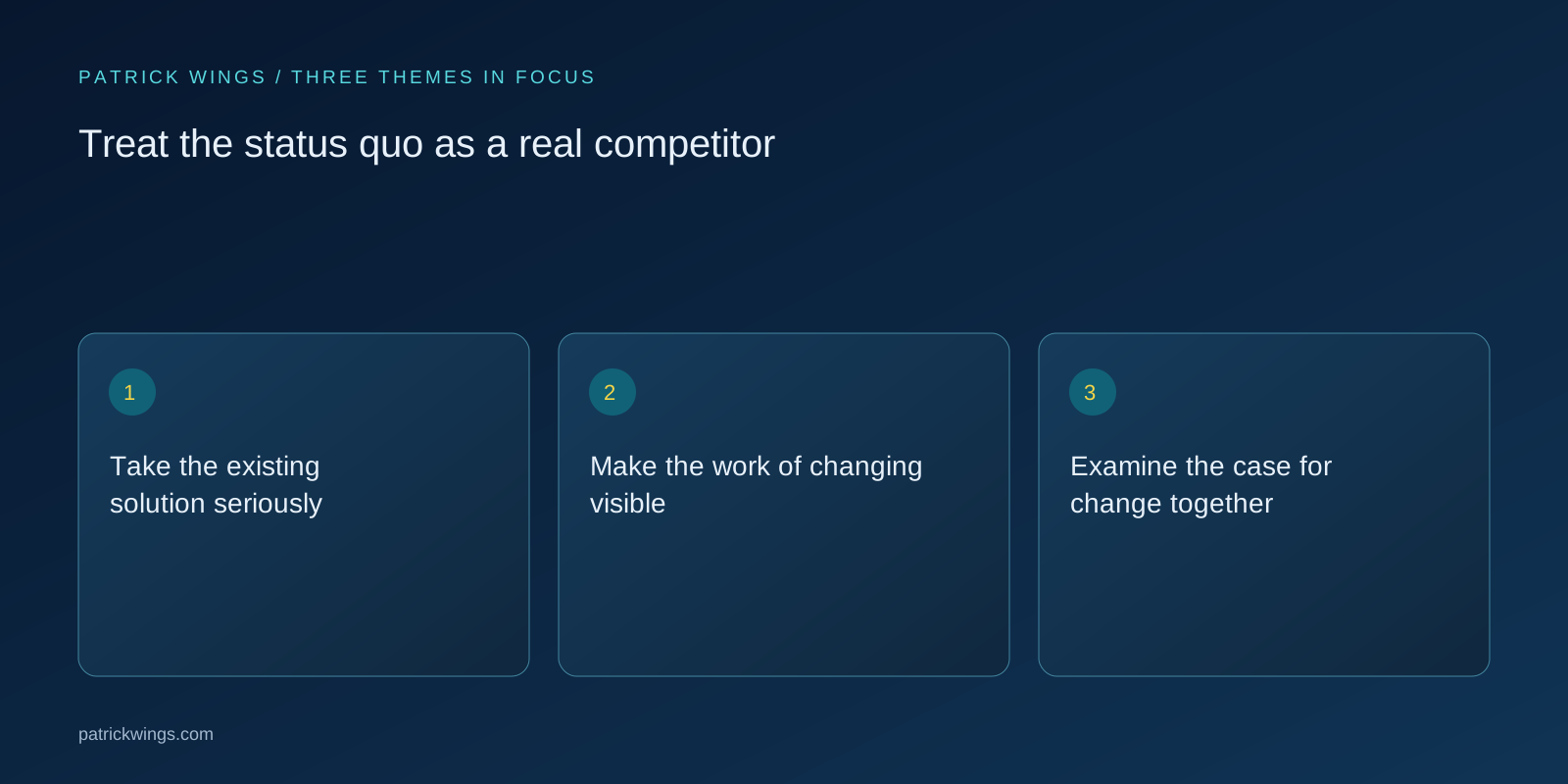
Examine the case for change together
Place desired progress alongside the burden of switching. Ask the customer to explain the consequences of the current approach through a specific incident. Avoid automatically treating every manual action as avoidable financial harm. Some activities are rare or provide necessary control. Then investigate what your solution could actually change and what would remain the same. A stronger case allows the customer to inspect and correct the underlying assumptions. It must also allow the conclusion that switching does not offer sufficient benefit yet. This makes the discussion more useful than a spreadsheet designed to justify a predetermined purchase.
Hypothetical example: familiar spreadsheets
A fictional consultancy plans projects in shared spreadsheets. A supplier demonstrates an automated capacity overview. The project lead finds it useful but does not want to introduce a new workflow immediately before a major customer project. Research reveals that the spreadsheets cause particular difficulty during staff cover. The supplier therefore proposes a bounded test of that handover situation after the project begins. It makes no blanket time-saving claim. The consultancy can assess whether the specific improvement justifies the work of adoption without immediately replacing its entire planning process. Commercial success remains an open question.

Provide evidence for a manageable transition
Prepare material explaining customer prerequisites, migration limitations, responsible people and a realistic route back where technically possible. Show the route from the present situation to the future workflow, rather than only the finished interface. A comparable customer example can help if its starting conditions and differences are clear. Avoid using a reference implementation that received substantially more support than the proposed package includes. Check the described steps with customer success. A credible transition is part of the value proposition and needs delivery ownership; it should not remain an improvised sales promise that someone else must fulfil.
Interpret deferral accurately
A deferred decision is not automatically a messaging failure. Budget, implementation capacity or a sufficiently important reason to change may be absent. Record which condition would need to change before another assessment becomes worthwhile. Agree a next step only when it serves a useful customer purpose. Later, compare cases where the existing approach remained in place. Was the task unimportant, the transition too demanding or the offer unsuitable? These distinctions improve positioning, qualification and product decisions more than a single “not interested” CRM category. They also help avoid repeatedly approaching accounts whose underlying circumstances have not changed.
INTERACTIVE / FROM READING TO ACTION
Three checkpoints for your implementation
Choose a checkpoint and track your reading progress. Checks are neither saved nor sent and do not score your business.
CHECKPOINT 01
Examine the case for change together
Place desired progress alongside the burden of switching.
Explore in the article ↗CHECKPOINT 02
Hypothetical example: familiar spreadsheets
A fictional consultancy plans projects in shared spreadsheets.
Explore in the article ↗CHECKPOINT 03
Provide evidence for a manageable transition
Prepare material explaining customer prerequisites, migration limitations, responsible people and a realistic route back where technically possible.
Explore in the article ↗Frequently asked questions
Should we criticise manual work?
No. Examine its actual consequences and possible benefits, including flexibility or control.
Is every non-purchase a lost opportunity?
Only if a suitable and realistic change was possible. Deferral can be reasonable.
Does migration support help?
When it addresses a demonstrated barrier and you can reliably deliver the proposed support.
How can I put “Take the existing solution seriously” into practice?
Ask about more than the software currently installed. An existing solution often combines spreadsheets, informal agreements, experience and separate tools. That arrangement may fit established responsibilities and contracts surprisingly well.
What matters when working on “Make the work of changing visible”?
List the work implementation would create for the customer: cleaning data, configuration, training, coordination and temporary parallel operation of old and new processes. Add individual exposure. Who must defend the decision internally, and who faces the consequences if it fails?